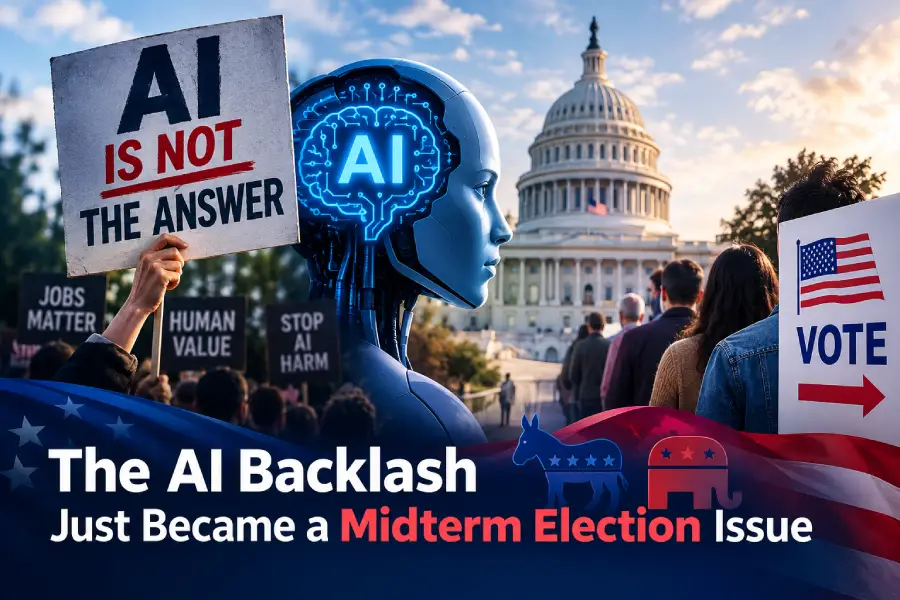
For a long time, public unease about AI lived mostly online: skeptical comments under tech news articles, the occasional viral post about a chatbot getting something embarrassingly wrong. That’s changed. As of late August 2026, souring public sentiment toward AI has moved from background noise into something showing up in polling, in local zoning fights, in courtrooms, and now, directly, in midterm election messaging.
Three separate threads converged this week to make that shift impossible to ignore: a new Pew Research survey on how Americans actually feel about AI, a wave of blocked and delayed data center projects tied to local opposition, and a landmark, multi-billion-dollar settlement between Meta and dozens of state attorneys general over social media’s effects on teenagers. None of these are new problems exactly, but seeing them land in the same news cycle is what’s turning this into a genuine political story rather than three separate tech headlines.
What the Polling Actually Shows
According to Pew Research Center’s most recent survey, conducted in late June 2026, 52% of American adults now say they’re more concerned than excited about the growing use of AI in daily life. That’s up from 37% who said the same thing back in 2021, when Pew first started asking the question. Only 9% of respondents currently describe themselves as more excited than concerned, down from 18% five years ago.
The shift is even sharper among young adults, the demographic often assumed to be AI’s most natural audience. Pew found that 55% of adults under 30 now say they’re more concerned than excited, up from 39% just two years earlier, and only 11% of that group describes itself as more excited than concerned, down from a quarter in 2021. Worry about job loss is climbing too: 71% of all Americans now believe AI will lead to fewer jobs for humans over the next 20 years, up from 64% in 2024, and that number jumps to 73% among adults under 30.
Distrust isn’t limited to the technology in the abstract. It’s personal, and it’s aimed at specific people. A CNBC Generation Lab survey of 18-to-34-year-olds found that more than 75% of respondents said they don’t trust Anthropic CEO Dario Amodei to act responsibly, with roughly 70% saying the same about OpenAI CEO Sam Altman and Meta CEO Mark Zuckerberg. That’s a genuinely striking number. It means a majority of young adults distrust the people leading the companies building the technology they’re also, per other surveys, increasingly likely to use.
Amodei himself has publicly acknowledged the problem. In a social media post earlier this month, he described the situation as fundamentally a crisis of trust, one where people don’t trust companies, governments, or the tech industry broadly, and suspect they’re being taken advantage of, adding that AI is really just the latest chapter in a much older pattern.
The Data Center Fight Is Where the Sentiment Becomes Physical
Polling numbers are one thing. Blocked construction projects are another, and they’re a much harder signal for politicians to ignore. According to a report from Data Center Watch, an organization that tracks local opposition to data center projects, opponents blocked or delayed at least 75 projects nationwide worth roughly $130 billion in just the first three months of 2026. That’s the most disruptive quarter on record since the organization began tracking in 2023, and it’s close to matching the total value of projects disrupted across all of 2025 combined.
The number of active opposition groups more than doubled over the same period, from roughly what it had been to 833 groups spread across 49 states. This isn’t concentrated in one or two politically predictable regions, either. Organizers report large turnouts specifically in Arizona, Michigan, and Pennsylvania, states where residents have shown up in real numbers to fight projects over concerns about water use, rising power costs, and noise.
What makes the data center fight different from typical NIMBY opposition is how bipartisan it’s turned out to be. Concerns about strained power grids and rising electricity bills cut across the usual political divide in a way that few issues do right now. The National Republican Senatorial Committee has reportedly described data centers as a “sleeper issue” for the entire 2026 midterm cycle, and candidates from both parties have started campaigning against specific projects in their districts, sometimes even when their own party’s leadership has been broadly supportive of AI infrastructure buildout.
That’s a genuinely awkward position for the AI industry to be in. Model capability races and benchmark scores get all the headlines, but local opposition to the physical infrastructure that actually runs these systems may be a bigger near-term constraint on scaling than any technical ceiling.
Meta’s Settlement Adds a Second Front
While the data center fight has been building for months, this week brought a separate, unrelated flashpoint that reinforced the same broader narrative: Meta agreed to a settlement of up to $18 billion (with roughly $17 billion of that tied specifically to a core lawsuit brought by a 29-state coalition) with state attorneys general over claims that the company designed Facebook and Instagram to be addictive and harmful to teenagers.
As part of the deal, Meta agreed to a default two-hour daily time limit across Facebook and Instagram combined for teen accounts, which can only be disabled with a parent’s permission. The company also agreed to mute most notifications during school hours and overnight, add stronger age-verification measures, and roll out a set of other default protections aimed at reducing compulsive use. The settlement covers 48 states plus Washington, D.C. New Mexico and Florida opted out, with New Mexico separately winning nearly $1 billion in damages at trial earlier this year, and Florida’s attorney general arguing publicly that the settlement doesn’t go far enough.
California Attorney General Rob Bonta, who helped lead the case, described the settlement as a floor rather than a ceiling, suggesting more changes could still follow. Common Sense Media CEO Jim Steyer, who has been tracking tech backlash for more than two decades, described the current moment as genuinely different from anything he’d seen before, noting that opposition to big tech now cuts across party lines in a way that simply wasn’t true a decade ago.
Why the Timing Matters
None of these three stories, the AI sentiment polling, the data center backlash, and the Meta settlement, are really about the same specific issue. But they’re landing in the same news cycle, and that’s making it much easier for the public to connect them into a single narrative: that the tech industry’s biggest players built enormously powerful, enormously profitable systems without fully reckoning with the social costs, and that the bill is now coming due, one lawsuit and one blocked construction permit at a time.
That framing matters especially for Anthropic and OpenAI right now, given that both companies are reportedly gearing up for potentially historic IPOs at valuations approaching $1 trillion. Public sentiment isn’t just a reputational concern for companies in that position. It’s a disclosed business risk. Reporting has indicated that AI backlash is expected to appear directly in Anthropic’s IPO prospectus as a named risk factor, which tells you how seriously public companies’ lawyers are taking the trend, independent of whatever the AI labs themselves say publicly about it.
The Legislative Response Is Already Underway
The data center fight isn’t just playing out at protests and city council meetings anymore. It’s moved into statehouses in a real, measurable way. Over 375 bills have reportedly been introduced across state legislatures this year specifically aimed at restricting data center development, and moratoriums or outright bans are under active consideration in at least 15 states. New York has already gone further than most, passing a one-year statewide moratorium on new large-scale data center permits, giving state regulators time to study the environmental, economic, and grid-reliability questions that local opposition groups have been raising for months.
Individual governors have started responding in strikingly different ways depending on the political pressure in their own states. Texas Governor Greg Abbott paused new data center approvals while the state audits tax breaks, ownership structures, and water usage tied to existing projects. Pennsylvania Governor Josh Shapiro, whose state has actively courted data center investment in the past, imposed new community-approval requirements and energy-cost standards on developers, a notable reversal in posture for a state that had been positioning itself as AI-infrastructure friendly. In Virginia, a state court invalidated local zoning approvals for the proposed Prince William Digital Gateway, a 2,100-acre, $24.7 billion project near Manassas National Battlefield Park, after finding that county officials failed to meet basic public notice requirements. Both developers involved subsequently withdrew from the project entirely.
That range of responses, from red-state Texas to blue-state New York to purple-leaning Pennsylvania, is itself part of the story. This isn’t shaping up as a fight where one party owns the “pro-AI-infrastructure” position and the other owns opposition to it. It’s shaping up as a fight where the relevant divide runs between incumbents facing organized local pressure and everyone else, regardless of party affiliation.
The Industry’s Own Response Has Been Mixed
It would be inaccurate to describe the reaction from the tech and AI sector as unified opposition to any of this. Some of the pushback on data centers has actually come from inside the industry’s own workforce. Amazon engineers testified at a Seattle City Council meeting earlier this year calling for stronger government regulation of AI data centers, criticizing the company’s use of carbon-intensive energy sources at some of its own facilities, which is a genuinely unusual dynamic: employees of a hyperscaler publicly pushing for more regulation of their own employer’s infrastructure buildout.
At the same time, groups representing organized labor have generally taken a more favorable view of data center construction than environmental and community organizations have, pointing to the significant number of construction jobs, and the ongoing electrician and HVAC work, that these projects generate locally once they’re built. That split, between the immediate economic benefit to construction trades and the longer-term concerns of nearby residents over water and power costs, is one of the more interesting fault lines running underneath what often gets described in the media as a simple binary fight between “AI industry” and “concerned communities.”
What to Watch Through the Midterms
A few threads are worth tracking as this plays out over the next two months:
- Whether data center opposition stays genuinely bipartisan. So far, it has, which is unusual for an infrastructure fight and gives it more staying power as a campaign issue than a partisan one would have.
- Whether other states follow New York’s lead. New York passed a moratorium pausing new large-scale data center permits, and it’s a template other state legislatures could copy if local pressure keeps building.
- Whether the Meta settlement becomes a template. The settlement explicitly frames itself as a floor, and other social platforms may face pressure to adopt similar defaults voluntarily rather than wait for their own lawsuits.
- How AI companies respond to the trust gap specifically. Amodei’s public acknowledgment that this is a trust crisis, not a PR problem, suggests at least some industry leaders understand that a marketing response alone won’t be enough. Whether that translates into real changes in how these companies operate, versus just better messaging, is the actual question worth watching.
The honeymoon period for AI, in terms of public sentiment at least, looks like it’s over. What happens next, whether the industry treats this as a genuine signal to change course or just a communications problem to manage through, is likely to shape both the midterms and the terms on which AI companies eventually go public.
Frequently Asked Questions
What percentage of Americans are concerned about AI in 2026? According to Pew Research Center, 52% of U.S. adults say they’re more concerned than excited about AI’s growing role in daily life, up from 37% in 2021. Among adults under 30, that figure rises to 55%.
Do Americans trust AI company CEOs? No, not according to recent polling. A CNBC Generation Lab survey found more than 75% of 18-to-34-year-olds don’t trust Anthropic CEO Dario Amodei to act responsibly, and around 70% said the same about OpenAI’s Sam Altman and Meta’s Mark Zuckerberg.
Why are data centers becoming a political issue? Local opposition to data centers, driven by concerns over water use, electricity costs, and noise, blocked or delayed roughly $130 billion worth of projects in the first quarter of 2026 alone. The issue has become genuinely bipartisan, with both Republican and Democratic midterm candidates campaigning against specific projects.
What did Meta agree to in its settlement with states? Meta agreed to pay up to $18 billion and implement a default two-hour daily time limit across Facebook and Instagram for teen accounts, mute notifications during school hours and overnight, and add stronger age-verification measures, as part of a settlement with attorneys general from 48 states.
How does this affect OpenAI and Anthropic’s planned IPOs? Both companies are reportedly targeting IPOs at valuations near or above $1 trillion. Public trust concerns aren’t just a reputational issue in that context, they’re expected to appear as a disclosed risk factor in at least one company’s IPO prospectus.