Introduction about AI Search
For more than two decades, traditional search engines shaped how people found information online. Type a few keywords, scan a page of blue links, click through, refine, repeat. Businesses optimized for rankings, publishers competed for visibility, and users gradually learned the craft of phrasing a good search.
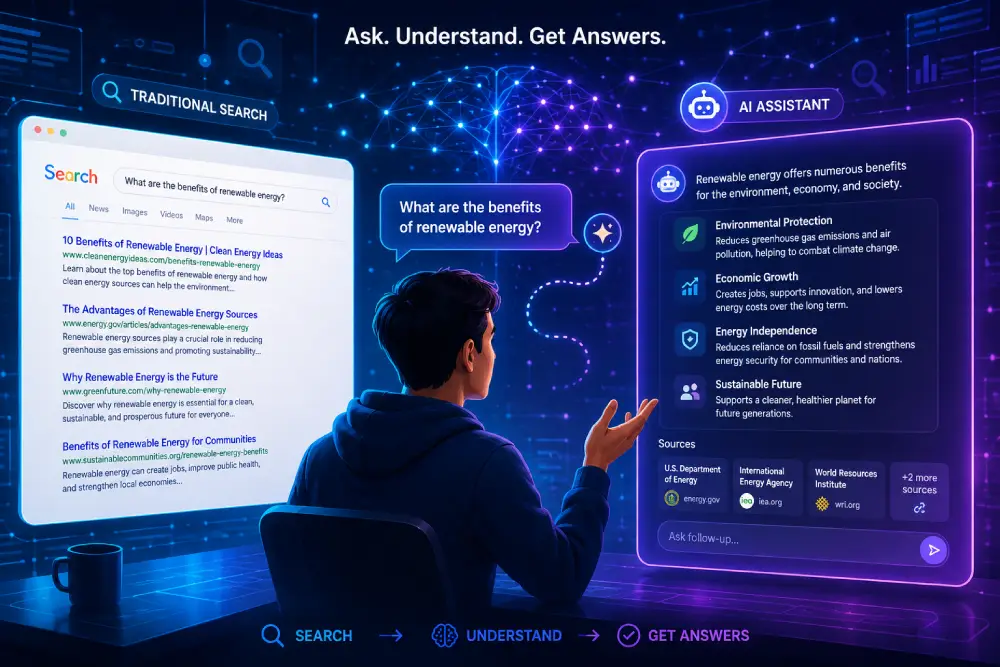
That long-standing model is evolving. AI has introduced a genuinely different approach instead of matching keywords and handing back a ranked list, AI-powered search can understand natural language, interpret intent, pull together information from multiple sources, and answer directly, conversationally. Searching is becoming less about finding the right webpage and more about getting the right answer.
This shift is also changing how people search in the first place covered in more depth in PostDune’s How AI Is Changing User Search Behavior in 2026.
The effects show up everywhere: students use AI to work through difficult concepts, professionals use it to summarize reports and compare options, and shoppers increasingly ask AI platforms for recommendations before buying anything. Businesses, publishers, and marketers are all adjusting strategy as behavior moves past traditional search.
The impact reaches well beyond convenience website traffic, digital marketing, SEO, content strategy, advertising, and the design of search itself are all shifting. New disciplines like Generative Engine Optimization (GEO) and Answer Engine Optimization (AEO) have emerged specifically to help publishers stay visible in an AI-first search environment.
This guide covers every major piece of AI search in 2026 how it works, why it’s growing so fast, how it differs from traditional search, the leading platforms available today, and what website owners should actually do to prepare. Whether you’re a casual user, a marketer, a business owner, or a content creator, understanding AI search is quickly becoming a genuinely useful skill.
What Is AI Search?
AI search is a new generation of search technology that uses artificial intelligence to understand a question, interpret context, and generate a meaningful answer instead of just displaying a list of relevant pages. Where traditional search mainly matches keywords against an index, AI search uses language models, machine learning, semantic understanding, and reasoning to process a complex question much the way a human assistant would. For the full beginner-friendly breakdown, see PostDune’s What Is AI Search?.
Take someone shopping for a laptop for video editing. A traditional search engine returns millions of results buying guides, reviews, retailer pages and the person has to open several, compare specs, weigh prices, and decide. An AI assistant approaches it differently: it understands the actual use case, compares suitable options, summarizes the key differences, weighs pros and cons, and recommends models that fit the stated budget and needs directly.
That conversational approach meaningfully cuts the time it takes to reach a useful answer, which is exactly why more people are choosing conversational assistants over traditional search a trend explored in Why Users Are Switching from Google Search to AI Chatbots.
AI search runs on several technologies working together:
Natural Language Processing (NLP): understanding everyday language rather than relying on exact keywords.
Large Language Models (LLMs): generating coherent, context-aware responses from patterns learned across vast amounts of text.
Machine Learning: continuously improving response quality and relevance through ongoing refinement.
Semantic Search: focusing on the meaning and intent behind a query, not just the isolated words in it.
Retrieval-Augmented Generation (RAG): combining the language model with current information from external sources for more accurate, current answers. For a deeper technical breakdown of all of this, see How AI Search Works.
Together, these make AI search feel a lot more like a conversation with a knowledgeable assistant than a traditional web search.
How Search Has Evolved: From Keywords to Conversations
The history of online search breaks down into a few major phases, each a real leap forward in how people find information.
Phase 1: Directory-Based Search
In the early internet, websites were manually organized into directories. People navigated through categories to find what they needed slow, and genuinely limited.
Phase 2: Keyword-Based Search
Modern search engines transformed retrieval by automatically crawling and indexing billions of pages, with ranking algorithms surfacing relevant results based on keywords, backlinks, freshness, and authority. This was the dominant model for over twenty years.
Phase 3: Semantic Search
As the technology matured, search engines started interpreting meaning rather than relying purely on exact keyword matches getting better at recognizing synonyms, context, location, and intent, which produced noticeably more relevant results.
Phase 4: AI-Powered Conversational Search
Today’s AI search is the next step in that same evolution and it’s already reshaping how people research products, compare services, and decide what to buy (more in How ChatGPT Is Influencing Consumer Search Decisions). People no longer need to think in keywords. They can ask detailed questions in natural language, request comparisons, seek explanations, or keep a conversation going with follow-ups while the AI holds context.
Instead of searching “best budget smartphones 2026,” someone can just ask “I’m a college student with a budget of $400 which smartphone has the best battery life and camera for everyday use?” The AI reads the intent, budget, and priorities together, then responds with something tailored explanation, comparison, and follow-up suggestions included.
That shift from keywords to conversation is redefining what people expect from search, across every industry.
How AI Search Works
AI search looks simple from the outside ask a question, get a detailed answer back in seconds. Underneath that simplicity is a real combination of AI technologies working together to understand, retrieve, evaluate, and generate. The process generally runs through five stages.
1. Understanding the User’s Intent
Traditional search mainly focuses on keywords. AI search goes further, analyzing the meaning, context, and actual purpose behind a question. Asked “I’m planning a trip to Japan in October which cities should I visit if I enjoy food and nature?”, an AI system reads several layers at once: travel is happening, the timing is October, food and nature both matter, and the user wants recommendations, not a factual definition. Understanding intent this precisely is a big part of why the response ends up more useful than a page of links. This is one of the biggest drivers behind changing search behavior more in How AI Is Changing User Search Behavior in 2026.
2. Understanding Context
One of the sharpest differences from traditional search is contextual memory. Ask “what’s the best laptop for programming?”, get some recommendations, then ask “which one has the best battery life?” the AI understands “which one” refers to what was just discussed. A traditional search engine treats each query as brand new; AI search creates an ongoing conversation, cutting repetition and making the whole interaction feel more natural.
3. Finding Reliable Information
Modern AI search doesn’t just rely on what a model learned during training. Many platforms use Retrieval-Augmented Generation searching trusted sources, retrieving relevant material, comparing across it, and using that to generate an updated response. That approach genuinely helps accuracy, especially for current events, product launches, research, or shifting regulations.
4. Generating a Human-Like Response
Once enough information is gathered, a large language model puts together the actual response organizing it into a logical explanation rather than just a list of links. Depending on the question, it might summarize findings, compare products, explain a concept, weigh pros and cons, recommend an option, or suggest a next step all built to save time and reduce how many separate sites someone has to visit.
5. Continuing the Conversation
Maybe the most useful innovation is being able to keep asking naturally. “Which electric car is best for families?” → answer → “what if my budget is under $40,000?” → “which one has the lowest maintenance costs?” each answer builds on the last, which makes the whole thing feel more like consulting an expert than running a search.
AI Search vs. Traditional Search
Both systems help people find information, but they’re built on genuinely different principles. Traditional search helps people discover relevant webpages. AI search helps people discover answers directly a distinction that changes the whole experience.
How Traditional Search Works
Crawl billions of pages, index the content, weigh ranking signals, display the most relevant links then the user opens several pages, compares, and decides. This model has worked well for decades and stays genuinely valuable for research, shopping, local business search, and navigating to specific sites. It does, though, put a fair amount of effort on the user.
How AI Search Shifts That Effort
AI search moves a lot of that effort from the user to the system itself understanding the question, gathering relevant information, comparing sources, generating a concise answer, and adding follow-up explanation as needed. For a lot of informational queries, that meaningfully cuts the time to a useful answer.
| Feature | Traditional Search | AI Search |
| Primary goal | Find relevant webpages | Provide direct answers |
| User input | Keywords or short phrases | Natural language questions |
| Results | Ranked list of links | Conversational, summarized response |
| Context awareness | Limited | High |
| Follow-up questions | No shared context | Continuous conversation |
| Information gathering | User compares multiple pages | AI synthesizes into one response |
| Time to answer | Often longer | Usually faster for informational queries |
| Best for | Research, navigation, shopping, local results | Learning, explanations, comparisons, brainstorming |
For a deeper comparison ranking systems, user experience, and where each approach genuinely wins see PostDune’s AI Search vs Traditional Search.
Why More Users Are Choosing AI Search
Faster answers: People increasingly prefer one complete answer over reviewing several separate webpages themselves.
Easier research: Instead of ten open tabs, AI can summarize multiple perspectives into a single response.
Better explanations: Complex or technical topics often get simplified into language that’s genuinely easier to follow.
A real conversational experience: People naturally ask follow-ups, and AI search is built to support exactly that.
Real productivity gains: Summarizing documents, comparing options, brainstorming, and answering questions all inside one conversation adds up to meaningful time saved.
Leading AI Search Platforms in 2026
AI-powered search has moved from experimental technology to a genuinely mainstream way of finding information. Several companies now offer conversational search, each with its own strengths and target audience.
ChatGPT Search
Popular for conversational answers, research help, writing support, coding assistance, and everyday productivity designed to answer directly, explain complex topics, summarize information, compare products, and continue naturally through follow-ups. Full breakdown: ChatGPT Search Explained.
Google AI Mode
Integrates AI-generated responses with Google’s existing search index, combining conversational answers with traditional web results rather than replacing them outright. Full breakdown: Google AI Mode Explained.
Perplexity AI
Focused on research-oriented search concise answers paired with cited sources, which is exactly why it’s popular with students, professionals, and researchers. Full breakdown: Perplexity AI Explained.
Microsoft Copilot
Combines web search with AI assistance inside Microsoft’s own ecosystem helping with research, productivity, and everyday workplace tasks. Full breakdown: Microsoft Copilot Explained.
Gemini
Google’s standalone AI assistant, supporting conversational search, genuine multimodal interaction, and integration across Google’s services. Full breakdown: Google Gemini Explained.
Claude
Anthropic’s assistant, known for thoughtful, well-structured responses and strong long-document handling a solid fit for writing, research, and detailed analysis. Full breakdown: Claude AI Explained.
Each platform approaches AI search a little differently some prioritize speed, others emphasize citations or ecosystem integration. For a full side-by-side comparison, see PostDune’s Best AI Search Engines in 2026.
Why No Single AI Search Engine Replaces the Open Web
AI search has genuinely transformed how people access information, but it hasn’t eliminated the need for websites or traditional search. AI systems still depend heavily on high-quality content created by publishers, researchers, businesses, and subject matter experts original reporting, first-hand experience, and authoritative resources remain the actual foundation of the information ecosystem.
For most people, AI search is the fastest way to understand a topic, while the open web remains the best place to explore original research, detailed documentation, official announcements, and a real range of viewpoints. AI search and traditional search aren’t really competitors they’re complementary tools serving different needs.
How AI Search Is Changing User Behavior
Search behavior has shifted dramatically over the past two decades. People used to rely on short keyword queries, open multiple sites, compare manually, and piece together an answer themselves. AI-powered search is changing that pattern directly instead of thinking about which keywords to type, people increasingly ask complete questions in everyday language and expect personalized, contextual, direct answers. This isn’t just a technical improvement; it’s a real shift in expectation. People don’t want to search for information anymore they want to understand it, as fast as possible.
From Keywords to Conversations
Traditional search trained people to simplify: “best budget smartphone 2026,” “SEO checklist,” “how to lose weight.” AI search lets people ask what they actually mean: “I’m a college student with a $400 budget which smartphone offers the best camera and battery life?” or “can you create a beginner-friendly SEO checklist for a small business website?” These conversational queries let AI understand intent far more precisely and respond accordingly.
Faster Decision-Making
AI search cuts the time it takes to gather information instead of opening several sites, people get a concise overview, compare options, and ask follow-ups in the same conversation. Especially valuable for comparing products, learning new skills, understanding technical concepts, planning trips, researching software, and summarizing reports.
More Confidence Through Guided Conversation
AI search also makes complex topics feel less intimidating anyone who doesn’t follow an answer can just ask “can you explain that more simply?” or “can you give me an example?” That interactive, low-friction way of learning is a big part of why AI search keeps gaining ground as a preferred way to explore information.
AI Search Statistics and Market Trends in 2026
Traditional search engines still process billions of queries daily, but AI-powered search has grown quickly as people adopt conversational interfaces for research, learning, and decisions.
- AI assistants are increasingly the starting point for informational queries
- Longer, natural-language searches are becoming the norm
- People expect a summarized answer before deciding whether to visit a website at all
- Businesses are investing more in AI-powered customer support and search experiences
- Publishers are adapting content specifically to improve visibility in AI-generated answers
These trends point toward AI search becoming an important complement to traditional search, not a full replacement. For the detailed figures behind these trends, see PostDune’s AI Search Statistics 2026.
Benefits of AI Search
Faster Access to Information
Instead of reviewing multiple pages, people often get a summarized answer within seconds real time saved, real effort saved.
Better Understanding of Complex Topics
AI can simplify technical language, explain unfamiliar concepts, and adapt explanations to different levels of expertise whether the topic is cloud computing, investing, or medical terminology.
Personalized Conversations
Unlike traditional search, AI remembers earlier questions within a conversation, letting people refine requests naturally instead of repeating full context every time.
Increased Productivity
Professionals use AI search to summarize long documents, brainstorm, draft emails, compare software, research competitors, and analyze information more efficiently.
Improved Accessibility
Conversational interfaces make information more accessible to people who aren’t deeply familiar with search operators, technical terms, or formal research methods.
Challenges and Limitations of AI Search
Accuracy Varies
AI systems generate responses based on language patterns and, often, retrieved web information genuinely useful, but capable of occasionally misreading a question, missing nuance, or presenting something incomplete or outdated. For anything medical, legal, financial, or safety-related, always check authoritative sources or qualified professionals.
Source Transparency Varies
Not every platform handles sources the same way some provide detailed citations, others summarize without clearly identifying where information came from. When accuracy really matters, check the original sources whenever they’re available.
Bias and Perspective
AI models learn from huge amounts of human-created content, which means responses can sometimes reflect existing biases or lean toward certain viewpoints. Checking multiple trusted sources remains a genuinely important part of critical thinking.
Reduced Website Traffic
One of the bigger concerns for publishers is that an AI-generated summary can satisfy someone’s question without a click to the original site closely tied to the rise of zero-click search, where people get enough directly inside the search experience. For content creators, that means success increasingly depends on producing genuinely original, in-depth resources that offer more than a quick summary. See PostDune’s The Rise of Zero-Click Searches: What It Means for Websites for the full picture.
Privacy Considerations
It’s worth being mindful of what gets shared with AI tools avoid confidential business information, sensitive personal data, passwords, or private documents unless the platform’s privacy practices and your permissions are clear.
How AI Search Is Changing SEO
SEO has long focused on helping pages rank higher in traditional results. That foundation still matters, but AI-powered search adds new considerations on top of it. If this is new territory, start with PostDune’s AI Search vs Traditional Search for the core differences.
Rather than just matching keywords, AI systems try to identify content that’s accurate, well-structured, easy to understand, comprehensive, trustworthy, and genuinely helpful which is why publishers are increasingly prioritizing clear writing, real topical depth, logical organization, and demonstrated expertise.
From Keywords to Topics
Instead of publishing many isolated articles chasing similar keywords, successful sites are organizing content into real topic clusters a pillar guide (like this one) supported by dedicated pieces on platform comparisons, statistics, optimization frameworks, and related trends, all reinforcing each other and demonstrating real authority on the subject.
Helpful Content Matters More Than Ever
AI systems are more likely to surface content that genuinely helps someone answer their question. That means clear explanations, original insight, practical examples, current information, logical structure, and reliable sourcing which benefits traditional SEO and AI-driven visibility at the same time.
What Businesses Should Do
AI search is worth treating as an opportunity, not a threat.
- Publish comprehensive guides that answer real customer questions
- Keep content accurate and genuinely current
- Add FAQs to important pages
- Demonstrate expertise through real examples and case studies
- Build strong topic clusters around core areas of knowledge
- Keep the site fast, mobile-friendly, and easy to navigate
Companies that invest in genuinely high-quality educational content are more likely to stay visible as AI search keeps evolving.
What Publishers and Bloggers Should Do
For publishers, the rise of AI search changes how success gets measured. Rather than chasing every trending keyword, the better long-term move is becoming a genuinely trusted resource on specific topics.
- Publish real, in-depth pillar pages
- Build supporting articles around each core topic
- Update evergreen content on a real schedule
- Strengthen internal linking throughout
- Include original graphics, comparison tables, and concrete examples
- Build author credibility and cite trustworthy sources where it matters
Sites that consistently provide unique, genuinely valuable information are better positioned to benefit from both traditional search and AI-powered discovery.
Generative Engine Optimization (GEO): The Next Evolution of SEO
As AI-powered search keeps growing, marketers and publishers are adapting their optimization strategy. One emerging discipline: Generative Engine Optimization, or GEO the practice of creating and organizing content so AI-powered search engines and conversational assistants can better understand, reference, and surface it in generated answers. Where traditional SEO focuses on ranking in results pages, GEO aims to increase the odds that content gets recognized as a trustworthy source for an AI-generated response. Full guide: Generative Engine Optimization (GEO).
AI search systems often weigh multiple sources before generating an answer. Well-structured, accurate, comprehensive content is more likely to end up part of that answer which means the goal isn’t just earning a click anymore, it’s becoming a source AI systems actually trust.
GEO Best Practices
- Answer the main question early in the article
- Cover the topic comprehensively, not just one keyword
- Use descriptive headings and subheadings
- Write in clear, natural language
- Include original examples, charts, and comparison tables
- Update evergreen content on a real schedule
- Build topic clusters with strong internal linking
- Demonstrate expertise through practical insight and accurate information
- Cite reliable sources for statistics or factual claims
GEO isn’t a replacement for SEO it builds on strong SEO fundamentals while preparing content for AI-driven discovery specifically.
Answer Engine Optimization (AEO)
A related discipline: Answer Engine Optimization, focused on creating content that directly answers a question in a format search engines and AI assistants can easily understand and present. Full guide: Answer Engine Optimization (AEO).
If someone asks “what is AI search?”, a well-optimized article gives a concise, accurate definition near the top before going deeper.
AEO Best Practices
- Use question-based headings
- Give a direct answer in the first paragraph under each heading
- Add real FAQ sections
- Use bullet points and numbered lists where they genuinely help
- Organize information logically
- Include comparison tables
- Write short, clear paragraphs
- Use structured data (schema markup) where relevant
Content that’s easy for a human to scan is usually easier for an AI system to interpret too. Once your content is genuinely optimized for both, PostDune’s How to Measure AI Search Traffic and AI Mentions and How to Optimize Your Website for AI Search cover the next steps.
The Future of AI Search
AI search is still evolving quickly, and the next few years are likely to bring real change to how people discover information online. More context in PostDune’s How AI Is Changing User Search Behavior in 2026.
More Personalized Search
AI systems will keep getting better at understanding individual preferences while respecting privacy controls future search may adapt based on prior conversations, learning style, or specific stated goals.
Multimodal Search
Search is expanding well past text people increasingly search with images, voice, video, documents, and screenshots, and AI assistants are getting better at understanding and combining these input types together.
Better Real-Time Information
As retrieval systems improve, AI-generated answers should keep getting more current, drawing on reliable, up-to-date sources when it actually matters.
Smarter Shopping and Product Research
AI assistants will keep improving at product comparisons, buying recommendations, and personalized shopping guidance helping people make more informed decisions with less legwork.
A Greater Focus on Trust
As AI-generated content becomes more common, trust becomes an even bigger differentiator. Publishers who demonstrate real expertise, stay accurate, update regularly, and offer genuinely unique value are the ones positioned to build lasting authority.
Frequently Asked Questions
What is AI search?
AI search is a modern approach to finding information that uses artificial intelligence to understand intent, interpret context, and generate a conversational answer rather than just displaying a list of webpages.
Is AI search replacing traditional search engines?
Not entirely. Traditional search remains valuable for navigation, local businesses, shopping, and finding specific sites. AI search complements it by making information easier to understand and explore conversationally.
What are the best AI search engines right now?
Leading platforms include ChatGPT Search, Google AI Mode, Perplexity AI, Microsoft Copilot, Gemini, and Claude each with different strengths depending on what you’re trying to do.
How is AI search different from Google Search specifically?
Traditional Google Search mainly presents ranked webpages; AI search emphasizes direct answers, summaries, and conversation. Google itself now blends both approaches through its AI-enhanced search experiences.
What is Generative Engine Optimization (GEO)?
GEO is the practice of creating content that’s genuinely easier for AI-powered search systems to understand, evaluate, and reference when generating an answer.
What is Answer Engine Optimization (AEO)?
AEO focuses on structuring content so it clearly answers a real question, increasing the odds that a search engine or AI assistant surfaces it directly.
Can AI search actually make mistakes?
Yes. Even as these systems keep improving, they can misread a question or produce something incomplete or inaccurate. Always verify anything important medical, legal, financial, or safety-related especially against authoritative sources.
How should businesses prepare for AI search?
Create comprehensive, trustworthy content, answer the questions customers actually ask, improve overall usability, and build real topical authority through well-organized content clusters.
Does AI search reduce website traffic?
For some informational queries, AI-generated summaries can reduce clicks. That said, high-quality original content stays essential AI systems still depend on authoritative sources, and people still visit sites for depth, evidence, tools, products, and genuinely unique insight.
Is SEO still worth investing in, given all this?
Absolutely. Technical SEO, quality content, strong internal linking, real user experience, and site authority all remain essential. GEO and AEO are best understood as complementary strategies layered on top of SEO, not replacements for it.
Final Thoughts
AI is reshaping search in something like the way smartphones reshaped mobile computing. Instead of treating search as a process of finding webpages, people increasingly expect search systems to understand a question, interpret intent, and provide a genuinely meaningful answer through natural conversation.
That evolution brings real opportunity alongside real challenge. For users, AI search means faster access to information, easier learning, and a more personalized experience. For businesses, it opens new ways to actually connect with customers and deliver value. For publishers and content creators, it reinforces something that was always true trustworthy, well-structured, genuinely helpful content wins.
The sites that do well in the coming years won’t be the ones publishing the most articles. They’ll be the ones that build real expertise, organize information thoughtfully, keep content current, and consistently solve real problems for the people reading it. AI search is changing how people discover information but the need for genuinely good human knowledge behind it has never been greater.