
AI has changed how people search for information. Instead of typing short keyword phrases and manually comparing a dozen webpages, people now ask complete questions and get a conversational answer back in seconds.
Perplexity AI has become one of the more popular choices among research-focused users specifically. Where a traditional search engine mostly returns a list of links, Perplexity combines conversational AI with real-time web search and source citations giving people a concise summary while still showing exactly where the information came from, which makes it easier to verify facts and dig into the original sources.
Instead of running four separate searches “what is quantum computing,” “quantum computing applications,” “quantum computing advantages,” “quantum computing companies” someone could just ask Perplexity to explain quantum computing in simple terms, cover real-world applications, and name the companies leading the technology, and get a structured answer with references attached.
That research-first approach has made it especially popular with students, researchers, journalists, business professionals, and content creators.
If conversational search is new to you, start with PostDune’s What Is AI Search? and Complete Guide to AI Search in 2026.
This guide covers what Perplexity AI actually is, how it works, its key features, real limitations, practical use cases, and how it compares to ChatGPT Search, Google AI Mode, and traditional search.
What Is Perplexity AI?
Perplexity AI is an AI-powered search platform combining conversational search, web information retrieval, and source citations to help people research topics more efficiently. Rather than just listing webpages, it aims to understand natural language questions, retrieve relevant information from the web, generate AI summaries, cite supporting sources, support follow-up questions, and generally let people explore a topic conversationally.
That combination is what makes it appealing to people who want both a fast answer and real transparency about where it came from instead of searching multiple sites independently, Perplexity organizes the relevant information into one readable response while still pointing back to the sources worth reviewing.
Why Perplexity AI Works Differently
Most traditional search requires searching, opening several pages, comparing what you find, verifying facts, and drawing your own conclusions. Perplexity compresses that. Instead of searching “best electric SUV,” someone can ask it to compare the best electric SUVs under $50,000 on range, charging speed, safety, and interior space and get a structured comparison with references attached for verification. That balance between AI-generated summary and source transparency is really Perplexity’s defining trait.
Why Perplexity AI Has Grown So Quickly
Citation-Based Answers
Where a lot of AI assistants mostly just generate a response, Perplexity puts real emphasis on showing supporting sources which helps people verify claims, read the original material, build trust in the answer, and keep researching from there. For students, journalists, researchers, and professionals, that’s a genuinely valuable feature, not just a nice-to-have.
Natural, Detailed Conversations
Instead of searching “climate change agriculture,” someone can ask “how is climate change affecting global agriculture, and what technologies are helping farmers adapt?” and get an answer built around the full question, not just the keywords in it.
Faster Research
Research usually means a dozen open browser tabs. Perplexity streamlines that by summarizing multiple sources into one coherent overview a faster way to understand a topic before diving into the original references that matter.
Follow-Up Conversations
Research is rarely a single step. Perplexity supports natural follow-ups “explain blockchain technology” followed by “how is blockchain used in healthcare?” gets understood as a continuation, not a fresh, disconnected question.
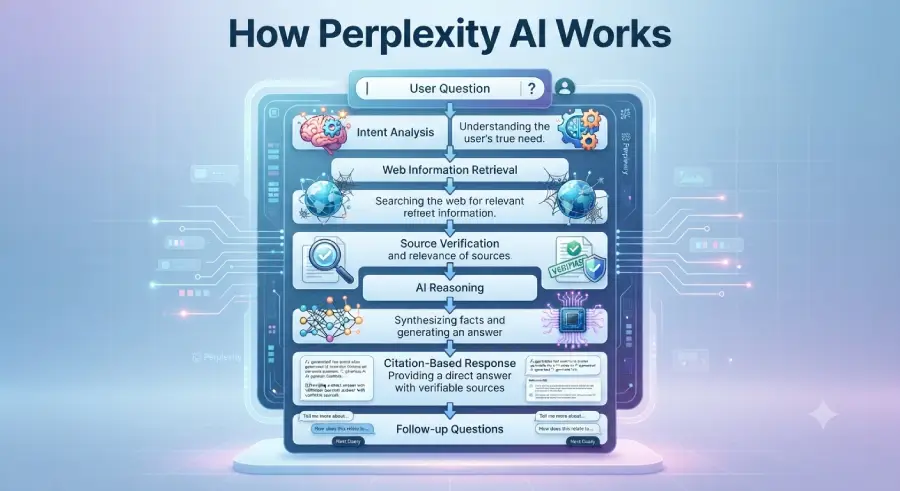
How Perplexity AI Works
The experience feels simple, but several technologies work together behind it: question → intent analysis → web retrieval → source selection → reasoning → citation-based summary → follow-up questions.
Step 1: Understanding Intent
Perplexity starts by figuring out exactly what’s being asked context, purpose, relationships between concepts, desired outcome, and conversation history, not just keyword matching. Asked “I’m starting an online business with a limited budget what marketing strategies should I focus on during my first six months?”, it reads that as a request for practical recommendations, not a definition of marketing.
Step 2: Retrieving Information From the Web
After parsing the question, Perplexity searches for relevant information from publicly available sources rather than relying solely on internal knowledge especially useful for fast-moving topics like technology, finance, business, science, sports, travel, and product comparisons.
Step 3: Evaluating Sources
Source transparency is really what sets Perplexity apart. Before generating a response, it identifies the sources actually supporting the information presented letting people verify claims, dig deeper, read the original material, and judge credibility for themselves. For researchers and professionals, that transparency genuinely speeds up the verification step.
Step 4: Reasoning
Rather than copying content directly from a webpage, Perplexity analyzes what it collected and organizes it into structure. Asked to “compare solar energy and wind energy,” it might break the answer into cost, efficiency, environmental impact, installation, maintenance, and best use cases a structure that actually helps someone decide.
Step 5: Generating Citation-Based Responses
The final answer is conversational but backed by citations often including summaries, bullet points, comparison tables, step-by-step explanations, and source references that encourage people to verify and keep exploring rather than just taking the summary at face value.
Key Features of Perplexity AI
Conversational search: ask naturally, without optimizing for keywords.
Source citations: a standout feature; references that let people evaluate the information directly.
AI-generated summaries: concise overviews instead of reading through multiple webpages.
Follow-up questions: continuing a conversation while keeping context.
Research assistance: understanding unfamiliar topics, comparing ideas, and discovering additional resources.
Multi-step queries: handling detailed, multi-part questions, like “which programming languages should I learn first for data science, and what free resources would you recommend?”
Why Perplexity AI Matters
Perplexity represents a real step in how AI-powered search has evolved combining conversational answers with genuine source transparency instead of forcing a choice between an AI summary and traditional web search. That fits into the broader trend covered in How AI Is Changing User Search Behavior in 2026 and Why Users Are Switching from Google Search to AI Chatbots.
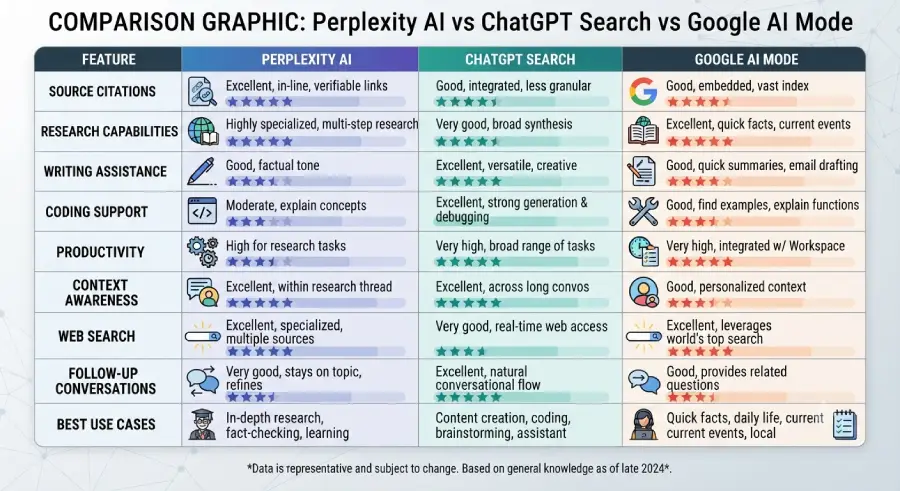
Perplexity AI vs. ChatGPT Search
Both are popular AI-powered search platforms and both use conversational AI, but they’re built around different priorities. Perplexity is primarily research and source-backed answers; ChatGPT Search combines conversational search with a broader assistant experience covering writing, coding, brainstorming, and productivity.
| Feature | Perplexity AI | ChatGPT Search |
| Primary Purpose | AI-powered research | AI assistant with web search |
| Source Citations | Excellent | Available for supported web search responses |
| Research Workflow | Excellent | Excellent |
| Writing Assistance | Good | Excellent |
| Coding Support | Good | Excellent |
| Brainstorming | Good | Excellent |
| Follow-up Conversations | Excellent | Excellent |
| Best For | Research, fact-finding, source discovery | Writing, coding, productivity, learning |
Perplexity fits well when you want to: research complex topics, verify claims with citations, compare multiple sources, explore technical subjects, or trace information back to original articles renewable energy trends or a report needing traceable sources are good examples.
ChatGPT Search fits well for: writing blog posts, drafting emails, brainstorming, learning new skills, coding, project planning, and interactive conversation more broadly. Full comparison: ChatGPT Search Explained.
Perplexity AI vs. Google AI Mode
Both generate AI answers, but the overall experience differs. Google AI Mode builds on Google’s existing search infrastructure, while Perplexity is designed specifically around conversational research with heavy emphasis on source transparency.
| Feature | Perplexity AI | Google AI Mode |
| Conversational Search | Excellent | Excellent |
| Source Visibility | Strong emphasis | Varies by response |
| Research Experience | Excellent | Very Good |
| Shopping Support | Limited | Strong |
| Local Search | Limited | Excellent |
| Product Discovery | Good | Excellent |
| Best For | Research and knowledge discovery | Everyday web search and navigation |
Choose Perplexity to conduct detailed research, explore cited sources, verify AI-generated claims, or read a summary before visiting the original article. Choose AI Mode to find official sites, search for local businesses, compare products, or use Maps. Full explanation: Google AI Mode Explained.
Perplexity AI vs. Traditional Search
Traditional search and AI search solve a similar problem differently. Traditional search focuses on helping you discover webpages; Perplexity focuses on helping you actually understand the information.
| Traditional Search | Perplexity AI |
| Keyword-based | Natural language |
| List of links | AI-generated summaries |
| Manual research | Guided research |
| Multiple webpages | Consolidated overview |
| Independent searches | Context-aware conversations |
| User evaluates information | AI organizes information with citations |
Traditional search: search “best cloud storage for businesses” → open several review sites → compare features manually → read pricing pages → decide.
Perplexity: ask it to compare the best cloud storage services for a 50-person business on pricing, security, collaboration, and storage limits → it retrieves relevant information → generates a structured comparison with citations → answers follow-ups.
That cuts a lot of the initial research time while still pointing back to the original sources worth reading. See AI Search vs Traditional Search for more on this shift.
Best Use Cases for Perplexity AI
Students
Understanding difficult concepts, summarizing study materials, exploring research topics, preparing assignments, and discovering additional reading something like “explain machine learning in simple language and recommend beginner resources” is a typical use.
Researchers
A reliable starting point for investigating complex topics summarizing information, surfacing different viewpoints, providing citations, and organizing complex subjects. It should complement reading original research and authoritative publications, not replace them.
Journalists
Researching background, exploring multiple perspectives, and identifying original sources faster with editorial verification still essential before anything gets published.
Bloggers and Content Creators
Topic research, fact-checking, content planning, competitor analysis, and outline creation useful for generating ideas, with human expertise still shaping the final piece.
SEO Professionals
Understanding search intent, researching industry trends, comparing competitor content, discovering supporting references, and planning topic clusters and content strategy.
Business Professionals
Market research, competitor analysis, industry updates, product research, presentation prep, and customer insight gathering.
Developers
Researching programming concepts, comparing frameworks, working through technical documentation, and exploring development trends.
Benefits of Perplexity AI
Source transparency: Citations make it far easier to verify information and keep researching.
Faster research: Structured summaries speed up the early stages of any research process.
Conversational experience: Ask detailed questions naturally and refine through follow-ups.
Better knowledge discovery: Uncovering connections between topics and different viewpoints along the way.
Improved productivity: Less time gathering information, with supporting references still readily available.
Limitations of Perplexity AI
AI can make mistakes: Like any AI system, it can occasionally produce inaccurate, incomplete, or outdated information critical decisions should rest on verified, authoritative sources.
Citations still need review: Even with sources attached, it’s worth evaluating the credibility, relevance, and context of the referenced material rather than trusting the summary alone.
Not built for every task: It’s strong for research specifically, but not a replacement for dedicated tools handling maps, shopping, government services, or banking traditional search still matters for those.
Feature availability changes: AI platforms evolve quickly, so specific capabilities can shift over time worth checking current platform updates.
What This Means for Publishers
Publish Original, Genuinely Helpful Content
AI systems increasingly surface content that demonstrates real expertise and originality focus on resources that add genuine value instead of repeating what’s already widely available.
Build Real Topic Clusters
Interconnected articles around a subject build topical authority far more effectively than isolated posts. A hub linking What Is AI Search?, How AI Search Works, Best AI Search Engines in 2026, and platform-specific guides like this one improves both navigation and topical relevance.
Answer Questions Clearly
Concise, direct answers to questions like “What is Perplexity AI?” help readers understand key concepts quickly and support visibility in AI-powered search.
Frequently Asked Questions
What is Perplexity AI?
Perplexity AI is an AI-powered search platform combining conversational AI, web search, and source citations to give direct, research-focused answers summarizing information and linking to supporting sources so people can verify and dig deeper.
How does Perplexity AI work?
It interprets your question with natural language processing, searches the web for relevant information, evaluates supporting sources, uses AI to organize the response, includes citations where appropriate, and supports follow-up questions within the conversation.
Is Perplexity AI free?
There’s a free tier with core search capability, plus premium plans offering additional AI models, extra features, and higher usage limits. Pricing and features change over time, so check the official platform for current details.
Is Perplexity AI better than ChatGPT Search?
It depends on the goal. Perplexity is especially strong for research, source citations, fact verification, and discovering original articles; ChatGPT Search excels at writing, coding, brainstorming, productivity, and longer conversations. Many people use both, depending on the task.
Can Perplexity AI replace Google Search entirely?
Not completely. It’s excellent for understanding topics and researching with citations, but traditional search is still better suited for finding official sites, local businesses, maps, shopping, and breaking news. For most people, it complements traditional search rather than replacing it.
Does Perplexity AI actually provide citations?
Yes, source transparency is one of its defining features, generally including citations that let people review supporting information and continue research from the original sources.
Is Perplexity AI accurate?
It aims for accurate, well-supported answers, but like any AI system it can occasionally produce inaccurate, incomplete, or outdated information. Verify anything important especially health, legal, financial, or academic decisions against authoritative sources.
Is Perplexity AI good for students?
Yes, as a learning aid learning new topics, summarizing research, understanding difficult concepts, preparing presentations, and exploring multiple viewpoints. It works best alongside textbooks, instructors, and primary research, not as a replacement for them.
Is Perplexity AI useful for SEO work?
Yes, commonly used to research search intent, explore competitor content, discover supporting references, build topic clusters, and generate content ideas, with human expertise and editorial review still essential before publishing.
What makes Perplexity AI different from a traditional search engine?
Traditional search mostly returns a ranked list of webpages. Perplexity goes further understanding conversational questions, summarizing information, organizing complex topics, including citations, and supporting natural follow-up conversation.
Key Takeaways
- Perplexity AI combines conversational search with web retrieval and source citations
- It’s particularly valuable for research, learning, and knowledge discovery
- Citation-based answers make it easier to verify information and explore original sources
- Traditional search engines remain essential for navigation, shopping, local search, and official sites
- Publishers should focus on original, trustworthy, well-structured content to stay competitive
- Strong topic clusters and internal linking help build authority and improve user experience
- Combining Perplexity with traditional search and other AI tools tends to produce the strongest research workflow
Conclusion
Perplexity AI has become one of the leading AI-powered search platforms by combining conversational AI with a genuinely strong emphasis on source transparency. Rather than just generating an answer, it actively encourages people to check the supporting references which is exactly why it resonates with students, researchers, journalists, and professionals who care about verifiable information.
Its ability to summarize complex topics, support real follow-up conversation, and streamline research shows how far AI search has moved past simple keyword matching. At the same time, traditional search engines still play an essential role for navigation, local information, and fast-moving events.
For publishers, Perplexity’s growth reinforces a consistent theme across this whole platform series: original, well-organized, genuinely useful content is what AI-powered search increasingly rewards. See PostDune’s guides on ChatGPT Search Explained, Google Gemini Explained, Microsoft Copilot Explained, and Claude AI Explained for the rest of the comparison series.