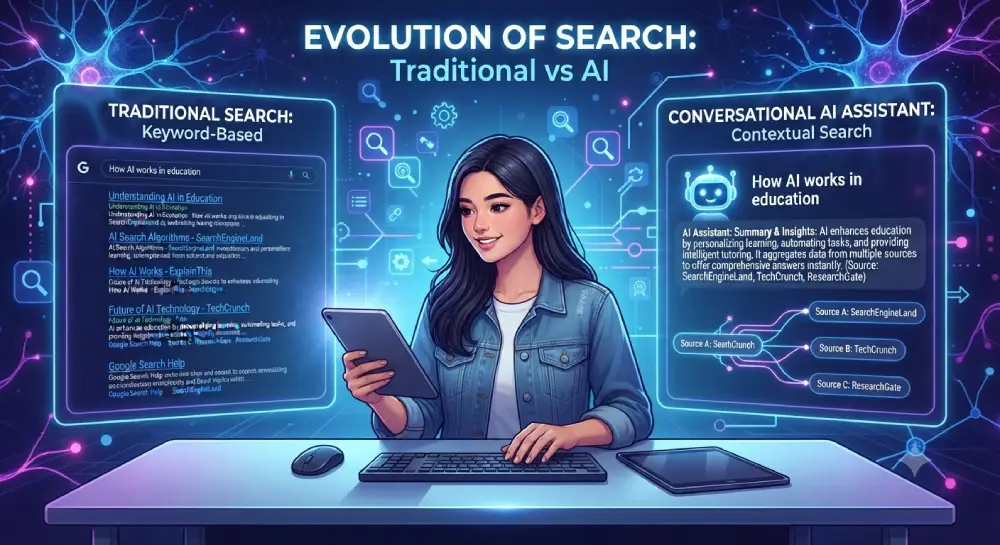
Searching the internet has come a long way from the early days of keyword boxes. For decades, the routine was the same: type a few keywords, get a list of pages back, open several tabs, and piece together an answer yourself. It worked, but it took real effort comparing sources, refining searches, and reading through a lot of material that wasn’t quite what you needed.
AI is changing that experience directly. Instead of just handing back a list of links, AI-powered search can understand natural language, pick up on what you’re actually asking, pull together information from multiple sources, and respond conversationally. People are increasingly searching for answers, not webpages.
That shift is already changing how people learn, shop, work, and decide. Students use AI search to work through difficult concepts, professionals use it to summarize reports, businesses use it for market research, and shoppers ask AI assistants for recommendations before buying anything.
For a broader look at how this is reshaping online behavior generally, see PostDune’s How AI Is Changing User Search Behavior in 2026.
This guide covers what AI search actually is, how it works, the technology behind it, how it differs from traditional search, and why it’s become one of the bigger shifts in how people find information online.
What Is AI Search?
AI search is a modern search approach that uses artificial intelligence to understand a question, interpret its context, and generate a genuinely useful answer instead of just handing back a list of web pages. Where traditional search engines mainly match keywords against indexed content, AI search systems analyze what’s actually behind a question, using technologies like natural language processing, large language models, machine learning, and semantic search to figure out what someone actually wants to know.
A Simple Example
Say you’re planning a vacation. With a traditional search engine, you might search “best places to visit in Japan in October” and get back thousands of pages travel blogs, airline sites, weather pages, hotel reviews that you then have to compare yourself.
Ask an AI search assistant instead: “I’m visiting Japan in October for ten days. I enjoy food, autumn scenery, and cultural experiences. Which cities should I visit?” and instead of a list of links, you get an answer built around your actual preferences why Kyoto works well for autumn colors, why Osaka is known for its food scene, and a travel route that fits a ten-day trip.
That conversational approach saves real time and makes information genuinely easier to work with. For more on why people are increasingly reaching for it, see PostDune’s Why Users Are Switching from Google Search to AI Chatbots.
Why Is AI Search Becoming So Popular?
AI search is catching on because it changes the basic interaction instead of forcing people to think like a search engine, it lets them ask questions the way they’d ask another person.
Faster Answers
AI search can pull together information from multiple sources and return a direct response in seconds, cutting down significantly on the time spent opening and comparing separate pages.
Better Understanding
Complex topics get easier to work through because AI can simplify technical concepts, add examples, and handle follow-up questions on the fly.
A Genuinely Conversational Experience
Unlike traditional search, AI holds onto context. Ask “what’s the best laptop for programming?” and follow up with “which one has the best battery life?” and the AI understands “which one” refers to the laptops just discussed a noticeably smoother, more natural back-and-forth.
Responses That Adapt to You
Privacy practices vary by platform, but within a conversation, AI search can tailor its answer to whatever context you provide mention your budget, experience level, or specific goal, and the recommendation shifts to match.
Real Productivity Gains
A lot of professionals now use AI search to research unfamiliar topics, summarize long documents, compare software and services, brainstorm, learn new skills, and draft content genuinely useful for both personal and professional tasks.
How Does AI Search Actually Work?
At its core, AI search combines several advanced technologies to understand a question and generate a useful answer. Every platform has its own specific architecture, but the process generally runs through five stages.
Step 1: Understanding the Question
The AI first works out what a query actually means and what it’s for not just the keywords in it, but the context, the relationships between words, and the overall goal. Asked “what’s the best smartphone for photography under $500?”, it picks out that a recommendation is wanted, photography is the priority, and the budget caps at $500. That level of understanding is what produces a genuinely relevant response.
Step 2: Processing Natural Language
Natural Language Processing lets AI understand how people actually talk grammar, context, synonyms, intent, sentence structure. Because of it, people don’t need awkward keyword combinations anymore; they can just ask a complete, natural question.
Step 3: Retrieving Relevant Information
A lot of AI search platforms combine their language model with current web information through approaches like Retrieval-Augmented Generation, retrieving relevant material from trusted sources before actually generating a response which improves both accuracy and freshness for anything that changes over time.
Step 4: Generating an Answer
Once enough information has been gathered, the AI organizes it into something clear and coherent summarizing key points, comparing options, explaining concepts, weighing advantages and disadvantages, or suggesting next steps, rather than just dumping a pile of webpages on you.
Step 5: Continuing the Conversation
One of AI search’s defining features is holding context across follow-ups. “Recommend a beginner-friendly mirrorless camera” followed by “which one performs best in low light?” gets understood as a question about the cameras just suggested the conversation just continues naturally, no need to restate anything.
Key Technologies Behind AI Search
AI search can look like one unified technology from the outside, but it’s really several advanced systems working together to understand a question, retrieve information, and generate a useful response.
1. Natural Language Processing (NLP)
NLP is the branch of AI that lets computers understand, interpret, and generate human language. Where traditional search leaned on keyword matching, NLP lets AI search understand what someone actually means, even without the exact words that might appear on a page “will I need an umbrella in Tokyo tomorrow?” gets read as a weather forecast question, not a literal search for those words.
What NLP actually enables:
- Understanding complete sentences
- Recognizing context
- Identifying real user intent
- Interpreting synonyms
- Handling genuinely conversational questions
2. Large Language Models (LLMs)
LLMs are trained on huge amounts of text to recognize language patterns, the relationships between concepts, and how people actually communicate. When you ask a question, an LLM analyzes the request and generates a response that’s relevant, coherent, and genuinely easy to follow explaining ideas, comparing options, summarizing long content, and handling follow-ups rather than just locating documents. Asked to “explain blockchain like I’m 12 years old,” an LLM can produce a genuinely simplified explanation instead of linking off to technical articles that adaptability to different audiences is one of AI search’s biggest strengths.
3. Machine Learning
Machine learning lets AI systems improve through experience rather than relying entirely on hand-coded rules recognizing patterns in data and getting better over time. Within AI search, it helps improve relevance, understand intent more precisely, rank retrieved information, catch spam, and sharpen recommendation quality as the system processes more interactions.
4. Semantic Search
Semantic search focuses on the meaning behind a query instead of matching individual words recognizing that different phrasings can express the same underlying goal. “Best budget phone,” “affordable smartphone,” “cheap phone with good camera,” and “which phone under $400 is worth buying?” would look like separate queries to simple keyword matching. Semantic search recognizes they’re all after the same thing: a reasonably priced phone that’s actually worth buying.
5. Retrieval-Augmented Generation (RAG)
A real limitation of any AI model is that its internal training doesn’t always reflect the latest information. RAG solves that by pairing the language model with information retrieved from external sources instead of relying purely on pre-trained knowledge, the system pulls relevant documents before actually generating its response.
What RAG buys you:
- More current information
- Better factual accuracy
- Improved citations, on platforms that support them
- Stronger answers for genuinely recent events
How These Technologies Work Together
A simplified workflow looks like: question → natural language processing → intent recognition → retrieve relevant information → the language model processes it all → generate a conversational answer → handle follow-up questions. Combined, this produces answers that are faster, more contextual, and easier to work with than keyword-based search alone ever managed.
AI Search vs. Traditional Search
Both approaches help people find information, but they work differently and fit different kinds of tasks. Traditional search excels at helping people discover websites, official resources, local businesses, and current news. AI search focuses on understanding the question itself and providing a direct, conversational answer.
| Feature | Traditional Search | AI Search |
| Primary Goal | Find relevant webpages | Provide direct answers |
| Query Style | Keywords | Natural language questions |
| Results | List of links | Conversational responses |
| Context Awareness | Limited | High |
| Follow-Up Questions | New search required | Supported naturally |
| Information | User reads multiple sources | AI summarizes information |
| Best For | Navigation, shopping, local search, official sites | Research, explanations, brainstorming, comparisons |
AI search offers a more conversational experience, but traditional search still matters plenty for finding original sources, official documentation, and highly specialized information. For a deeper comparison, see PostDune’s AI Search vs Traditional Search.
Popular AI Search Platforms
A number of companies now offer AI-powered search, each with its own particular strengths depending on what you’re actually looking for.
ChatGPT Search
Combines conversational AI with web-assisted retrieval to answer questions, summarize topics, compare products, and support research particularly strong for learning new concepts, brainstorming, writing help, coding assistance, and research summaries. Beyond just answering questions, it’s also shaping how people evaluate products before buying see How ChatGPT Is Influencing Consumer Search Decisions. Full breakdown: ChatGPT Search Explained.
Google AI Mode
Google extended traditional search by adding AI-generated summaries alongside the familiar results page combining conversational assistance with Google’s existing index, so people get a quick overview while still being able to explore the original pages. Particularly useful for everyday search, local businesses, shopping research, travel planning, and current events. Full breakdown: Google AI Mode Explained.
Perplexity AI
Known for its emphasis on source transparency it typically provides citations that let people verify information and explore the original sources directly, which is exactly why it’s popular with students, researchers, and professionals. Full breakdown: Perplexity AI Explained.
Microsoft Copilot
Combines AI search with workplace productivity beyond answering questions, it helps with emails, documents, presentations, spreadsheet analysis, and general business workflows. Full breakdown: Microsoft Copilot Explained.
Gemini
Combines conversational AI with genuine multimodal capability people can ask using text, images, or documents, which makes it useful for learning, productivity, and creative work. Its integration with Google’s other services also helps with tasks that span multiple apps. Full breakdown: Google Gemini Explained.
Real-World Examples of AI Search
AI search is already woven into everyday life across several categories.
Education:. Students ask AI assistants to explain difficult subjects, summarize chapters, and generate practice questions.
Shopping: People compare phones, laptops, insurance plans, and travel packages through conversational questions instead of manually reviewing dozens of sites.
Business: Professionals use it to summarize reports, analyze competitors, generate ideas, and research industry trends.
Travel: Instead of separately searching flights, hotels, attractions, and weather, travelers can ask for a complete itinerary built around their interests and budget.
Health information: People often use AI search to understand medical terminology or general wellness topics though genuinely important medical decisions should always rest on advice from qualified healthcare professionals and authoritative sources.
Benefits of AI Search
AI search is changing how people interact with information by making it more intuitive, conversational, and efficient. Instead of opening several webpages and comparing sources manually, people get a clear, structured answer in seconds.
Faster Access to Information
Traditional search means searching, opening several pages, reading through different articles, comparing, and drawing your own conclusion. AI search compresses that into one summarized response, getting people to an answer noticeably faster.
More Natural Conversations
No more hunting for the “perfect” keyword. Instead of “best laptop programming student,” someone can ask “I’m a computer science student with a budget of $800 which laptop would you recommend for programming and why?” and get an answer built around the actual context.
Personalized Recommendations
AI search tailors its response to whatever’s shared during the conversation budget, experience level, location, goals, preferences producing recommendations that genuinely fit rather than a generic top-10 list.
A Better Learning Experience
Students and lifelong learners benefit from being able to keep asking follow-ups until something actually clicks “explain cloud computing” → “can you explain it with a real-world example?” → “what’s the difference between cloud storage and cloud computing?” a genuinely interactive path to real understanding.
Real Productivity Gains
Professionals increasingly use AI search to summarize reports, draft emails, compare software, brainstorm, learn unfamiliar concepts, and research competitors cutting down on repetitive research so there’s more time for actual analysis and decisions.
Better Accessibility
AI search lowers the barrier for people unfamiliar with advanced search techniques no need to learn search operators or hunt for the exact right keyword when you can just ask in plain language.
Limitations of AI Search
AI search offers a lot, but it isn’t perfect understanding its limitations helps people use it responsibly.
Responses Aren’t Always Perfect
AI systems generate responses based on language patterns and, often, information retrieved from external sources which means answers can occasionally be incomplete, outdated, or missing important context. For high-stakes topics like healthcare, legal matters, finance, or safety, always verify with authoritative sources or qualified professionals.
Source Transparency Varies by Platform
Some platforms provide citations or links to supporting sources; others give a summarized answer without clearly identifying where it came from. Wherever attribution is available, checking the original material helps you judge reliability.
AI Can’t Replace Human Expertise
AI is a genuinely excellent research assistant, but it shouldn’t substitute for expert judgment. Doctors, lawyers, financial advisors, and engineers bring specialized knowledge, real-world experience, and accountability that AI simply can’t fully replicate.
Privacy Is Worth Thinking About
Avoid entering passwords, financial account details, confidential business information, sensitive personal data, or private documents unless you actually understand a platform’s privacy practices. Using AI responsibly includes protecting your own and your organization’s information.
Impact on Website Traffic
As AI search delivers answers directly, some people no longer need to click through to individual sites for basic informational queries closely tied to the rise of zero-click search, where people get what they need without leaving the search interface at all. See PostDune’s The Rise of Zero-Click Searches: What It Means for Websites for what this means for publishers.
How AI Search Is Changing the Internet
AI search is influencing more than how people look things up it’s reshaping how content gets created, optimized, and discovered in the first place.
For Users
People are getting more comfortable asking detailed, conversational questions instead of short keyword phrases a more intuitive experience that encourages deeper exploration through follow-ups. More on this shift in PostDune’s How AI Is Changing User Search Behavior in 2026.
For Businesses
Companies are using AI search to improve customer support, simplify product discovery, and help customers make more informed purchase decisions. Businesses publishing clear, trustworthy, educational content are more likely to stay visible as AI search keeps evolving.
For Content Creators
Writers and publishers are shifting from writing for individual keywords toward building comprehensive topic clusters that genuinely answer questions in depth a strategy that demonstrates real expertise and improves the odds of being referenced by AI-powered search.
For SEO Professionals
SEO remains essential, but the emphasis is shifting toward topical authority, genuinely helpful content, logical site structure, strong internal linking, clear direct answers, and regular updates. For more on how AI search compares to traditional optimization, see AI Search vs Traditional Search.
Frequently Asked Questions
What is AI search, in simple terms?
AI search is a type of search technology that uses artificial intelligence to understand a question and provide a direct, conversational answer instead of just listing webpages.
How is AI search different from traditional search?
Traditional search mainly displays links to webpages; AI search focuses on understanding intent and generating a genuinely helpful, conversational response.
Is AI search replacing Google Search?
No, it complements traditional search rather than replacing it. Traditional search remains valuable for official websites, local businesses, current news, and original sources.
Which AI search platform is actually best?
It depends on what you need. Some people prefer a conversational assistant for learning and brainstorming; others value a platform that provides source citations for research specifically.
Is AI search free to use?
Most platforms offer a free tier, with some advanced features requiring a paid subscription.
Can AI search get things wrong?
Yes, AI-generated responses can occasionally be inaccurate or leave out important details. Always verify anything important against trusted, authoritative sources.
Why are more people using AI search?
A lot of people appreciate that it’s faster, supports natural conversation, and makes complex topics easier to understand through clear, adaptable explanations.
Is AI search useful for students?
Yes, it can help students understand concepts, summarize material, generate study questions, and explore new topics. That said, students should still consult textbooks, academic resources, and instructors where it matters.
Conclusion
AI search represents one of the more significant developments in how people find information online. By combining artificial intelligence with a conversational interface, real natural language understanding, and smart information retrieval, it lets people access knowledge in a faster, more intuitive way than keyword search alone ever offered.
It’s not really replacing traditional search so much as expanding how people discover and understand information. Traditional search stays valuable for navigating the web and reaching original sources; AI search is what excels at summarizing information, answering questions directly, and supporting a genuinely interactive way of learning.
As the technology keeps advancing, understanding how AI search actually works is becoming genuinely useful for users, businesses, marketers, educators, and website owners alike. To go deeper, continue with PostDune’s Complete Guide to AI Search in 2026, covering the underlying technology, leading platforms, SEO implications, GEO, AEO, and where AI-powered search is headed next.