Introduction
For over two decades, the word “search” meant one thing: opening a browser, typing a few words into Google, and scrolling through a list of blue links. That behavior became so universal it entered the dictionary as a verb. To “Google” something was to look it up. Full stop.
That assumption is now cracking.
In 2026, a measurable and growing number of users are bypassing Google entirely, opening apps like ChatGPT, Claude, Gemini, or Perplexity, and typing or speaking their questions in plain, natural language. They get a direct, synthesized answer in seconds. No ads. No ten links to evaluate. No five tabs to open. Just an answer.
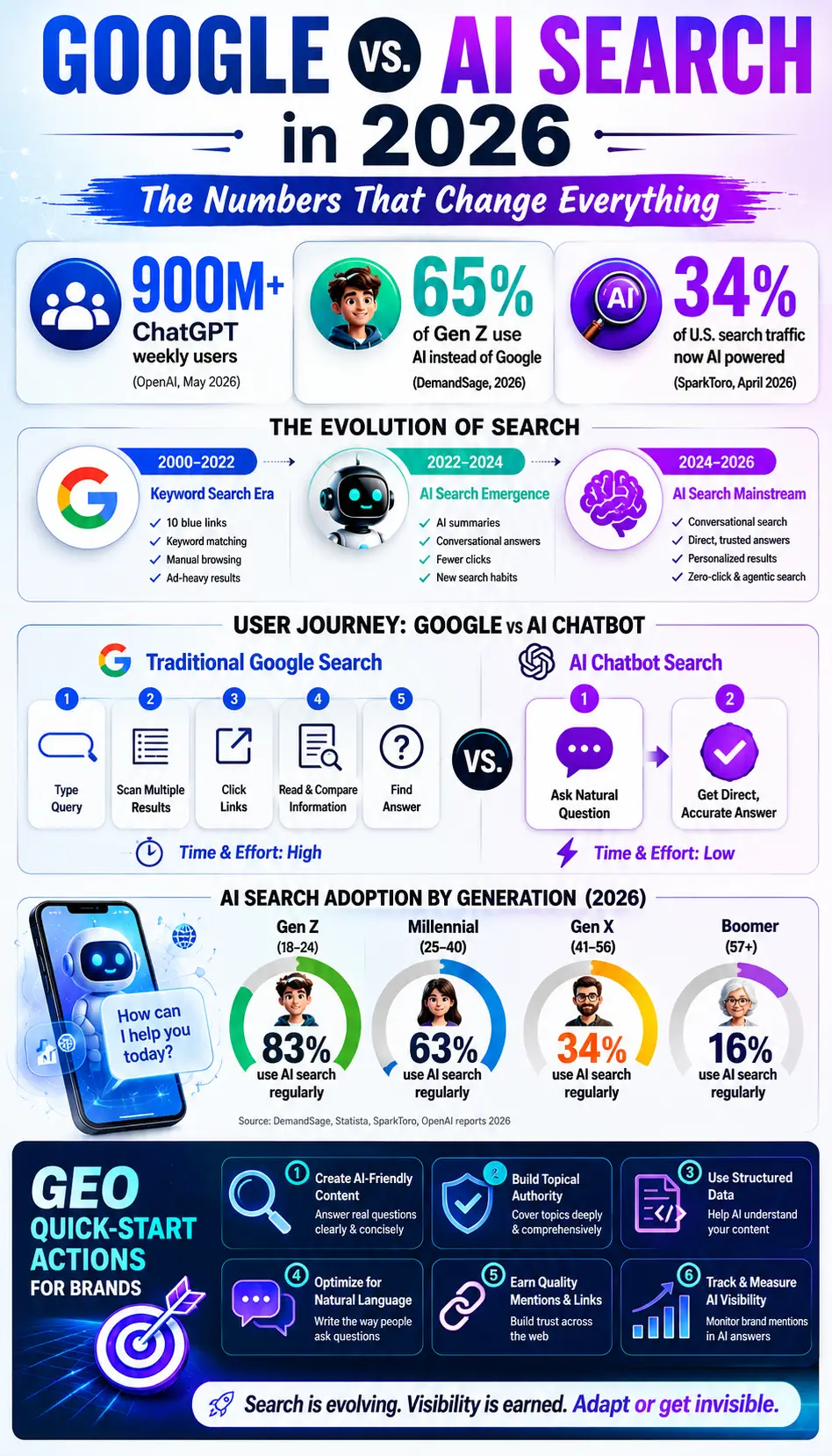
The numbers confirm the shift. ChatGPT alone has reached 900 million weekly active users as of early 2026 more than double its count just a year earlier. In the US, AI platforms now account for 34% of search-equivalent traffic when mobile app sessions are correctly counted alongside web traffic. And in a Harvard Business Review / Gallup survey of nearly 2,500 US adults aged 18–28, 65% reported using an ai chatbot as a replacement for google search in the last month.
This is not a niche experiment. The future of search is being rewritten right now and for businesses, marketers, SEO professionals, and publishers, understanding why users are switching is the first step to staying visible in a world where the rules have fundamentally changed.
If you’re new to this shift, our guide on How AI Is Changing User Search Behavior in 2026 is the ideal companion piece to this article.
The Traditional Google Search Experience
To understand why users are switching, it helps to revisit what they’re switching from.
Google search is an index-based, keyword-matching system built on a simple and powerful idea: crawl the web, rank pages by relevance and authority, and return a list of links ordered by quality. At its peak, this was transformative. Before Google, finding information online was genuinely difficult. Google made it easy, fast, and (mostly) reliable.
Google search works like this: a user types a query, Google’s algorithm parses those words, matches them against its index of billions of pages, applies hundreds of ranking signals, and returns a Search Engine Results Page (SERP) typically featuring ten organic links, assorted ads, featured snippets, Knowledge Panels, local map packs, and image results. The user then clicks a link, lands on a page, reads (or skims) the content, and either finds what they need or returns to Google to try again.
The advantages of this model are real and enduring. Google provides source transparency you see exactly where each result comes from before clicking continuously updated crawled content, breadth of results covering multiple perspectives and voices, specialized verticals integrating maps, shopping, images, news, and video, and reliability for navigational queries such as getting to your bank’s login page.
For much of the internet’s history, this was sufficient even excellent. Google’s global search engine market share held comfortably above 90% for over a decade. But that dominance was built on an era before users had an alternative that could talk back.
The Rise of AI Chatbots as Search Tools
The landscape of ai search engines began shifting meaningfully in late 2022, when OpenAI launched ChatGPT and demonstrated something users had never experienced before: a system that could have a conversation, synthesize multiple sources into a single answer, and remember context across an extended exchange. The result felt less like a search engine and more like a knowledgeable colleague.
By 2026, a full ecosystem of ai search assistants has emerged, each with distinct strengths:
ChatGPT (OpenAI): The platform that created the category. With 900 million weekly active users and a 76.85% share of the AI chatbot market (StatCounter, April 2026), ChatGPT is the dominant ai-powered search platform and, by session volume, the world’s second-largest information discovery tool after Google. It processes an estimated 2.5 billion queries per day.
Gemini (Google DeepMind): Google’s own ai search assistant, integrated natively into Search and Google Workspace. Gemini reached approximately 400 million monthly users by early 2026 and grew its regular usage share from 29% to 33% year-over-year the largest gain of any AI platform in the Orbit Media 2026 AI + Search Survey.
Claude (Anthropic): Favored by enterprise users and researchers for its focus on accuracy, safety, and long-document analysis. Claude punches significantly above its usage-share weight in referral traffic meaning the users it sends to websites are highly engaged and convert at strong rates.
Microsoft Copilot: Deeply integrated with Bing search engine and Microsoft 365, Copilot is the dominant ai search layer for enterprise and workplace users. Its transparent citation behavior makes it a trusted research companion for professional contexts.
Perplexity AI: The purest ai-powered search product a real-time answer engine that cites sources inline. Processing over 780 million queries monthly as of May 2025 and growing rapidly, Perplexity has cultivated an audience of highly engaged, research-oriented users who want AI answers with visible sourcing.
Together, these platforms are redefining what ai search engines can do and raising user expectations far above what a list of links can satisfy.
Key Reasons Users Are Switching from Google Search to AI Chatbots
Instant Answers Without Clicking Multiple Links
The most frequently cited reason users prefer ai chatbots over traditional google search is elegantly simple: they get the answer immediately, without clicking anything.
When a user asks ChatGPT “What’s the difference between a Roth IRA and a traditional IRA, and which is better if I expect to be in a higher tax bracket in retirement?”, they receive a synthesized, personalized answer in seconds. The equivalent Google experience involves scanning a results page, evaluating which of the top links looks most authoritative, clicking through, waiting for the page to load, finding the relevant section, and often repeating the process two or three more times.
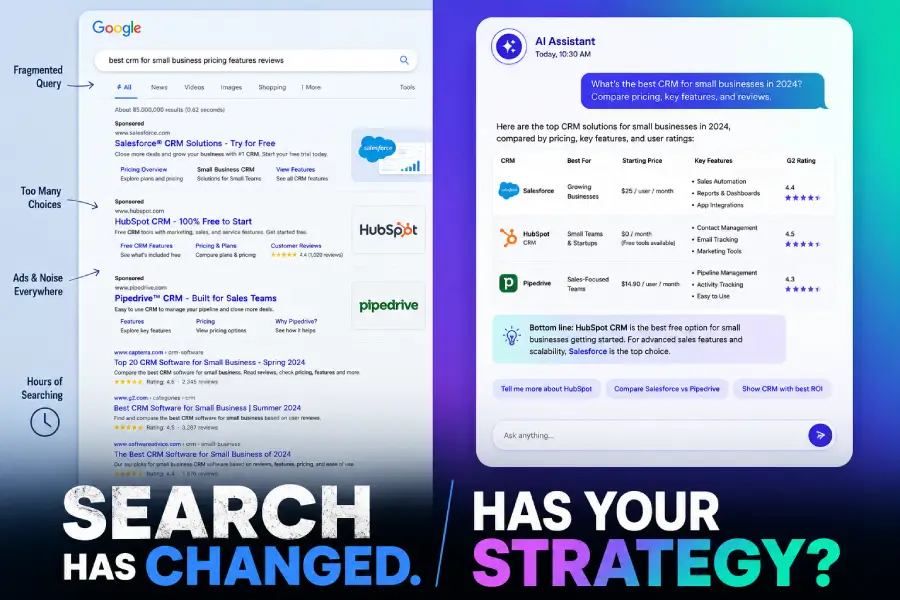
This single behavioral difference answer vs. links explains more of the google vs ai search dynamic than any other factor. When the answer is right there, the motivation to click diminishes to near zero. It is no coincidence that zero-click searches reached record levels in 2025, with 58.5% of US searches ending without any click to an external website, and an average zero-click search rate of 83% when AI Overviews appeared, according to Adobe Digital Insights.
Conversational Search Experience
Conversational search is the natural mode of interaction with ai chatbots, and for many users particularly younger ones it feels dramatically more intuitive than composing search queries.
Traditional google search requires users to translate their natural question into search-engine syntax: dropping filler words, stripping grammar, adding operators. AI chatbots require nothing of the sort. Users simply ask, the way they would ask a person. According to the Orbit Media 2026 survey, 44% of respondents say ai chatbots have changed the way they look for information online a figure that has grown from 42% the year prior. See our full guide on The Rise of Conversational Search and What It Means for Your Content Strategy for deeper analysis.
Better Context Understanding
One of the most meaningful technical advantages ai-powered search has over traditional search engines is genuine context comprehension. Traditional search engines parse keywords. AI systems understand intent, nuance, ambiguity, and sub-questions.
A query like “Is it safe to take ibuprofen with my blood pressure medication?” sends very different signals to the two systems. Google search returns a list of general articles about NSAIDs and blood pressure. An ai chatbot interprets the medical context, addresses the interaction risk, explains the mechanism, recommends consulting a physician, and flags which specific blood pressure drug classes carry the highest risk all in a single, coherent response. The difference is not speed. It is genuine comprehension.
Personalized Responses
Generative ai search platforms are increasingly delivering genuinely personalized answers. Unlike traditional google search, which personalizes only at the level of location and browsing history, ai search engines adapt their tone, depth, format, and focus to match the user’s apparent expertise level, stated preferences, and conversational context.
A software engineer asking Claude how to implement a caching strategy gets a technical, code-aware answer. A non-technical founder asking the same question gets an analogy-driven explanation with real-world trade-offs. This kind of dynamic personalization is structurally impossible for a list of links to replicate.
Faster Research and Learning
For complex research tasks comparing options, building arguments, summarizing long documents, or mapping out a topic they know little about users have discovered that ai search assistants dramatically accelerate their process.
The ai search trends 2026 data backs this up: visitors arriving from ai search engines spend 68% more time on-site than traditional organic search visitors (SE Ranking, 2025), suggesting that when AI does send users to a page, they are genuinely engaged and prepared to act.
Summarized Information
One of the most practically valuable things ai chatbots do is synthesize. When a user wants to understand a topic, they don’t need ten opinions they need a coherent synthesis of the most important perspectives, with noise filtered out.
Traditional google search returns the raw material. AI chatbots produce the synthesis. According to the Orbit Media survey, AI Chat is preferred over Search for step-by-step instructions by 40% of respondents, and AI’s advantage on quick factual lookups grew from 23% to 29% year-over-year. Explore how this affects content strategy in our piece on How to Optimize Content for AI Search Engines.
Improved Productivity
The productivity case for ai-powered search is backed by conversion data. A Seer Interactive case study found that ChatGPT search converted at 15.9% and Perplexity at 10.5%, versus Google organic at just 1.76%. Ahrefs reported that AI search engine visitors accounted for just 0.5% of their traffic but generated 12.1% of all signups a 23x higher conversion rate than traditional search engine traffic.
These numbers reflect a user who arrives from an AI tool already further along in their decision journey. They’ve already had the research conversation, compared options, and formed a view. That’s a fundamentally different and more valuable visitor profile than one who clicks the first SERP result.
Natural Language Queries
The shift from keyword syntax to natural language is one of the most visible manifestations of the google vs ai search transition. Users querying ai search engines write longer, more conversational questions averaging three times the word length of traditional google search queries. This habit is bleeding back into Google itself: average Google search length is up 8% year-over-year in both the US and UK, driven by question-word queries (who, what, where, when, why) growing across all user segments.
AI search engines reward natural language, making the barrier to effective search nearly zero. No special syntax, no Boolean operators, no need to guess what phrase a page has ranked for a friction lessness that is particularly valuable for users who found traditional google search opaque or effortful.
Follow-Up Questions Without Starting Over
Perhaps the single biggest experiential advantage of conversational search over traditional google search is the ability to drill down without starting over. When a user gets an answer from Google and wants to ask a follow-up, they must compose an entirely new query, losing the thread entirely.
AI chatbots maintain full conversational memory within a session. A user can ask “explain quantum computing,” follow up with “how does that differ from classical computing for machine learning specifically?”, then “give me a real-world example in drug discovery” and each response builds on all prior context. This transforms search from a series of disconnected queries into a genuine research dialogue.
AI-Powered Recommendations
Ai-powered search is changing how decisions are made, not just how research happens. A 2025 survey found that 94% of B2B buyers used generative ai search tools during their purchase process, and 56% of tech buyers now use ai chatbots as a top source for vendor discovery. If AI doesn’t recommend your brand in a shortlist query, you may not exist in the buyer’s consideration set at all.
Google Search vs. AI Search: Full Comparison
| Feature | Google Search | AI Chatbots |
|---|---|---|
| Search Method | Keyword and semantic matching against indexed pages | Natural language understanding; generative synthesis |
| User Experience | SERP with ranked links, ads, snippets, Knowledge Panels | Single synthesized answer; conversational interface |
| Speed | Near-instant results page; slower to reach final answer | Direct answer delivery; faster time to insight |
| Personalization | Location, device, browsing history | Conversation context, stated preferences, expertise level |
| Context Awareness | Query-by-query; limited cross-query memory | Full session memory; understands follow-up questions |
| Research Capabilities | Excellent for discovery and multi-source exploration | Excellent for synthesis, comparison, and deep Q&A |
| Accuracy | Links to authoritative sources; accuracy varies by source | High on well-established topics; hallucination risk on edge cases |
| Source Transparency | Full source visibility before clicking | Varies; Perplexity is citation-first; ChatGPT less transparent |
| Follow-Up Questions | Requires new query; loses prior context | Native; session memory maintained throughout |
| Best Use Cases | Navigational, local, transactional, breaking news, image/video | Informational research, summarization, planning, comparison, step-by-step guidance |
The google vs ai search table above illustrates that this is not a clean winner-takes-all competition each system has genuine advantages in different contexts. Google search wins decisively on breadth, transparency, and integration with local, shopping, video, and navigational search. AI chatbots win decisively on depth, conversational flow, and synthesized answers for research-heavy queries. The practical reality for most users is a dual-tool workflow. For a full breakdown, see our guide on Google AI Overviews: What They Mean for Your Organic Traffic.
Statistics Showing the Shift Toward AI Search
The following tables present verified, current data on the google vs ai search transition and ai search trends 2026.
AI Chatbot Growth and Market Share
| Metric | Statistic | Source |
|---|---|---|
| ChatGPT weekly active users (Feb 2026) | 900 million | OpenAI |
| ChatGPT growth (Feb 2025 to Feb 2026) | +125% (more than doubled) | OpenAI |
| ChatGPT AI chatbot market share (April 2026) | 76.85% | StatCounter |
| Gemini monthly users (early 2026) | ~400 million | |
| Perplexity monthly queries (May 2025) | 780 million+ | Platform reports |
| Total AI sessions globally (Q4 2025) | 45 billion/month | Graphite.io |
| AI share of US search-equivalent traffic | 34% | Graphite.io, March 2026 |
| AI share of combined search market (June 2025) | ~8% | Bloola Research |
| Ratio of Google users to AI users (June 2025) | 4.7:1 (was 10:1 twelve months prior) | Bloola Research |
User Behavior and Preference Shifts
| Metric | Statistic | Source |
|---|---|---|
| Adults using AI Chat as primary/frequent research tool | 55% | Orbit Media, March 2026 |
| Gen Z adults using AI chatbots as Google replacement | 65% | Harvard/Gallup, Jan 2026 |
| Gen Z preferring AI over Google for information | 61% | Vox Media survey |
| Millennials preferring AI over Google | 53% | Vox Media survey |
| Consumers saying AI has changed how they search | 44% | Orbit Media, 2026 |
| Gen Z using AI chatbots for search (all demographics) | 34% | Appinio/Search Engine Land |
| US teens (13-17) who have used AI chatbots | 64% | Pew Research, Feb 2026 |
| Users believing chatbots will eventually replace search engines | 46% | Orbit Media, 2026 |
| B2B buyers using generative AI in purchase process | 94% | 6sense, 2025 |
Traffic, Conversion, and Revenue Impact
| Metric | Statistic | Source |
|---|---|---|
| AI referral traffic to US retail sites (YoY growth) | +693% | Adobe Digital Insights, Jan 2026 |
| AI referrals conversion advantage over non-AI traffic | +31% better | Adobe Digital Insights |
| ChatGPT conversion rate (B2B software) | 15.9% vs. Google organic’s 1.76% | Seer Interactive |
| Ahrefs AI traffic signups vs. share of total traffic | 0.5% of visits → 12.1% of signups | Ahrefs, June 2025 |
| AI search visitors time on site vs. organic | +68% longer | SE Ranking, 2025 |
| Zero-click rate when AI Overviews appear | 83% average | Adobe/Industry data, 2025 |
How AI Chatbots Are Changing Search Behavior
Longer Search Queries
Search behavior trends data consistently shows that AI has trained users to ask longer, more complete questions. According to RealityMine’s April 2026 behavioral analysis, average Google search length has grown 8% year-over-year in both the US and UK, and queries containing question words (who, what, where, when, why) are growing across every demographic even among users who don’t regularly use ai chatbots. The behavioral spillover from AI into traditional google search is now measurable and systemic.
Conversational Search
Conversational search has moved from niche to norm on AI platforms. The Orbit Media 2026 survey found that 55% of respondents use AI chat as their primary or frequent research tool. The conversational format ask, refine, follow-up, synthesize has redefined user expectations for what a good ai search experience should feel like.
Multi-Step Research Sessions
Traditional google search was episodic: query, result, done. AI-powered search is continuous: query, conversation, follow-up, refinement, decision. Google’s own AI Mode data shows planning-related queries have outpaced overall AI growth by 80%, reflecting users who lean on ai chatbots to map out complex decisions in a single extended session.
Reduced Reliance on Search Results Pages
Zero-click searches are now the default experience for a significant portion of queries. Semrush data shows that over 65% of informational queries resolve without a website visit, and Adobe Digital Insights reports AI referral traffic to retail sites grew 693% year-over-year in 2025. The SERP, once the central hub of every search engine journey, is increasingly a waypoint rather than a destination.
Growing Trust in AI Responses
Trust in AI answers is growing, if unevenly. The Orbit Media survey found that 49% of respondents trust Google results more than AI chat down from 52% a year earlier. Meanwhile, 44% say ai chatbots have changed how they search, up from 42%. The direction is clear: trust is shifting, but skepticism remains particularly among older users. Among Gen Z, trust and adoption run significantly higher, driving the overall ai search trends 2026 data.
Rise of Voice-Based AI Search
Voice ai-powered search and ai chatbots are converging rapidly. More than 1 in 6 US users now combine voice interaction with ai search features. Smart speakers, AI-powered earbuds, and always-on voice assistants are extending the AI search experience into non-screen contexts, further eroding the assumption that google search requires a keyboard and a browser.
Why Younger Users Prefer AI Search
The generational dimension of the google vs ai search shift may be the most strategically important data point in this article. The behaviors taking root among younger users today will define the future of search for the next two decades.
A Harvard Business Review / Gallup survey of nearly 2,500 US adults aged 18–28 (published January 2026) found that 74% of young adults used an ai chatbot at least once in the last month and 65% reported using it as a direct replacement for google search. In a Vox Media survey cited by Fast Company, 61% of Gen Z and 53% of millennials said they prefer ai search engines over traditional google search for finding information.
Among US teens aged 13–17, Pew Research Center’s February 2026 study found that 64% have used ai chatbots, with 57% using them specifically to search for information and nearly 3 in 10 using them daily.
According to Search Engine Land, 34% of Gen Z use ai chatbots for search far above other age groups. Notably, younger users also engage in a multi-platform search behavior strategy: using TikTok for discovery, AI for research, and google search only when navigating to a specific destination.
WebFX’s analysis of 3,000+ search queries across four generations found that Gen Z writes the longest queries (5.83 words on average) and searches most conversationally mirroring the natural language input style that ai chatbots are designed for. This generational conversational search behavior is not accidental: it is the result of growing up with Siri, Alexa, and now full AI assistants, where speaking naturally has always produced the best results.
Millennials present a slightly different profile. They show the highest work-oriented AI adoption 52% rely on generative AI for their jobs according to PYMNTS Intelligence and are the generation most actively integrating ai search assistants into professional workflows, including vendor research, competitive analysis, and content creation.
Deloitte’s December 2025 report adds important context: 76% of Gen Z had used a generative AI tool by mid-2025, compared to just 20% of Boomers. The gap is not narrowing at any meaningful pace. The search engine evolution being driven by Gen Z is a structural shift, and the pipeline of ai search-native users is expanding every year as Gen Alpha enters the workforce.
Challenges of Using AI Chatbots for Search
A balanced analysis of ai search assistants requires honest engagement with their current limitations. The shift toward ai-powered search carries real risks alongside its benefits.
Hallucinations
AI chatbots can generate confident, fluent, well-structured responses that are factually incorrect. This “hallucination” problem is the most frequently cited concern about ai search engines among both users and experts. Unlike traditional google search, which points to an external source that users can verify, an ai chatbot presents a synthesized answer as if it were reliable with no indication of where the uncertainty lies. This is examined in depth in our guide on The Challenges and Risks of AI-Powered Search: What Users and Brands Need to Know.
Inaccurate Information
Even when AI answers are not full hallucinations, they may be outdated, partially correct, or imprecisely worded in ways that mislead. The Princeton GEO research paper and subsequent studies have documented cases where ai search systems confidently provided accurate-sounding but incorrect figures, dates, and attributions. The 36% of Orbit Media respondents who are “unlikely to ever trust AI chat tools” up from 32% the prior year cite this concern most frequently.
Source Verification Issues
Unlike google search, which displays source URLs before users click, most ai chatbots (with the notable exception of Perplexity and Microsoft Copilot) do not consistently surface their source materials. Users who want to verify a claim must independently run a second google search effectively completing two searches where one once sufficed. This verification gap is particularly consequential for health, legal, financial, and news-related queries.
Bias and Misinformation
AI search engines are trained on large datasets that reflect the existing distribution of information on the internet including its biases, gaps, and misinformation. They can reproduce and amplify existing biases in ways that are difficult to detect because the outputs appear authoritative and coherent. This concern is especially acute for political, health, and social topics.
Privacy Concerns
Conversational search involves users sharing detailed, context-rich personal information with ai chatbot platforms the nature of their health symptoms, financial situations, relationship dilemmas, and business strategies. The privacy implications of this data collection are not yet fully addressed by regulation. The FTC launched an inquiry in September 2025 into AI chatbot companies including OpenAI, Meta, and Google regarding data practices and teen safety, signaling that regulatory scrutiny of ai-powered search is intensifying.
Dependence on AI-Generated Answers
A 2025 Wharton School experiment found that users given access to AI for a research task expended less effort and generated shallower recommendations than those who used standard google search. The Harvard/Gallup Gen Z survey reinforced this: 65% of young adult respondents said ai chatbots discourage engaging with information in a deep or critical way. The efficiency gains of ai search may come at the cost of genuine comprehension a concern that has important implications for education and information literacy.
How Google Is Responding to the AI Search Revolution
Google search is not standing still. The company has mounted one of the most aggressive product responses in its history to the challenge posed by ai chatbots and generative ai search platforms.
AI Overviews: AI-generated summaries that appear at the top of google search results pages now appear on approximately 25% of all US Google queries, up from just 4% in January 2025, according to Conductor’s 2026 benchmarks. In health and science categories, the figure reaches 40% or higher. These summaries draw from multiple indexed sources, presenting synthesized answers while keeping users within Google’s ecosystem. For a complete analysis, see Google AI Overviews: What They Mean for Your Organic Traffic.
AI Mode is Google’s immersive, chatgpt vs google-style conversational interface within Search. Launched in 2025, it surpassed 75 million daily active users within its first year. On Alphabet’s Q4 2025 earnings call, CEO Sundar Pichai stated that google search had “more usage in Q4 than ever before,” citing AI Mode’s contribution to overall search volume growth a data point that complicates the simple “Google is dying” narrative.
Gemini integration has extended Google’s AI capabilities across Search, Gmail, Docs, Sheets, and Maps. Users who interact with Gemini within Google’s ecosystem remain in Google’s advertising and data environment, which is critical to Google’s business model as traditional SERP click-through rates face ai search-driven pressure.
Search Generative Experience (SGE) was the precursor to AI Overviews Google’s initial experiment with embedding generative ai search responses in search results. It provided the technical and product foundation for the current AI Mode and AI Overviews, demonstrating Google’s commitment to evolving its core search engine rather than defending its legacy model.
As analyzed in Search Engine Land’s Google AI strategy coverage, Google’s strategic position remains formidable: Chrome represents 51% of US internet users, and Google is the default search engine for Chrome. Distribution advantages of that scale do not disappear quickly, even as ai search trends 2026 show accelerating migration toward ai chatbots for research queries.
What This Means for SEO and Website Owners
The google vs ai search shift has concrete, urgent implications for every business that depends on search visibility.
Organic traffic is changing shape, not just declining. US organic traffic has declined roughly 2.5% year-over-year in aggregate, but this headline figure masks dramatic variation by query type. Purely informational queries “how to,” “what is,” “explain” now frequently resolve inside ai chatbot interfaces without a click. Transactional and navigational queries remain more stable. The result is a traffic base that is smaller in volume but higher in purchase intent.
Zero-click searches are now the baseline for informational content. With zero-click searches reaching 83% average rates when AI Overviews appear, publishers of informational content must reframe success metrics. Being cited in an ai search response may generate more brand authority than a traditional click even if it generates no direct traffic. See our companion guide on Zero-Click Searches: Why They Matter and What to Do About Them.
Generative Engine Optimization (GEO) is becoming essential. Also called Answer Engine Optimization (AEO) or LLMO, GEO is the practice of structuring content so ai search engines can extract, cite, and recommend it. The GEO market is projected to grow from $848 million (2025) to $33.7 billion by 2034 at a 50.5% annual growth rate. 54% of US marketers plan to implement GEO strategies within three to six months (eMarketer, January 2026). Our full guide What Is GEO? A Beginner’s Guide to Generative Engine Optimization covers implementation steps in detail.
E-E-A-T is the foundation of AI visibility. AI search engines cite authoritative, expert-backed sources. Websites with verified author schema are three times more likely to appear in ai search answers (BrightEdge). See E-E-A-T in 2026: How to Build Authority for AI Search for a full implementation checklist.
Earned media drives AI citations. A Muck Rack analysis of over 25 million links found that 84% of ai search citations come from earned editorial coverage in third-party publications. Brand-owned content is necessary but not sufficient traditional digital PR is now directly correlated with ai-powered search visibility.
Structured data accelerates citation eligibility. Sites implementing Article, FAQ, HowTo, and Organization schema markup saw a 44% increase in ai search citations (BrightEdge). Pages updated within 60 days are 1.9x more likely to appear in ai chatbot answers than older content.
Practical recommendations for website owners:
- Audit top-performing pages for “answer block” structure does the opening paragraph directly answer the implied question?
- Implement FAQ schema on all relevant pages
- Build an earned media strategy targeting authoritative publications in your vertical
- Track AI citation rates across ChatGPT, Gemini, Perplexity, and Claude using available monitoring tools
- Refresh cornerstone content quarterly to maintain recency signals
- Build genuine author and organizational entity pages with consistent cross-platform presence
The Future of Search
The future of search is already visible in the trends playing out today and the trajectory points toward a world where the distinction between “search engine” and “ai chatbot” has collapsed entirely.
AI search engines will become the default interface for most research. Gartner’s forecast of a 25% drop in traditional search engine volume by end-2026 is playing out on schedule. Semrush projects that ai search visitors will overtake traditional google search visitors by 2028.
AI agents will replace multi-step research and transaction journeys. The next evolution beyond conversational search is autonomous AI agents systems that don’t just answer questions but take actions. Researching a product, comparing vendors, booking a service, and completing a purchase may all happen inside an AI agent session without a single visit to a brand’s website. This is already emerging in travel, software procurement, and financial services.
Multimodal search will expand what “searching” means. Image-based google search alternatives, audio queries, video understanding, and real-time visual AI are extending the search engine evolution beyond text. Content optimization will need to address images, video transcripts, and structured product data not just written text. See OpenAI’s multimodal research for the technical direction these capabilities are heading.
Predictive AI will surface answers before users ask. AI search engines are learning to anticipate user needs from context surfacing relevant information before a query is typed. Google’s and Microsoft’s early implementations of predictive AI in consumer products are the thin end of a wedge that will eventually make proactive, personalized information delivery a reality for every internet user.
Search and AI will converge into a single experience. The trajectory for both google search and ai chatbots is toward the same destination: a comprehensive, personalized, context-aware information interface. The companies and brands that embed themselves most deeply in that interface as trusted, frequently cited sources will carry a significant and durable competitive advantage.
Frequently Asked Questions
1. Is ChatGPT replacing Google Search? Not replacing but competing for a meaningful and growing share of informational queries. ChatGPT search now handles an estimated 2.5 billion queries per day and holds 76.85% of the ai chatbot market. However, google search still processes 8.5–13.7 billion daily queries and holds ~89.6% of the global search engine market. The more precise statement: ChatGPT is becoming the preferred starting point for research-oriented queries among younger users, while google search retains dominance for navigation, transactions, and local results. Gartner’s forecast of a 25% traditional search engine volume drop by end-2026 provides the most credible near-term projection.
2. Why do people prefer AI chatbots over Google? The primary reasons are: (1) direct answers without clicking multiple links, (2) natural language interaction, (3) conversational search follow-up capability, (4) synthesized, context-aware responses, and (5) faster time to genuine understanding. For informational and research queries especially, ai search assistants deliver a materially better user experience than traditional link lists. The Orbit Media 2026 survey confirms 44% of users say AI has meaningfully changed how they look for information.
3. Which AI chatbot is best for search? It depends on use case. For breadth and general research, ChatGPT is the most capable and widely used ai search engine. For citation-backed, verifiable answers, Perplexity is the strongest performer. For integration with existing workflows, Microsoft Copilot (Bing-powered) excels in enterprise contexts. For complex, long-form analysis, Claude is frequently preferred. For multimodal queries, Gemini has native advantages through its Google data access. See First Motion’s AI search statistics for a current performance comparison.
4. What is conversational search? Conversational search refers to the practice of finding information through extended, natural-language dialogue with an ai chatbot, rather than composing isolated keyword queries. Unlike traditional google search, conversational search maintains context across multiple exchanges, allowing users to ask follow-up questions, request clarifications, and refine their understanding without starting over. It is the dominant query mode on all major ai search engines as of 2026.
5. Is Google losing users to AI? Gradually and measurably, yes but more precisely, users are supplementing google search rather than abandoning it. Google’s absolute query volume has not fallen; Google stated record search engine usage in Q4 2025. However, Google’s share of the combined information-discovery landscape dropped from ~89% to ~57.6% between December 2022 and December 2025, according to Graphite.io research covered by DOJO AI, as ai search sessions grew dramatically. Bloola’s research shows the ratio of Google users to ai search users narrowed from 10:1 to 4.7:1 in just twelve months.
6. How do AI chatbots handle zero-click searches? AI chatbots are zero-click search platforms by design they deliver answers within the interface, eliminating the need to visit an external site. Traditional google search zero-click searches occur when featured snippets, Knowledge Panels, or AI Overviews answer the query without requiring a click. The critical difference: ai chatbot zero-click behavior is the intended user experience. This is why monitoring ai search citations rather than traditional rankings is becoming the more meaningful measure of brand visibility.
7. What is Generative Engine Optimization (GEO)? GEO is the discipline of structuring content and building digital authority so that ai-powered search platforms including ChatGPT, Gemini, Claude, Perplexity, and Google AI Overviews can extract, cite, and recommend your brand. Unlike traditional SEO, which targets a rankings position, GEO aims to get your content cited inside ai search responses. The discipline was formally defined in the Princeton University GEO research paper. Key GEO tactics include direct answer structuring, FAQ schema markup, earned media building, entity optimization, and regular content freshness updates.
8. Are AI search results accurate? Generally reliable for well-established, widely-documented topics, but fallible on edge cases, rapidly changing information, obscure facts, and highly specialized subjects. AI chatbot hallucination generating confident but incorrect responses remains a genuine limitation. Users are advised to verify important claims, particularly in health, legal, financial, and scientific contexts, against authoritative primary sources before acting on ai search responses.
9. How is the google vs ai search shift affecting website traffic? The impact varies significantly by industry and content type. Informational publishers are experiencing the sharpest traffic declines, with some reporting 20–40% reductions since AI Overviews became widespread. However, ai search-referred traffic converts at dramatically higher rates nearly 9x google search organic benchmark for ChatGPT B2B traffic (Seer Interactive). While volume is declining for many, the quality of ai search-sourced visitors is significantly higher.
10. How should businesses adapt to the AI search revolution? Businesses should pursue a parallel-track strategy: maintain traditional SEO investment for navigational and transactional queries, while systematically building GEO capabilities for research and informational queries. This means auditing content for answer-block structure, implementing schema markup, investing in earned editorial coverage, building genuine author and organizational entity pages, and monitoring ai chatbot citation performance across major platforms. See our complete checklist in What Is GEO? A Beginner’s Guide to Generative Engine Optimization.
Conclusion
The google vs ai search question is no longer a thought experiment. It is a measurable, accelerating reality that is reshaping how users find information, how brands get discovered, and how the internet economy functions.
The evidence is unambiguous. 900 million weekly users have made chatgpt search their regular research tool. 65% of Gen Z adults used ai chatbots to replace google search in the last month. AI referral traffic to retail sites grew 693% year-over-year. And ai-powered search traffic converts at nearly five times the rate of traditional organic traffic.
Yet the picture is genuinely nuanced. Google search is not dying. AI chatbots are not replacing every search engine function. The information-discovery landscape is bifurcating by query type: for navigation, local, transactions, and breaking news google search remains dominant. For research, comparison, learning, synthesis, and recommendation ai search engines are winning decisively among younger users, and increasingly among all users. This search engine evolution is structural, not cyclical.
For businesses: Start monitoring your ai search citation rates today. Understand whether ai chatbots are recommending you or your competitors. Build a GEO strategy alongside your existing SEO program, because visibility in ai-powered search is not guaranteed by strong traditional rankings.
For SEO professionals: Expand your KPI dashboard beyond traffic and rankings. Citation rate, branded search growth, and ai search referral conversion are the metrics that will define performance in 2027 and beyond. The future of search rewards the brands that have built genuine topical authority not just optimized pages.
For publishers: Invest in earned media, expert sourcing, and original research. Those are the assets ai search engines cite and they compound over time in ways that thin, high-volume content never can.
For content creators: Structure everything for extraction. Every piece you publish should open with a direct answer to the implied question, use clear headers that mirror natural queries, and include FAQ sections where appropriate. The brands that win the generative ai search era will be those that are genuinely worth citing and that have made sure AI platforms can find, read, and trust what they’ve published.
The search engine evolution underway is not a crisis to be weathered. It is an opportunity to build genuine authority in a landscape where authority not keyword density, not link count alone is the ultimate competitive advantage.
Key Takeaways
- ChatGPT reached 900 million weekly active users in early 2026 more than double its count a year earlier.
- 65% of Gen Z adults used ai chatbots as a direct google search replacement in the last month (Harvard/Gallup, Jan 2026).
- AI platforms now represent 34% of search-equivalent traffic in the US when mobile apps are correctly counted (Graphite.io, March 2026).
- AI search traffic converts at 15.9% (ChatGPT, B2B) vs. Google organic’s 1.76% a nearly 9x difference (Seer Interactive).
- Zero-click rates hit 83% average when Google AI Overviews appear making citation visibility more important than click-generation.
- 84% of AI citations come from earned editorial media in third-party publications, not brand-owned content (Muck Rack, May 2026).
- Generative Engine Optimization (GEO) is the emerging discipline for ai search visibility the GEO market is projected to reach $33.7 billion by 2034.
- Traditional SEO is not dead, but it is no longer sufficient alone: a parallel GEO strategy is now essential for complete search engine visibility.