
Search has been reshaping itself for a while now. Classic SEO was always about one thing: getting a webpage to rank higher so people would click it. Today, a growing share of searches never make it to a click at all people get a direct answer and move on.
Ask “What is Generative Engine Optimization?” or “What’s the best AI search engine?” and most people now expect an immediate, conversational response, not a list of ten links to sort through themselves.
That shift is what Answer Engine Optimization (AEO) is built around: creating content that’s easy for AI systems, voice assistants, and answer engines to understand, select, and present as a direct response. Where SEO is mostly about ranking pages, AEO is about answering questions clearly, accurately, and completely enough that a system trusts your content enough to use it. It doesn’t replace SEO or Generative Engine Optimization (GEO) it works alongside both.
If AI search is new territory for you, PostDune’s Complete Guide to AI Search in 2026, What Is AI Search?, and How AI Search Works are worth reading first.
What Is Answer Engine Optimization (AEO)?
AEO is the practice of creating and organizing content so search engines, AI assistants, and answer engines can easily identify, understand, and present it as a direct answer to a real question. Instead of optimizing purely for rankings, AEO is focused on:
- Answering specific questions directly
- Using natural, conversational language
- Structuring information clearly
- Improving overall readability
- Addressing genuine search intent
- Supporting voice and conversational search
The goal isn’t to earn a click it’s to be the best possible answer.
Why AEO Matters Now
Search behavior has changed noticeably. Instead of typing “best running shoes,” a lot of users now ask something closer to “what are the best running shoes for beginners with flat feet under $150.” Instead of “SEO checklist,” it’s “can you give me a step-by-step SEO checklist for a new website.”
Answer engines are built to interpret exactly these kinds of natural-language questions and generate a useful response from them. That means publishers need to think past keywords and toward actually solving the problem behind the search.
The Rise of Conversational Search
Traditional search used to mean: type a keyword, open several sites, compare what you find, and draw your own conclusions. Conversational search collapses that process a user asks a question, the AI interprets intent, retrieves relevant information, generates a direct answer, and the user just asks a natural follow-up instead of starting a new search from scratch. That loop is faster, and it’s quickly becoming the default.
What Exactly Is an Answer Engine?
An answer engine is any search system built to give a direct, concise, context-aware answer instead of just listing webpages. That includes AI-powered search experiences, conversational AI assistants, voice assistants, summary-generating search features, knowledge panels, and featured snippets. The technology behind each varies, but the goal is the same everywhere: get the user useful information as fast as possible.
AEO vs. Traditional SEO
SEO and AEO share plenty of overlap, but they’re aimed at different outcomes.
| Traditional SEO | Answer Engine Optimization (AEO) |
| Optimize webpages | Optimize answers |
| Improve rankings | Improve answer visibility |
| Focus on keywords | Focus on questions and intent |
| Drive clicks | Deliver useful answers |
| SERP performance | AI and answer engine visibility |
| Ranking success | Being selected as a trusted answer |
Neither replaces the other they’re complementary, and most sites need both.
AEO vs. GEO: What’s the Difference?
It’s easy to conflate AEO with Generative Engine Optimization (GEO), since both deal with AI-powered search. They overlap, but their priorities differ.
| AEO | GEO |
| Optimizes direct answers | Optimizes comprehensive AI visibility |
| Focuses on question-and-answer content | Focuses on overall AI understanding |
| Supports featured snippets and voice search | Supports conversational AI systems |
| Emphasizes concise responses | Emphasizes topical authority |
| Question-first strategy | Topic-first strategy |
A simple way to remember it: SEO helps people find your webpage. AEO helps people find your answer. GEO helps AI systems understand your expertise. Together, they form a fairly complete search strategy.
Why Businesses Should Care
As AI-powered search keeps growing, users increasingly expect an answer, not a link list. Sites that invest in AEO tend to see gains in AI-response visibility, better alignment with conversational search, a smoother user experience, stronger brand recognition, and deeper topical authority. The mindset shift is worth internalizing: success isn’t only about clicks anymore it’s also about how often your content is useful enough to be referenced or summarized by an AI system.
What AEO-Friendly Content Looks Like
- Clear, descriptive headings
- Direct answers placed near the top of each section
- Short, explanatory paragraphs
- Bullet points where they aid clarity
- Comparison tables
- A genuine FAQ section
- Logical organization throughout
- Plain, conversational language
These choices improve readability for people and machines at the same time there’s no real tradeoff here.
AEO in Action: A Quick Example
Question: “What is Answer Engine Optimization?”
Weak answer: “Answer Engine Optimization is related to search engine optimization and AI technologies.” vague, and it doesn’t actually answer the question.
Strong answer: “Answer Engine Optimization (AEO) is the practice of creating content that clearly answers user questions so search engines, AI assistants, and voice search platforms can easily understand and present it as a direct response.” Then expand with detail, examples, and best practices.
That layered structure concise answer first, depth after serves both the reader who wants a quick answer and the one who wants the full picture.
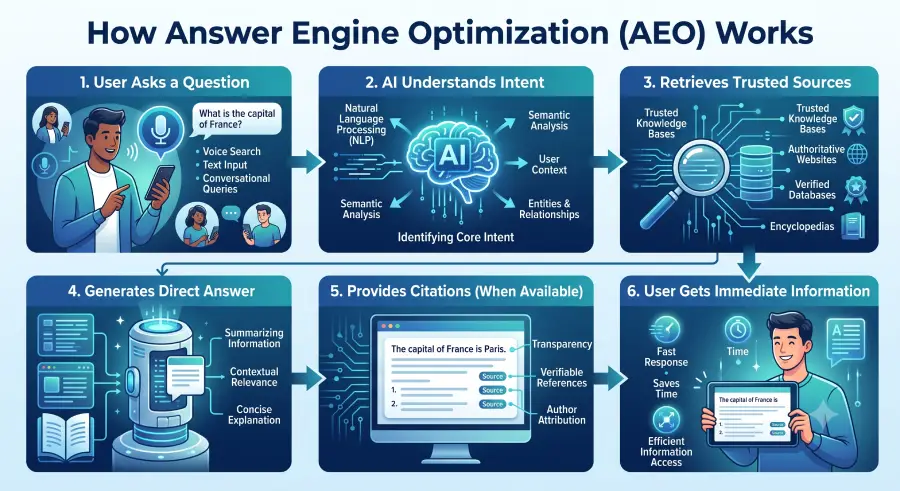
How Answer Engines Actually Work
Unlike a traditional search engine returning a ranked list, answer engines try to understand the question and hand back the most helpful response directly. The general workflow: a user asks a question, the system interprets intent, retrieves relevant information, evaluates the quality of candidate sources, generates a clear answer, and where supported provides citations or links. The target isn’t ranking a page. It’s delivering the best possible answer. For more on the mechanics involved, see How AI Search Works.
How AI Assistants Decide What to Use
A question worth asking directly: how does an AI assistant decide which information to actually use? Every platform runs its own systems, but a few principles show up consistently.
Relevance
Content needs to closely match the actual question. For “What is Answer Engine Optimization?”, a page explaining the definition, purpose, benefits, best practices, examples, and how it differs from SEO and GEO is far more useful to an AI system than a page that mentions AEO only in passing.
Clarity
Answer engines tend to favor content that’s easy to read, well organized, free of unnecessary complexity, and written in natural language. Clear writing is simply easier to summarize accurately.
Authority
A site that consistently publishes quality material on a topic tends to outperform an isolated article covering the same ground. Building an interconnected content hub fundamentals, comparisons, platform guides, statistics provides much stronger topical coverage than any single piece could on its own.
Freshness
Technology moves fast, and answer engines tend to favor content that reflects recent developments, especially in a fast-moving space like AI. Refresh statistics, add new features as they appear, update screenshots, and expand examples on a regular schedule.
Trustworthiness
Accurate information, corrected errors, credible citations, careful explanations of complex topics, and a lack of exaggerated claims all build the kind of trust that both readers and AI systems respond to.
The Role of Search Intent
Every search reflects a goal, and AEO starts with understanding that goal, not just the literal words typed.
Informational: “What is AI Search?” the user wants to learn something.
Navigational: “ChatGPT website” the user wants a specific destination.
Commercial investigation: “Best AI search engine for research” the user is comparing options.
Transactional: “Buy AI writing software” the user is ready to act.
Why Question-Based Headings Work
Many answer engines are built around questions, so it helps to write headings the way people actually ask them: “What Is Answer Engine Optimization?”, “How Does AEO Work?”, “Is AEO Better Than SEO?”, “Does AEO Replace SEO?” that phrasing aligns naturally with conversational search instead of fighting against it.
The Short Answer + Detailed Explanation Technique
Short answer: “Answer Engine Optimization (AEO) is the process of creating content that clearly answers user questions so AI-powered search systems, voice assistants, and answer engines can understand and present it effectively.”
Then expand: why it matters, how it differs from SEO, practical examples, best practices, and common mistakes.
This structure serves the reader who wants a fast answer and the one who wants real depth, without making either group scroll past what they don’t need.
Voice Search and AEO
Voice queries tend to be longer, more conversational, phrased as complete questions, often location-aware, and action-oriented. Instead of “weather Delhi,” someone speaking to an assistant is more likely to ask “what’s the weather like in Delhi this weekend?” Writing naturally and answering full questions directly supports this kind of search by default.
Featured Snippets and Direct Answers
Featured snippets and AI-generated answers aren’t the same thing, but they share a lot of DNA. Content that performs well in both tends to include direct definitions, numbered steps, bullet lists, comparison tables, FAQs, and concise summaries formats that are simply easier to extract information from, whether the extraction is happening by algorithm or by eye.
Structured Data and AEO
Structured data helps a search engine understand your page content more precisely. Worth implementing where relevant: Article, FAQ, Breadcrumb, Organization, Author, and HowTo schema (when the content is instructional). Whatever you add, make sure it accurately reflects the visible content on the page and follows Schema.org guidelines mismatched schema tends to do more harm than good.
What Strong AEO Content Has in Common
- Solves a real user problem
- Provides a direct answer early
- Expands with genuinely useful detail
- Uses descriptive, question-aligned headings
- Includes real examples
- Answers related follow-up questions
- Uses simple, natural language
- Links to supporting resources
- Demonstrates real expertise
- Gets updated regularly
Common AEO Mistakes
Writing for keywords instead of people: Answer the actual question rather than forcing a phrase into every paragraph.
Burying the answer: Don’t make readers scroll through several paragraphs to find it lead with it.
Publishing thin content: A single paragraph rarely satisfies a complex question.
Skipping internal linking: Related articles reinforce topical authority and help readers go deeper.
Letting content go stale: AI technology moves quickly enough that outdated guides lose value fast.
AEO Best Practices That Actually Move the Needle
Understanding the theory is one thing implementation is what actually improves your odds of showing up in AI answers, featured snippets, and voice search results. A condensed, practical set of habits worth building:
Answer the primary question immediately: The first paragraph after any heading should give a clear, concise answer before expanding further.
Use question-based headings: Structure sections around real questions people ask, mirroring how conversational search actually works.
Stick to one primary intent per page: Mixing informational, navigational, and transactional intent on a single page dilutes all of them.
Go deep, not just wide: Cover meaning, benefits, limitations, examples, comparisons, best practices, mistakes, and FAQs not just a definition.
Build real topic clusters: Interconnected articles on one subject demonstrate far more authority than any single piece.
Write the way people actually talk: “How can I optimize my website for AI-powered search?” reads better than a keyword string, and performs better too.
Write for humans first: Helpful, accurate, genuinely engaging content is still the foundation everything else sits on.
Include a real FAQ section: It rounds out coverage and captures related search intent naturally.
Support voice search explicitly: Use complete sentences and natural phrasing, since voice queries tend to be longer and more conversational.
Structure content clearly: H2s, H3s, bullet lists, tables, numbered steps, and summary boxes all help readers find what they need fast.
Use comparison tables where they fit: AEO vs. SEO, GEO vs. AEO, platform vs. platform tables simplify complex comparisons instantly.
Show real experience: Original workflows, screenshots, and lessons learned differentiate your content from generic AI summaries.
Strengthen E-E-A-T: Author information, relevant expertise, accurate references, editorial review, and current dates all build trust.
Keep evergreen content current: Refresh statistics, update screenshots, and expand explanations on a set schedule.
Write descriptive, specific titles: “Answer Engine Optimization (AEO): The Complete Guide to Ranking in AI Answers” beats “Everything About AEO” every time.
Link to genuinely related resources: Internal linking should feel like a natural next step, not an afterthought.
Optimize your images properly: Descriptive filenames, meaningful alt text, relevant captions, reasonable file sizes.
Implement accurate structured data: Article, FAQ, Breadcrumb, Organization, Author, and HowTo schema where genuinely applicable.
Publish original research when you can: Surveys, case studies, and first-hand observations are hard for AI summaries to replicate.
Cite credible sources: Official documentation, academic research, and trusted industry publications build real credibility.
Avoid keyword stuffing: Natural phrasing reads better and performs better than forced repetition.
Prioritize readability: Short paragraphs, plain language, clear transitions, and helpful visuals serve a wider audience.
Anticipate related questions: Covering likely follow-ups mirrors how conversational AI search actually behaves.
Use concrete examples: Abstract concepts land much better with a practical scenario attached.
Track performance over time: Organic traffic, engagement, search queries, internal link usage watch trends, not single data points.
Point readers toward further reading: Related guides at the end of an article keep people engaged with your broader content hub.
Build a recognizable, trustworthy brand: Consistency compounds there’s no real shortcut to it.
Avoid overpromising: Don’t claim guaranteed rankings or AI citations explain what these practices realistically improve instead.
Measure success beyond rankings: User satisfaction, engagement, returning visitors, and topical authority all matter alongside position.
Focus on genuinely helping people: The most durable strategy is still just answering real questions well.
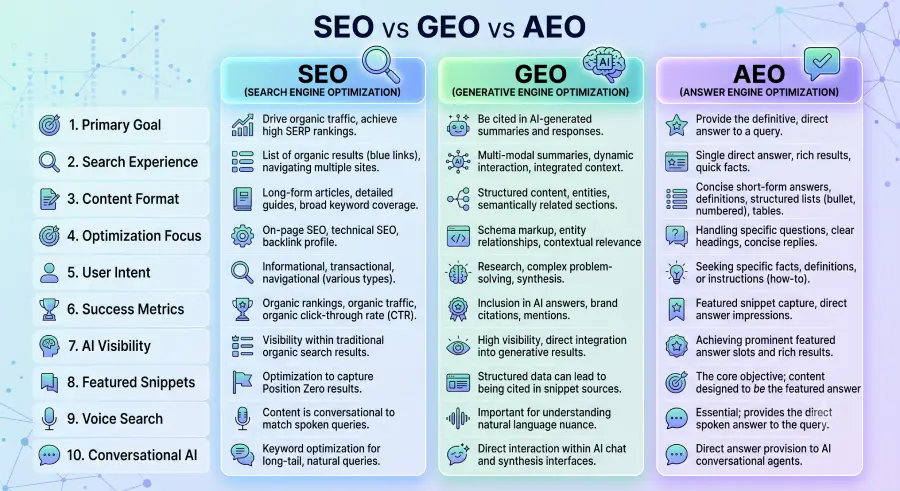
AEO vs. Featured Snippet Optimization
These two get conflated often, but they’re not quite the same thing.
| AEO | Featured Snippet Optimization |
| Optimizes answers for AI-powered search experiences | Optimizes content for Google’s featured snippets |
| Covers conversational search broadly | Focuses on traditional search results |
| Includes voice search and AI assistants | Primarily targets SERPs |
| Encourages comprehensive, answer-focused content | Often emphasizes concise definitions and structured lists |
A well-structured article can realistically support both at once the formatting habits mostly overlap.
Where AEO Is Headed
Answer engines will likely keep getting more sophisticated: deeper conversational AI, better personalization, richer multimodal search across text, images, audio, and video, and tighter integration into everyday productivity tools and browsers. Whatever form that takes, the underlying goal won’t change give people clear, accurate, genuinely helpful answers.
Frequently Asked Questions
What is Answer Engine Optimization?
AEO is the practice of creating content that helps AI-powered search systems, voice assistants, and answer engines understand and deliver accurate answers to user questions.
Is AEO different from SEO?
Yes. SEO focuses on improving webpage visibility in search results; AEO focuses on providing clear, direct answers that AI systems can actually use.
Is AEO replacing SEO?
No. AEO complements traditional SEO rather than replacing it.
How is AEO different from GEO?
AEO emphasizes question-and-answer optimization, while GEO focuses more broadly on helping AI systems understand and reference comprehensive content.
Is voice search part of AEO?
Yes, voice search relies heavily on conversational, answer-focused content, which makes it a core part of AEO.
Does structured data guarantee AI answers?
No. It improves machine readability, but it doesn’t guarantee that content will appear in an AI-generated response.
Can small websites benefit from AEO?
Yes. Smaller publishers can compete effectively by creating focused, high-quality resources that address specific questions well.
Key Takeaways
- AEO is about answering user questions clearly and directly, not just ranking pages
- It complements SEO and GEO rather than replacing either one
- Search intent should drive content structure from the start
- Question-based headings align naturally with how people actually search
- Comprehensive, well-organized content consistently outperforms thin summaries
- Internal linking reinforces topical authority
- E-E-A-T principles still matter, arguably more than before
- Regular updates keep evergreen content genuinely useful
- Real success comes from being useful, not from chasing shortcuts
Conclusion
Answer Engine Optimization reflects a real shift in how publishers need to think about visibility. As AI assistants, voice search, and conversational experiences become the default for more people, the ability to provide clear, trustworthy, well-structured answers matters more every year.
AEO doesn’t replace SEO or GEO it extends both by focusing specifically on how information gets presented, understood, and delivered in answer-first search experiences. Publishing comprehensive guides, keeping internal linking strong, and consistently prioritizing genuinely helpful content is what builds authority across both traditional search and the AI platforms built on top of it.
For the surrounding strategy, see PostDune’s guides on Generative Engine Optimization (GEO), AI Search vs Traditional Search, and AI Search Statistics 2026.