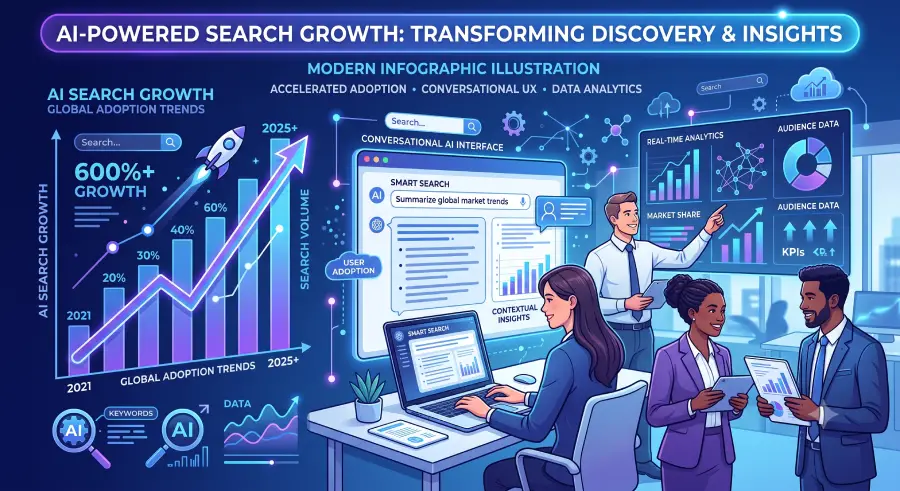
Artificial intelligence is reshaping how people search for information. Instead of typing a short keyword string and browsing a handful of websites, more users are now asking full questions and getting conversational answers directly from an AI assistant.
That shift is opening new opportunities for businesses, publishers, and marketers while quietly upending search habits that have held steady for two decades. If you’re new to the topic, start with What Is AI Search? for the basics of how AI-powered search actually differs from traditional search.
How Big Is the AI Search Market?
The AI search industry has grown substantially over the past few years as organizations adopt generative AI, conversational interfaces, and intelligent enterprise search tools.
According to Grand View Research:
- The global AI search engine market was valued at approximately $16.3 billion in 2024
- It’s projected to reach roughly $18.3 billion in 2026
- Longer-term forecasts put it near $50.9 billion by 2033 a projected CAGR of about 13.6% from 2025 to 2033
A separate analysis from Future Market Insights projects:
- The AI search engine market reaching roughly $21.1 billion by the end of 2026
- Growth toward $78.2 billion by 2036, at a projected CAGR near 14%
Different research firms use different methodologies, which explains the variation but the direction is consistent across all of them: strong, sustained growth driven by enterprise adoption, better natural language processing, and rising demand for conversational search.
Why Is AI Search Growing So Quickly?
A Genuinely Better User Experience
Traditional search often means searching multiple times, comparing several websites, reading through lengthy articles, and stitching the answer together yourself. AI search collapses most of that effort into a single synthesized, conversational response.
Natural Language, Not Just Keywords
People are increasingly comfortable asking something like “what’s the best laptop for programming under $1,500?” or “create a three-month SEO strategy for a new SaaS company” full requests an AI assistant can interpret for intent, not just match on keywords.
A Genuine Productivity Boost
Professionals now lean on AI search well beyond simple lookup summarizing reports, drafting emails, building presentations, analyzing spreadsheets, brainstorming, generating code, and planning campaigns. That expands AI search from information retrieval into actual task completion.
Rapid Enterprise Adoption
74% of frontline white-collar employees report using AI frequently, according to recent workplace research, and organizations with a clearly defined AI strategy are more likely to see measurable business impact than those simply handing out access to AI tools without a plan.
Top AI Search Statistics for 2026
Market Value
$18.3 billion the estimated global AI search engine market size in 2026 (Grand View Research).
Long-Term Growth
$50 billion+ the market’s projected size by 2033, reflecting sustained, long-term investment in AI-driven search technology.
Enterprise Search Growth
The enterprise search market is expanding in parallel, as organizations look for better ways to surface internal knowledge:
- An estimated $6.39 billion market size in 2026
- Forecast to reach roughly $12.76 billion by 2034
AI User Adoption Statistics
AI assistants have become part of daily workflows for a genuinely large number of people:
- ChatGPT reports 900 million+ weekly active users, according to platform figures summarized by industry analysts
- Perplexity AI processes 100 million+ queries per week
- Analysts expect continued growth in AI-assisted search usage through the rest of 2026
These numbers point to conversational AI settling in alongside traditional search engines, not replacing them outright at least not yet.
Zero-Click Search Statistics
One of the most consequential trends for publishers is the growth of zero-click searches where a user gets their answer directly on the results page and never visits another website.
- Around 65% of Google searches end without a click, per recent industry compilations
- Mobile zero-click rates run even higher as much as 77% in some studies
- AI-generated search features are associated with lower click-through rates for traditional organic listings
For publishers, this reinforces a real shift in what success looks like: being useful enough to get referenced or cited by an AI system matters just as much as ranking highly. For the full picture, see The Rise of Zero-Click Searches: What It Means for Websites.
AI Search Is Reshaping SEO
Traditional SEO success used to come down to ranking #1, increasing clicks, and growing page views. Modern AI search optimization adds a parallel set of goals: clear, direct answers, well-structured content, real topical authority, trustworthy sourcing, strong internal linking, and demonstrated expertise.
That’s exactly why so many marketers are layering Generative Engine Optimization (GEO) and Answer Engine Optimization (AEO) on top of traditional SEO. Recent industry commentary keeps circling back to the same point: becoming a source AI systems can actually cite now matters as much as chasing blue-link rankings.
Why These Statistics Matter for Publishers
The data points to a simple reality: AI search isn’t an emerging trend anymore it’s already a meaningful part of how people find information and get things done. For website owners and content creators, that means:
- Building real topical authority instead of scattering isolated articles
- Creating original, experience-based content instead of generic summaries
- Using structured headings and leading with concise answers
- Strengthening internal linking across related content
- Keeping evergreen resources genuinely current
AI Search User Behavior Statistics for 2026
AI-powered search is changing not just where people search but how they search. Instead of a few keywords, users increasingly ask complete questions, refine the answer through follow-ups, and expect the assistant to help them finish a task not just hand back a webpage. For more on this shift, see How AI Is Changing User Search Behavior in 2026.
How the Search Process Has Changed
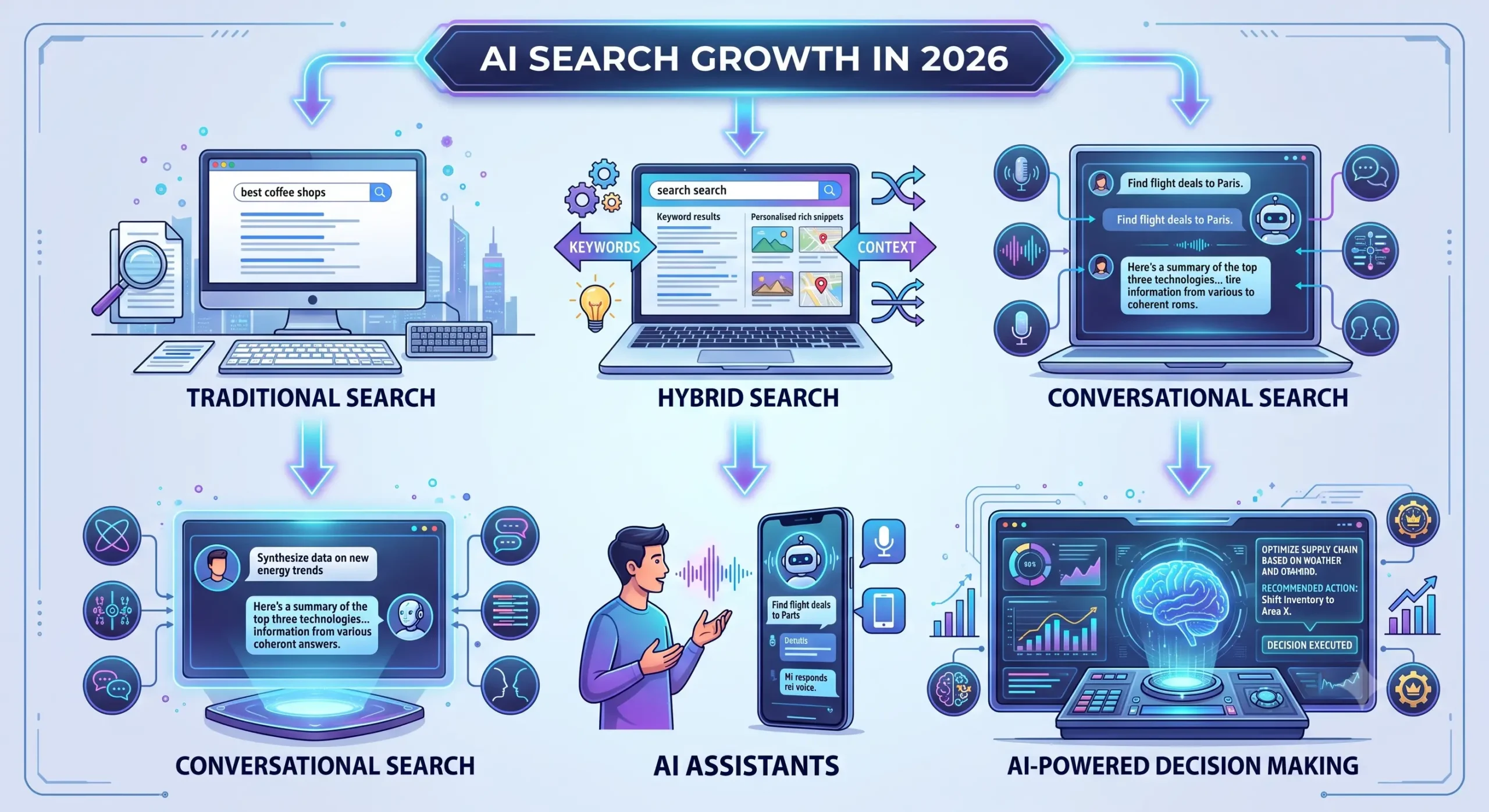
Traditional: search query → browse multiple results → open several sites → compare → decide.
AI-powered: ask the assistant → get a direct answer → ask a follow-up → refine → task complete.
Instead of re-running the same search with slightly different keywords, people can just keep the conversation going until they have what they need.
Conversational Queries Are Becoming the Norm
Instead of searching “best CRM software,” a lot of users now ask something like “which CRM is best for a small business with fewer than 20 employees and a limited budget?” AI assistants can work with that level of context directly.
Follow-Up Questions Are Cutting Down Repeat Searches
A single conversation can now replace what used to be four or five separate searches “explain SEO” → “explain it for beginners” → “give me a 90-day roadmap” → “turn that into a weekly checklist” all without starting over.
Users Expect Actionable Output, Not Just Information
People increasingly expect AI to write emails, summarize reports, build presentations, create marketing plans, explain code, compare products, draft outlines, and generate ideas. The expectation has shifted from finding information to actually getting something done.
How Many People Actually Use AI Search Daily?
Per Deloitte’s 2026 technology predictions:
- About 29% of adults in developed markets are expected to use search experiences that include generative AI summaries every day
- Daily use of AI features built directly into search is forecast to be roughly three times more common than use of standalone generative AI apps
That suggests most people will keep encountering AI through the search engines they already use, rather than switching over to separate AI apps.
AI Is Becoming Part of Product Discovery
A 2026 Forrester survey found:
- 26% of U.S. online adults reported using ChatGPT in the past month to research a product they were considering buying
- Traditional platforms still dominate product discovery overall, but answer engines are steadily gaining ground
For businesses, that means product pages, comparison guides, and buying advice need to be built for AI-generated answers, not just traditional search. See How ChatGPT Is Influencing Consumer Search Decisions for more on this specific trend.
Enterprise AI Adoption Statistics
74% of frontline white-collar employees report using AI frequently, and organizations with a clearly defined AI strategy are significantly more likely to report measurable business impact than those that simply hand out access without direction. Common enterprise use cases include:
- Customer support
- Internal knowledge search
- Content creation
- Coding assistance
- Document summarization
- Workflow automation
- Meeting preparation
- Data analysis
This kind of enterprise adoption is a real driver behind the broader demand for AI-powered search technology.
Zero-Click Search Continues to Rise
SparkToro research found:
- 01% of Google searches in the U.S. ended without a click during the first four months of 2026
- The share of searches leading to a click has dropped noticeably compared with 2024
For website owners, this keeps reinforcing the same point: content that AI systems can reference and cite matters more than content built purely to bait a click. Read more in The Rise of Zero-Click Searches.
How AI Is Changing SEO Measurement
SEO professionals are also rethinking how they measure success. Rankings, clicks, and organic traffic haven’t gone away, but many marketers are now also tracking AI visibility, AI citations, brand mentions, topical authority, structured content, and answer quality. Google has begun rolling out Search Console reporting for generative AI search features, which is itself a signal of how much weight AI visibility now carries for publishers.
What These Trends Mean for Content Creators
Build Comprehensive Topic Clusters
Instead of isolated articles, build interconnected resources around a subject. A strong AI Search hub, for example, connects foundational guides on What Is AI Search?, How AI Search Works, Best AI Search Engines in 2026, and AI Search vs Traditional Search with platform-specific and optimization guides reinforcing topical authority across the whole cluster instead of any single page.
Publish Original Insight, Not Generic Summaries
AI systems increasingly favor content built on first-hand experience, real expert analysis, unique research, practical examples, and genuine case studies. Generic summaries that repeat what’s already widely available offer very little differentiation.
Structure Content for Both People and AI
Clear headings, concise answers, tables, bullet points, FAQs, and logical organization make content easier to interpret for a human skimming it and for an AI system parsing it.
Build Real Trust
As AI-generated answers become more common, trust becomes one of the biggest differentiators available. Accurate information, credible references, regular updates, transparent authorship, and genuinely clear explanations all contribute and research consistently shows trust is one of the biggest factors shaping AI search adoption in the first place.
Where AI Search Is Headed: 2026–2030
AI is expected to keep reshaping how people search, discover information, and interact with digital content. The exact pace is uncertain, but several trends are worth watching closely.
1. AI Search Becomes the Default, Not the Exception
Rather than sitting off to the side as a separate tool, AI is being built directly into search engines, browsers, productivity software, and mobile devices. AI-generated summaries and conversational interfaces are becoming a normal part of searching, which means publishers need to optimize for AI-generated responses alongside traditional rankings.
2. Queries Keep Getting More Conversational
People are moving from “best DSLR camera” toward something closer to “I’m a beginner photographer with a $1,000 budget which camera should I buy for travel and wildlife photography?” As AI assistants get more capable, expect longer, more natural queries to become the norm rather than the exception.
3. AI Agents Start Completing Tasks, Not Just Answering Questions
The next generation of AI systems is expected to move past answering questions and toward handling full workflows planning trips, booking appointments, comparing products, drafting reports, managing calendars, building presentations, automating repetitive business tasks. That could meaningfully change how people interact with websites and online services generally.
4. Quality Starts Beating Volume, for Real
Publishing large volumes of generic articles is becoming a weaker strategy. What’s working instead: original research, expert insight, real-world experience, case studies, comprehensive topic coverage, and genuinely helpful multimedia the kind of content that’s more likely to actually get cited or recommended by an AI system.
5. AI Search Optimization Keeps Maturing
Traditional SEO remains the foundation, but publishers are layering on complementary strategies Generative Engine Optimization (GEO), Answer Engine Optimization (AEO), entity optimization, structured data, and topical authority building. None of these replace SEO they expand how content can be discovered across AI-powered environments.
What This Means for Website Owners
Whether you run a personal blog, a business site, or a large publishing platform, the direction of travel is the same: quality, expertise, and organization matter more than raw output.
- Build comprehensive topic clusters instead of isolated articles
- Answer user questions directly and clearly
- Publish original insights and practical examples
- Keep evergreen content genuinely updated
- Strengthen internal linking between related articles
- Use descriptive headings and structured formatting
- Add relevant schema markup where it actually applies
Key AI Search Statistics at a Glance
| Category | Key Insight |
| Market Growth | AI search is projected to keep growing rapidly through the next decade |
| User Behavior | More users are asking conversational, task-oriented questions |
| Enterprise Adoption | Organizations are steadily integrating AI into everyday workflows |
| Zero-Click Searches | A growing share of searches end without a click to another website |
| Content Strategy | Comprehensive, trustworthy, experience-based content is becoming more valuable |
| SEO | Traditional SEO is expanding to include AI visibility and answer optimization |
Frequently Asked Questions
What is AI search?
AI search uses artificial intelligence to understand natural language, interpret intent, and generate a direct, helpful response instead of just returning a list of webpages.
Why are AI search tools becoming so popular?
They save time, give direct answers, summarize complex information, generate content, and help people complete tasks through a natural, conversational interaction.
Is traditional search disappearing?
No. Traditional search engines remain essential for navigation, breaking news, academic research, and finding specific sites AI-powered search is becoming a common complement, not a full replacement.
Which industries are adopting AI search fastest?
Education, healthcare, finance, marketing, software development, customer support, e-commerce, legal services, and media all show significant adoption.
How should website owners prepare?
Focus on original, genuinely helpful content, real demonstrated expertise, interconnected topic clusters, accurate and current information, and solid technical SEO with structured data.
Key Takeaways
- AI-powered search is fundamentally changing how people discover and interact with information online
- Conversational, task-oriented queries are becoming the norm rather than the exception
- Businesses are rapidly integrating AI into research, productivity, and customer support workflows
- Publishers should prioritize topical authority and content quality over sheer content volume
- Traditional SEO remains valuable, but AI-focused optimization is becoming a real necessity alongside it
- Regularly updated, well-structured, trustworthy content is best positioned for long-term visibility
Conclusion
AI-powered search has moved well past the “niche technology” stage it’s becoming a core part of how people find information, do research, and get everyday tasks done. As conversational interfaces and generative AI keep maturing, user expectations are shifting from simply finding information to actually getting meaningful help.
For businesses, marketers, and publishers, that shift cuts both ways. Lower click-through rates from traditional search may call for new strategies, but there’s also real upside: more potential to reach audiences through content that’s authoritative, well-structured, and genuinely helpful.
The numbers in this guide point to one consistent theme: success going forward depends on trust, expertise, originality, and comprehensive topic coverage. Sites that consistently provide accurate information, answer real questions, and maintain strong internal linking will stay visible across both traditional search and the AI-powered experiences increasingly built on top of it.