On Amazon’s busiest shopping day of 2025, something notable happened: traffic arriving from AI shopping assistants jumped 3,300% compared to Prime Day the year before. Not from Google. Not from social media. Overwhelmingly from ChatGPT.
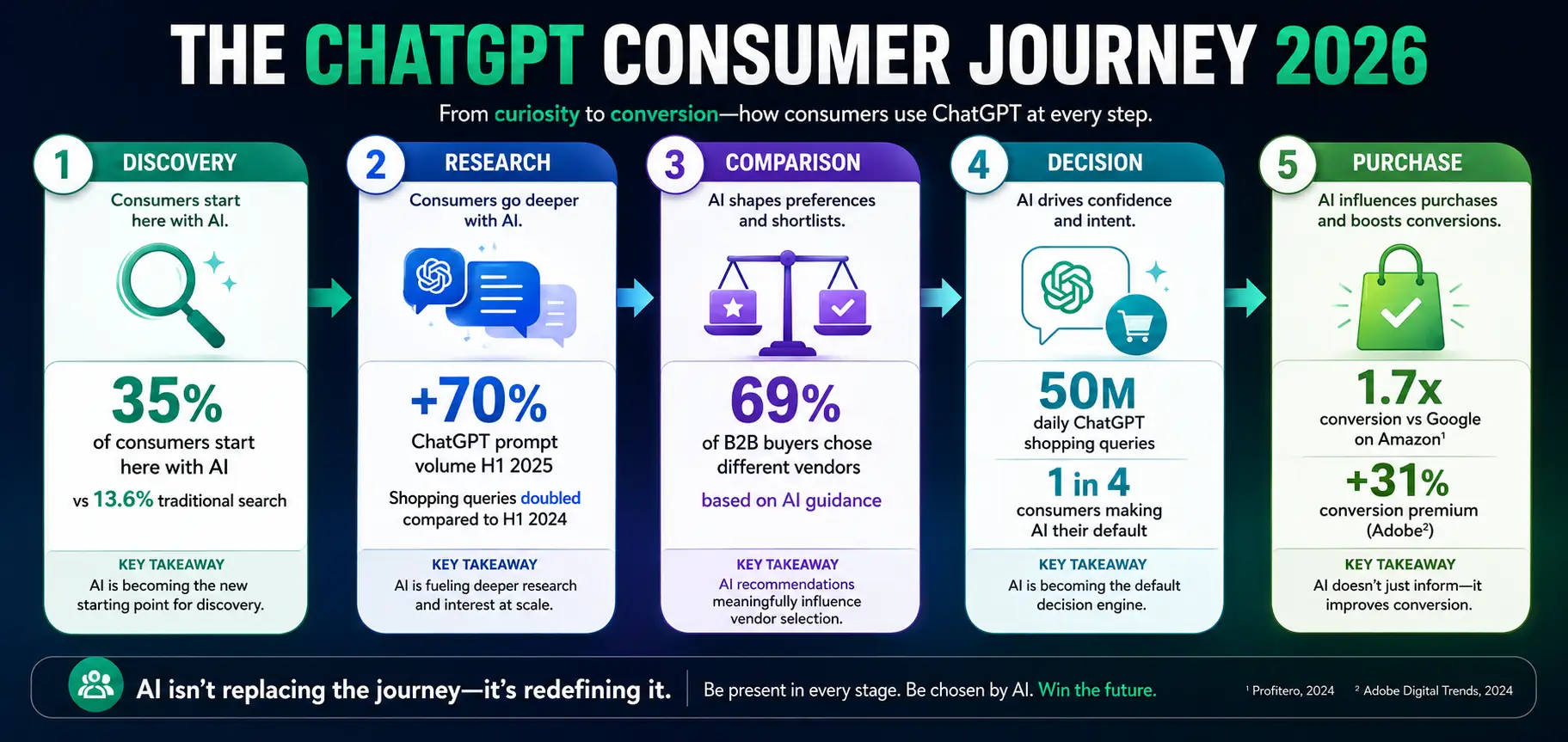
That single number captures a shift that’s become impossible to ignore. ChatGPT has moved from novelty to a genuine driver of how people discover, research, and decide what to buy. A product that didn’t exist four years ago became the most downloaded mobile app globally in 2025, surpassing TikTok and Instagram with roughly 770 million installs. Its weekly active users reached 900 million by February 2026 up 125% from a year earlier. People now send an estimated 2.5 billion queries through ChatGPT every day, and roughly 50 million of those are shopping-related.
The ripple effects touch nearly every industry. According to First Page Sage’s May 2026 research, 47% of travel and hospitality customers now use ChatGPT somewhere in their purchasing journey, followed by retail (36%), IT services (34%), and healthcare (29%). Forrester’s 2026 Buyers’ Journey Survey, covering nearly 18,000 global buyers, found that 94% of B2B decision-makers used a large language model in their 2025 purchase process and twice as many named generative AI as their most meaningful research source, ahead of any other channel.
For marketers, SEO professionals, e-commerce teams, and brand managers, this isn’t a future problem to plan for it’s already reshaping brand discovery, purchase journeys, and competitive visibility in ways traditional search optimization alone can’t fully address. For the broader behavioral context, see PostDune’s How AI Is Changing User Search Behavior in 2026.
This guide breaks down how ChatGPT is actually influencing consumer search behavior, what the data shows, and how businesses can adapt before their competitors do.
How Consumer Search Behavior Got Here
Understanding the scale of what ChatGPT has triggered helps to trace how digital search behavior evolved beforehand each earlier shift quietly built the conditions for this one.
Traditional Search Engines
From the early 2000s through the mid-2010s, consumer search meant Google. People typed keyword phrases, scanned a ranked list of blue links, clicked through several sites, and pieced together their own answer. It worked, but it put the burden of synthesis entirely on the user reconciling conflicting information across sources took real research and personal judgment.
Social Media Search
Social platforms especially Instagram, TikTok, YouTube, and Pinterest introduced a discovery-first search model built around visual content, peer recommendations, and algorithmic curation. For product discovery specifically, this created an entirely new pathway where search leaned entertainment-first rather than information-first. Gen Z in particular shifted a lot of discovery behavior to TikTok, bypassing Google entirely for product recommendations and reviews.
Voice Search
Voice search first through Siri and Alexa, later Google Assistant trained people to phrase queries in natural language. Instead of typing “best running shoes under $100,” people started saying “what are the best running shoes under a hundred dollars?” That shift toward conversational phrasing quietly built the linguistic groundwork that made chatbot interfaces feel immediately intuitive when they arrived.
AI-Powered Search Assistants
ChatGPT and its competitors Claude, Gemini, Perplexity, Microsoft Copilot represent the convergence of everything before them: the breadth of Google’s information access, the natural-language interface of voice search, the personalization of social recommendation models, and a synthesis capability none of the earlier systems could match. The result doesn’t just return links it holds a conversation, synthesizes a conclusion, and remembers context across a multi-turn research session. That’s why this shift has moved faster than any previous search evolution.
Why Consumers Are Turning to ChatGPT
Faster Answers
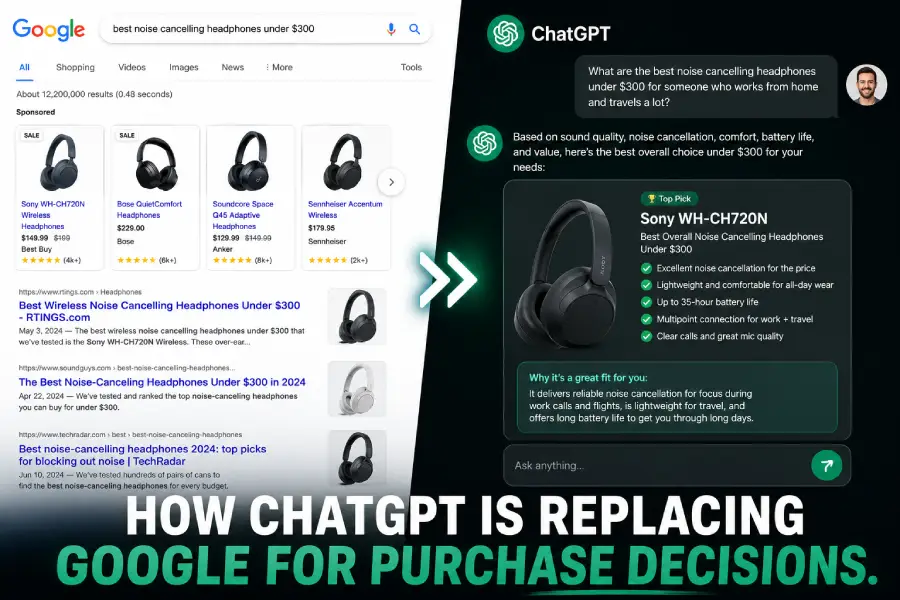
The most basic driver here is speed not page load time, but time to actual insight. Ask ChatGPT “what’s the best noise-canceling headphone for working from home under $200 that pairs well with a Mac?” and you get a tailored recommendation in seconds. The Google equivalent means opening several review sites, wading through affiliate content, weighing conflicting opinions, and making a judgment call with limited confidence.
Compressing a multi-step research process into one exchange is ChatGPT’s most compelling value proposition for purchase decisions. Bain & Company’s behavioral research found ChatGPT prompt volume grew 70% in just the first half of 2025, with shopping-related queries doubling in six months clear evidence people are catching onto the time savings for purchase decisions specifically.
Genuinely Personalized Recommendations
Traditional search returns the same results for the same query no matter who’s asking. ChatGPT adapts to whatever context is provided a parent shopping for a teenager’s school laptop gets a different answer than a developer shopping for their own workstation, even typing the identical “best laptop 2026.” Folding in budget, use case, existing ecosystem, and personal preference turns a generic list into something that actually feels tailored.
McKinsey’s October 2025 consumer research found roughly 50% of consumers across every demographic including Baby Boomers now intentionally use AI recommendations for purchases. Personalization is consistently cited as a primary reason for adopting it, across every age group.
Genuinely Natural Conversations
The old friction of translating a human question into keyword syntax just disappears with conversational AI. People talk to ChatGPT the way they’d talk to a knowledgeable friend no need to guess which keywords will surface the right content.
This is especially powerful for complex, multi-part questions: “I’m planning a honeymoon to Southeast Asia in March, we love food and culture more than beaches, our budget is around $8,000 all-in where should we go and what should we avoid?” That’s essentially unsearchable in keyword terms. For ChatGPT, it’s just a natural opening to a useful conversation.
Real Time Savings
AI-assisted buying compresses research from hours into minutes. Research from the Nuremberg Institute for Market Decisions, covering 1,503 US consumers, found ChatGPT users completed product-selection tasks significantly faster than Google users but with a notable trade-off: they trusted AI-generated recommendations without much further verification, while Google users clicked through multiple sources to confirm their choice. The time savings are real; the trust dynamic carries its own risk, covered later in this guide.
A Genuine Research Partner
ChatGPT has become more research partner than search tool. For significant purchases a car, an appliance, enterprise software, even a medical decision people use it for iterative, multi-turn research that surfaces considerations they hadn’t thought of and helps structure the decision itself. G2’s April 2026 Answer Economy report, covering 1,076 B2B software buyers, found 71% use ChatGPT or a similar tool somewhere in their research, and 69% ended up choosing a different vendor than originally planned based on what the AI recommended.
Faster Product Comparisons
Comparison shopping is one of ChatGPT’s highest-value use cases. Instead of juggling seven browser tabs to compare specs, prices, and reviews, people just ask ChatGPT to compare products across whatever criteria matters to them. Shopping queries grew from 7.8% to 9.8% of all ChatGPT queries in the first half of 2025 alone a 25% category gain on top of a 70% overall usage increase, per Bain & Company’s Sensor Tower analysis.
Simplified Decision-Making
AI-assisted buying reduces the cognitive load of too many options and no clear framework for evaluating them. For complex or high-stakes categories, being able to ask ChatGPT to “help me think through this” and get a structured response back has proven genuinely compelling to people who previously relied on personal advisors, review sites, or word of mouth which is exactly why adoption skews highest in travel, technology, healthcare, and financial services, where complexity and the cost of a wrong choice are both high.
How ChatGPT Shapes Consumer Decisions, by Category
Product Research
ChatGPT has become a standard starting point for research on considered purchases. Adobe Digital Insights’ January 2026 report found AI-driven traffic to US retail sites grew 693% year-over-year during the 2025 holiday season, converting 31% better than non-AI traffic. By Q1 2026, AI-driven retail traffic was up 393% year-over-year. These aren’t experimental browsers they’re high-intent shoppers who’ve already done their research inside ChatGPT and arrive ready to buy.
During Black Friday 2025, shoppers arriving from ChatGPT converted on Amazon at 1.7x the rate of Google-referred shoppers, with 11% higher average order values the clearest commercial signal yet that this traffic is qualitatively different and more valuable than typical organic search traffic.
Brand Discovery
ChatGPT is becoming a genuine top-of-funnel discovery channel that directly competes with Google. G2’s April 2026 data found a third of B2B buyers purchased from a vendor they’d never heard of before ChatGPT surfaced it during their research. For brands that have historically leaned on organic rankings for discovery, that’s a significant finding being absent from AI recommendations now means missing the consideration set entirely, regardless of where you rank on Google.
Similarweb’s 2026 AI Brand Visibility Report backs this up: 35% of consumers use AI tools at the initial discovery stage of research, compared to just 13.6% using traditional search at that same stage. ChatGPT is genuinely winning the discovery moment.
Service Recommendations
For services consulting, SaaS, professional services, home improvement ChatGPT functions as a referral system operating at scale. People ask “what’s the best project management tool for a remote team of 15?” and get categorized, opinionated answers that used to require real digging across comparison platforms like G2 or Capterra.
SE Ranking’s AI citation research found brands with strong profiles on G2, Capterra, and Trustpilot earn 3x more ChatGPT citations than those without meaning third-party review presence now directly shapes AI recommendations in a way traditional SEO alone doesn’t fully cover.
Travel Planning
Travel is the highest-impact category by economic value. First Page Sage’s May 2026 research puts 47% of travel and hospitality customers now incorporating ChatGPT into their purchasing journey representing an estimated $1.48 trillion in economic activity. People use it to research destinations, build itineraries, compare flights and hotels, check visa requirements, and assess seasonal conditions, compressing what used to be days of research into a single conversation.
Travel fits this model especially well: decisions involve many variables (dates, budget, companions, interests), carry real stakes (significant spend), and benefit far more from synthesis than from fifteen tabs to evaluate independently.
Software Selection
B2B software shows some of the most dramatic shifts of any category. Forrester’s 2026 survey found 94% of B2B decision-makers used an LLM in their 2025 software purchase process, naming conversational AI as their most meaningful research source at twice the rate of any other channel including analyst reports, vendor sites, or peer recommendations.
For software vendors, the implication is stark: buyers increasingly arrive at sales conversations with an AI-generated shortlist, having already eliminated competitors ChatGPT simply didn’t mention. 6sense’s 2026 B2B Buyer Experience Report found buyers complete roughly 70% of their decision journey before ever contacting a vendor and for software specifically, a lot of that now happens inside ChatGPT.
Educational Choices
Choosing courses, universities, or certification programs is a growing category here too. People use ChatGPT to weigh the ROI of different paths, compare program structures, check accreditation and employer recognition, and map out the most efficient route to a specific career goal. Education-related queries grew notably in the first half of 2025, helped along by GPT-5’s improved tutoring capability.
Financial Research
Financial queries are among the fastest-growing categories, with real implications for financial service providers. People use ChatGPT to understand products like mortgages and insurance, compare providers, interpret documents, and sketch out planning strategies. Bain & Company’s Sensor Tower data found healthcare and financial services among the strongest-growing prompt categories in H1 2025.
Worth flagging clearly: financial queries raise real accuracy concerns. ChatGPT isn’t a licensed financial advisor, and its answers can be imprecise or outdated on specific product terms and rates a risk covered further in the challenges section below.
Healthcare Information Searches
Healthcare is the second-fastest-growing category after travel, with 29% of healthcare consumers incorporating ChatGPT into their patient journey (First Page Sage, May 2026). People ask it to interpret test results, understand treatment options, compare medications, and identify specialists. At GPT-5’s August 2025 launch, OpenAI specifically highlighted improved healthcare capability, including a 1.6% factual error rate on hard medical questions a real improvement over earlier versions.
Healthcare carries the highest stakes of any category here. The potential for harmful misinformation makes professional verification essential a point OpenAI and healthcare regulators both consistently emphasize. For publishers in this space, ChatGPT as a patient research tool is both a major disruption to informational content traffic and a genuine opportunity for citation from authoritative medical sources.
ChatGPT vs. Traditional Search Engines
| Factor | ChatGPT | Traditional Search |
| User Experience | Conversational; synthesized answers; no click required | Link-based results page; user evaluates and clicks through |
| Speed to Insight | Seconds for a complete, synthesized answer | Minutes across multiple site visits |
| Personalization | High; adapts to stated context and expertise level | Low; location and browsing history only |
| Context Awareness | Full session memory across follow-ups | Query-by-query; no cross-query context |
| Product Discovery | Strong for complex, research-heavy decisions | Strong for navigational and transactional queries |
| Research Efficiency | Compresses multi-step research into one conversation | Requires manual synthesis across sources |
| Source Transparency | Improving, but inconsistent by default | High; source URL visible before clicking |
| Best For | Complex research, comparison, planning | Navigation, transactions, breaking news, local search |
The ChatGPT-vs-Google dynamic isn’t really a binary competition it’s a functional split by query type. ChatGPT consistently wins for research-heavy, multi-variable decisions where synthesis is the point. Traditional search wins for navigational intent (finding a specific site) and transactional intent (completing a specific purchase). For most people, the practical reality is a dual-tool workflow: ChatGPT for research and comparison, Google for execution and navigation. For businesses, that means both traditional SEO and AI visibility need attention being absent from either creates a real blind spot in discoverability.
AI Recommendations and Consumer Trust
Why People Trust AI Recommendations
The NIM/Vorarlberg University study of 1,503 US consumers revealed a striking pattern: ChatGPT users trusted AI-generated recommendations without much further verification, at notably higher rates than Google users, who tended to click through multiple sources before settling on a conclusion. A few things drive that: the professional, authoritative tone of AI responses; the apparent comprehensiveness of a synthesized answer; the absence of visible ads; and the conversational, almost personal feel of the interaction.
Gen Z shows particularly high trust metrics here 23% trust AI product recommendations more than human ones, and 83% find AI chatbots useful for shopping (PayPal 2025 Holiday Shopping Survey / IESE research). Among daily AI users, that trust translates directly into behavior: 70% had already tried AI shopping in 2025, spending an average of $540 across nine transactions.
Real Benefits of AI-Assisted Decisions
AI-assisted buying delivers genuine value: faster time to a confident decision, access to synthesized expertise without needing personal expertise, follow-up questions without starting over, 24/7 availability, and freedom from the commercial bias baked into a lot of traditional search results. For complex categories technology, finance, healthcare, travel this can meaningfully improve decision quality, not just speed.
The Risk of Over-Reliance
The same NIM research that documented ChatGPT’s speed advantage flagged a real risk: people who trusted AI recommendations without verifying them made decisions just as fast, but potentially lower quality, than people who cross-checked multiple sources. When the AI is right, that’s a pure efficiency gain. When it’s wrong or outdated, uncritical trust becomes a real liability the same risk that shows up in professional contexts: confidence without verification.
The Transparency Gap
Conversational AI platforms face a real structural limitation: people generally can’t see which sources informed a given recommendation, what criteria were applied, or whether any commercial relationship shaped the output. Unlike Google, where the source URL is visible before you even click, ChatGPT’s synthesis process is largely opaque a genuinely new category of risk that traditional search doesn’t carry.
OpenAI is actively expanding citation behavior here: between March and June 2025, click-throughs from ChatGPT tripled (from roughly 100,000 to 300,000 per month), with average click-through rates jumping from 2.2% to 5.7% as OpenAI added more live links to answers. That’s a real, positive direction but the gap versus traditional search transparency remains significant.
Bias and Recommendation Quality
AI recommendations can perpetuate the biases baked into their training data. Systems trained mostly on English-language web content can systematically underrepresent brands and products from non-English-speaking markets. Popular, frequently-mentioned brands tend to get recommended more than newer or niche alternatives, reinforcing existing market concentration in ways that don’t always serve individual needs. Recommendation quality also varies a lot by category well-documented, established products get more accurate treatment than cutting-edge, recently released, or highly specialized ones.
ChatGPT’s Impact on E-Commerce and Online Shopping
Product Discovery
ChatGPT is reshaping e-commerce product discovery faster than any previous channel shift. On Prime Day 2025, Amazon saw 3,300% more traffic from AI shopping assistants than the year before. During Black Friday 2025, AI influenced over $14 billion in online sales (Reuters). AI-referred traffic converted 31% better than non-AI traffic that holiday season, with Adobe tracking 56% of US consumers using generative AI during that period up from just 11% a year earlier. See PostDune’s Why Users Are Switching from Google Search to AI Chatbots for the fuller behavioral context.
ChatGPT’s shopping research mode, launched by OpenAI in November 2025, lets people search for products with rich visual cards, pricing comparisons, and direct merchant links a structured discovery experience competing directly with Google Shopping and Amazon search.
Product Comparisons
Comparison shopping is the highest-frequency behavior in the ChatGPT shopping journey comparing price, features, reviews, warranty terms, and reputation in one session instead of a dozen open tabs. It performs especially well for comparison-heavy categories: electronics, beauty, home and garden, kitchen appliances, outdoor gear. For these categories, research done inside ChatGPT is effectively replacing the multi-site comparison process that used to drive real traffic to comparison sites and affiliate blogs.
Shopping Recommendations
ChatGPT has become a meaningful awareness channel for brands people wouldn’t otherwise encounter. As noted, a third of B2B buyers purchased from a previously unknown vendor based on ChatGPT’s guidance (G2, April 2026). Among consumers, roughly two-thirds of younger shoppers use ChatGPT for product recommendations, and nearly 60% are replacing traditional search with generative AI for shopping research specifically (Capgemini research cited by Salesforce). For brands with strong AI visibility, that’s a genuinely powerful new discovery channel for brands without it, a real coverage gap.
Purchase Decision Support
ChatGPT also functions as a decision coach at the final stage of the purchase journey. Someone who’s narrowed things down to two or three options might ask “I’ve narrowed it down to X and Y which should I choose given that I primarily need it for Z?” That final-mile influence means AI visibility matters not just for awareness but for the actual conversion moment.
Reduced Search Friction
AI-assisted buying strips out a lot of the friction in traditional e-commerce search parsing multiple results, navigating cluttered comparison sites, filtering sponsored content, reconciling inconsistent information across sources. That’s exactly why AI-referred visitors consistently arrive with meaningfully higher purchase intent than typical search visitors.
A Restructured Customer Journey
6sense’s 2026 research describes the traditional awareness-consideration-decision funnel giving way to a fundamentally nonlinear, AI-mediated process with 70% of the decision journey typically complete before a consumer ever makes first contact with a vendor. ChatGPT isn’t just influencing individual steps in that journey anymore; it’s restructuring the journey itself, which means marketing investment increasingly needs to shift upstream toward AI citation readiness.
Statistics and Data on AI Consumer Search Trends
ChatGPT Growth and Reach
| Metric | Statistic | Source |
| ChatGPT weekly active users (Feb 2026) | 900 million | OpenAI |
| ChatGPT WAU growth (Feb 2025 → 2026) | +125% (400M → 900M) | OpenAI |
| Daily ChatGPT queries (July 2025) | 2.5 billion | OpenAI |
| ChatGPT daily shopping queries | 50 million (~2% of all queries) | OpenAI Economic Research |
| ChatGPT prompt volume growth (H1 2025) | +70% | Bain/Sensor Tower |
| Shopping query growth on ChatGPT (H1 2025) | +25% category share | Bain/Sensor Tower |
| ChatGPT click-through rate increase (Mar–Jun 2025) | 2.2% → 5.7% | Bain/Sensor Tower |
| Most downloaded app globally (2025) | #1 (surpassed TikTok, Instagram) | AppMagic, 2025 |
| ChatGPT AI chatbot market share (April 2026) | 76.85% | StatCounter |
Consumer Adoption and Behavior
| Metric | Statistic | Source |
| Consumers planning AI chatbot shopping in 2026 | 64% | PartnerCentric, 1,004 consumers |
| Consumers who used GenAI for shopping | 61% | DemandSage, 2025 |
| Global consumers using AI for shopping (6 months) | 77.6% | Search Engine Land, April 2026 |
| US consumers using GenAI during 2025 holidays | 56% (up from 11% in 2024) | Adobe Digital Insights |
| Daily AI users who tried AI shopping in 2025 | 70% (avg. $540, 9 transactions) | PartnerCentric |
| Consumers planning AI as default shopping method | 1 in 4 (25%) | PartnerCentric |
| Gen Z who used AI for shopping in past year | 61% | PayPal 2025 Holiday Survey |
| Gen Z preferring AI over search for product research | 33% (vs 37% traditional) | Capgemini |
| Millennials using or planning to use AI shopping | 58% | Capital One Shopping Research |
| All demographics using AI for purchase decisions | ~50% | McKinsey, October 2025 |
B2B Purchase Influence
| Metric | Statistic | Source |
| B2B decision-makers who used an LLM in 2025 purchases | 94% | Forrester 2026 Buyers’ Journey Survey |
| B2B software buyers starting research in AI chatbot | 51% (more than Google) | G2 Answer Economy, April 2026 |
| B2B buyers using AI somewhere in research process | 71% | G2, April 2026 |
| B2B buyers choosing a different vendor based on AI | 69% | G2, April 2026 |
| B2B buyers purchasing from a previously unknown brand | 1 in 3 | G2, April 2026 |
| B2B buyers completing journey before vendor contact | ~70% | 6sense, 2026 |
Traffic and Revenue Impact
| Metric | Statistic | Source |
| AI referral traffic to US retail (YoY, Holiday 2025) | +693% | Adobe Digital Insights |
| AI referral traffic to US retail (Q1 2026 YoY) | +393% | Adobe Analytics |
| AI-referred traffic conversion premium (Holiday 2025) | +31% vs non-AI | Adobe Digital Insights |
| AI agents driving global orders (Holiday 2025) | 20% of orders ($262B) | Salesforce State of Marketing 2026 |
| Shopify AI-referred traffic growth | 7x in 2025 | Shopify |
| ChatGPT shopper conversion vs Google on Amazon (BF 2025) | 1.7x higher | Black Friday analysis |
| ChatGPT shopper AOV vs Google (BF 2025) | +11% higher | Black Friday analysis |
| Prime Day 2025 AI traffic increase (Amazon) | +3,300% YoY | Adobe Analytics |
| AI-driven impact on Black Friday online sales | $14 billion | Reuters |
How Different Industries Are Being Affected
Retail & E-Commerce
Retail has felt the most immediate, measurable disruption. AI-driven traffic to retail sites grew 693% during the 2025 holiday season and 393% in Q1 2026. The global market for AI in retail is estimated to reach $54.24 billion in 2026, growing to $287.1 billion by 2032, with 77.6% of global consumers having used AI for shopping in the past six months.
Challenge: many retailers lack the structured product data, review presence, and schema markup needed to appear reliably in AI recommendations only 16% of brands currently track their AI search performance systematically (Erlin, 2026). Opportunity: brands investing in product feed quality, review presence, and structured data gain first-mover citation advantages before this space gets saturated.
Travel & Hospitality
With 47% of travel consumers using ChatGPT in their purchasing journey and an estimated $1.48 trillion in influenced economic activity, travel is the highest-value category by far. ChatGPT has become the preferred tool for itinerary building, destination research, and flight/hotel comparison.
Challenge: travel brands with thin online presence struggle to appear in recommendations. Opportunity: destinations, hotels, and travel providers publishing authoritative, specific, experience-rich content the kind ChatGPT cites to answer “what’s the best hotel in Kyoto for an anniversary trip?” gain disproportionate AI visibility.
Finance
Financial services is a high-stakes category with rapid adoption and real regulatory implications. People use ChatGPT to compare products, understand investment options, interpret documents, and evaluate insurance plans. Profound’s June 2025 data showed Bank of America with 32.2% visibility across AI platforms in banking queries, while smaller brands like Navy Federal Credit Union achieved disproportionate AI representation.
Challenge: financial hallucinations wrong rates, outdated terms, misleading investment claims carry real consumer harm and regulatory liability. Opportunity: authoritative financial content optimized for AI citation earns significant visibility in a category where trust is the primary conversion driver.
Education
ChatGPT is both a search tool for educational choices and a study companion tutoring requests make up roughly 10% of all ChatGPT activity. People use it to evaluate program ROI, compare universities, and assess career outcomes.
Challenge: proprietary or paywalled content can’t be surfaced by AI. Opportunity: educational publishers with clear, authoritative, publicly accessible content on program comparisons and outcomes gain citation rates that drive direct enrollment inquiries.
Healthcare
29% of healthcare consumers now use ChatGPT somewhere in their patient journey a real opportunity for providers and a serious safety consideration at the same time. People increasingly use it to research symptoms, compare treatments, and evaluate providers before booking appointments.
Challenge: healthcare misinformation carries direct patient-harm risk GPT-5’s 1.6% factual error rate on hard medical questions is an improvement, but nowhere near the zero-error bar clinical decisions require. Opportunity: providers publishing authoritative, regularly updated medical content earn citations that drive high-intent patient inquiries from people who arrive already informed.
Software & Technology
B2B technology is the category most acutely disrupted in the purchase journey specifically. With 94% of decision-makers using AI in their process, 51% starting research in a chatbot rather than Google, and 69% choosing a different vendor based on AI guidance, ChatGPT’s influence on software purchase outcomes is now decisive.
Challenge: vendors absent from ChatGPT recommendations get eliminated from consideration before any marketing touchpoint happens. Opportunity: vendors investing in thought leadership, strong G2/Capterra profiles, and earned media are disproportionately cited.
Real Estate
An emerging category with real near-term growth potential. People use ChatGPT to research neighborhoods, understand market conditions, compare mortgage options, and figure out what questions to ask a realtor.
Challenge: real estate content is highly localized, and training data may lag current market conditions. Opportunity: professionals publishing consistently updated, authoritative local content are well-positioned as the category matures.
How Businesses Can Adapt to AI-Driven Consumer Search
Create High-Authority Content
The foundation of any 2026 strategy here is content AI systems actually trust and cite. Platforms including ChatGPT, Google AI Overviews, Perplexity, and Claude systematically favor content that’s authoritative, well-sourced, precise, and current. Original research, proprietary data, detailed case studies, and real expert analysis are the content types most likely to earn AI citations. Muck Rack’s analysis of 25 million AI citations found 84% come from earned editorial coverage in third-party publications not brand-owned content alone.
Build Real Brand Recognition
Brand recognition is the most durable hedge against AI visibility volatility. Branded queries get handled with high accuracy and reliability by AI platforms, and brands with strong top-of-mind recognition are partly insulated from disruption, since AI can’t easily redirect a branded query to a competitor. Building recognition through multi-channel content, PR, and consistent earned media is probably the highest-ROI long-term adaptation available.
Optimize for AI Citations
Appearing in AI recommendations requires practices that differ from traditional SEO: building strong profiles on G2, Capterra, Trustpilot, and other structured review platforms AI systems actually cite (earning 3x more citations for brands with strong third-party profiles); keeping brand and product information consistent and findable across every indexed source; and connecting product feeds through structured protocols like OpenAI’s Agentic Commerce Protocol and Google’s Universal Commerce Protocol. For a complete implementation guide, see PostDune’s How to Optimize Your Website for AI Search.
Strengthen E-E-A-T Signals
Google’s E-E-A-T framework Experience, Expertise, Authoritativeness, Trustworthiness also shapes citation behavior on ChatGPT and other AI platforms. Sites with verified author schema, consistent expert bylines, and cross-platform thought leadership earn AI citations at meaningfully higher rates.
Publish Genuine Expert Insights
Unique perspective opinions, predictions, analysis that can’t just be synthesized from existing web content is among the most citable content type on AI platforms. Proprietary research, named-practitioner commentary, and first-person case studies with real performance data earn citations precisely because AI can’t generate them from synthesis alone.
Focus on Intent, Not Just Keywords
People using ChatGPT for product research ask longer, more nuanced questions with personal parameters baked in use case, budget, existing setup, preferences. Content that directly addresses those intent-rich, parameter-specific questions is more likely to get cited than content built around high-volume keyword phrases. The real shift here is from keyword density to intent depth.
Build Genuinely Conversational Content
Conversational search calls for conversational content a real structural shift. That means direct question-and-answer sections, clean definitions that can be extracted and cited cleanly, comparison tables an AI can summarize, and FAQ sections that mirror how people actually phrase questions. Moving from prose written for readers to content structured for AI extraction is one of the highest-impact adaptations available right now.
Use Structured Data
Schema markup is a direct technical signal to AI crawlers about what your content actually is. Implementing Article, Product, Review, FAQ, HowTo, and Organization schema helps AI systems correctly extract information for recommendations pages that get cited consistently show higher schema implementation rates.
Invest in Generative Engine Optimization (GEO)
GEO also called AEO or LLMO is the systematic practice of structuring content and building digital authority so AI systems can extract, cite, and recommend a brand. The GEO market, valued at $848 million in 2025, is projected to reach $33.7 billion by 2034. Only 23% of marketers currently invest in GEO measurement (Incremys, 2025), which leaves a real first-mover opportunity for brands starting now. See PostDune’s Generative Engine Optimization (GEO): The Complete Guide for a full implementation framework.
Risks and Challenges of AI-Driven Search Decisions
Hallucinations
ChatGPT can generate confident, well-structured responses that are simply wrong the well-known hallucination problem. For purchase decisions, this risk is sharpest in complex or fast-changing categories: exact product specs, current pricing, warranty terms, clinical effectiveness, or financial performance data. Anyone trusting AI recommendations without verification risks acting on information that’s partly or entirely inaccurate.
Inaccurate Recommendations
Beyond outright hallucination, recommendations can be systematically off for categories where training data is thin, biased, or outdated products released after a model’s knowledge cutoff, niche market segments, or region-specific availability are all areas where quality tends to degrade.
Lack of Source Visibility
The opacity of AI synthesis not being able to see which sources shaped a recommendation or whether commercial relationships influenced it is a real structural limitation that transparency-minded consumers find frustrating. While citation behavior is improving, the gap versus traditional search remains meaningful, especially for high-stakes decisions.
Privacy Concerns
Conversational AI introduces a privacy dimension traditional search doesn’t really have. Sharing detailed personal context health symptoms, financial situations, family circumstances to get a personalized recommendation means handing that data to the platform. PartnerCentric’s December 2025 survey found 76% of consumers are concerned about how chatbots use their data, and 60% don’t trust chatbots with payment information a real adoption barrier, especially among older demographics and in regulated categories.
Over-Personalization
A risk unique to AI recommendations is a filter-bubble effect systems that learn from behavior and stated preferences can progressively narrow what they show, reinforcing existing preferences instead of surfacing genuinely better options someone hasn’t encountered yet. This matters most for people relying heavily on AI-assisted buying across many categories and sessions.
Uneven Consumer Trust
Despite high adoption, trust is genuinely uneven. Partner Centric’s research found 58% of Gen Z don’t fully trust AI chatbots to give the best shopping answers, and 49% say AI shopping takes the fun out of the process a real counterpoint to the headline adoption numbers. Brands appearing in AI recommendations should keep an eye on how they’re characterized, since inaccurate AI summaries can quietly damage brand perception in ways that are hard to detect and correct.
The Future of Consumer Search in the AI Era
AI Agents
The next step beyond conversational search is autonomous agents systems that research, compare, and act on someone’s behalf without conversational input at every stage. OpenAI’s Agentic Commerce Protocol, launched September 2025, lays the technical groundwork for agents that can interact directly with merchant catalogs, pricing, and checkout. During the 2025 holidays, AI agents drove 20% of global orders $262 billion in sales, per Salesforce’s State of Marketing 2026 an early signal of a future where research and purchase execution get delegated to AI entirely.
Personalized Shopping Assistants
The move from general-purpose assistant to specialized, personal shopping AI is already underway. Assistants that know someone’s size, style, purchase history, and budget will deliver recommendations of a qualitatively different, more valuable kind than today’s general conversational responses. Brands sharing structured product data with these systems earliest will have a real discoverability edge once personalized AI shopping goes mainstream.
Conversational Commerce
Conversational AI is becoming the primary interface for commercial interaction end-to-end research through purchase through post-purchase support. Full conversational commerce, where the whole journey happens inside one AI conversation, feels directionally inevitable, even if mainstream timing is still uncertain.
Voice-Based AI Shopping
Voice interfaces combined with AI shopping capability represent the next phase of frictionless commerce speaking a purchase intent to a device that researches, recommends, and buys on your behalf, already available in early form through Alexa and Google Assistant. This will expand significantly as conversational AI improves, especially for replenishment purchases and low-complexity categories.
Multimodal Search
Consumers increasingly search with images, voice, and text together “find me something like this jacket but in navy and under $150,” accompanied by an uploaded photo, is a query type traditional search never really anticipated but multimodal AI handles naturally. This is expanding fast, with real implications for visual categories: fashion, furniture, home décor, beauty.
Predictive Recommendations
The most advanced near-future form is predictive rather than reactive AI surfacing recommendations before someone consciously forms an intent, based on behavioral signals, seasonal patterns, and context. The line between marketing and commerce will blur further as these predictive systems mature through 2030.
Expert Insights and Industry Perspectives
Bain & Company (October 2025). Bain’s Sensor Tower analysis framed this as a structural shift, not a passing trend: “ChatGPT usage is surging. The number of prompts grew by nearly 70% during the first half of 2025. Shopping doubled in popularity over six months, so brands that rely on search need to adapt quickly to stay relevant.” Their most actionable point: “Users are clicking links in ChatGPT at more than twice the rate they were just a few months ago, so companies need to optimize for links as well as mentions.”
Forrester (2026 Buyers’ Journey Survey). Analyzing nearly 18,000 global buyers, Forrester concluded the dominance of conversational AI in B2B research represents a “fundamental reorientation of the buyer journey.” Their core finding that twice as many buyers named generative AI as their most meaningful research source over any other channel has real implications for content strategy and sales development. Brands invisible in AI responses are getting eliminated before sales conversations even start.
G2 (April 2026 Answer Economy Report). Covering 1,076 B2B software buyers, G2 produced maybe the most commercially significant finding in this space: 69% chose a different vendor than originally planned based on AI chatbot guidance. “The AI shortlist is now the real shortlist,” G2 concluded. “If you’re not on it, the subsequent sales process rarely begins.”
McKinsey (October 2025). McKinsey’s research showing ~50% AI adoption across all demographics including Boomers for purchase decisions underscores how far this has moved beyond early adopters into mainstream behavior. Their recommendation: “Brands that align their content strategy with how AI systems discover, process, and cite information will establish compounding competitive advantages as AI search market share continues to grow.”
Adobe Digital Insights (January 2026). Tracking over a trillion retail site visits, Adobe documented the scale here plainly: AI drove $262 billion in global holiday orders, grew retail referral traffic 693% year-over-year, and delivered a 31% conversion premium over non-AI traffic. Their conclusion: “AI-driven commerce is no longer an emerging trend it is a significant and growing share of total retail sales that requires dedicated strategy and measurement.”
Frequently Asked Questions
How does ChatGPT influence buying decisions?
Mainly at the research and comparison stages. People use it to get synthesized recommendations, compare options across criteria, and build confidence in a decision without visiting multiple sites. G2’s April 2026 research found 69% of B2B buyers chose a different vendor than originally planned based on AI guidance. On the consumer side, Adobe documents AI-referred traffic converting 31% better than non-AI traffic evidence ChatGPT influences outcomes, not just research.
Can ChatGPT actually replace Google for product research?
For complex, multi-variable research comparing across criteria, incorporating personal preference, synthesizing a recommendation ChatGPT already outperforms Google for a growing share of people; 60% of younger consumers have started replacing traditional search with generative AI for shopping research (Capgemini). It doesn’t currently replace Google for navigational queries, real-time pricing, local availability, or breaking product news. Most people end up running a dual-tool workflow ChatGPT for research, Google for navigation and execution.
Why do consumers trust AI recommendations so readily?
A few reinforcing reasons: the professional, authoritative tone of the response; the apparent comprehensiveness of synthesized answers; the lack of visible advertising; personalization to stated context; and an interaction style that feels more like expert advice than algorithmic output. NIM’s study of 1,503 US consumers found ChatGPT users trusted recommendations without further verification at notably higher rates than Google users a dynamic that benefits accurate recommendations and amplifies the harm of inaccurate ones.
Is ChatGPT actually good for shopping advice?
It’s strong for research-intensive purchases electronics, travel, software, home goods where comparison across multiple factors matters, and best where people have several valid options and would benefit from personalized filtering. It’s less reliable for time-sensitive information like live stock or pricing, highly localized queries, and specialized or very recently released products where training data may be thin.
How are businesses actually adapting to AI search?
The most effective approaches: investing in GEO to improve AI citation rates; building strong third-party review profiles on platforms AI systems cite; publishing original research and expert content AI can’t generate through synthesis; implementing structured data across key content; monitoring AI citation rates; and building earned media strategy, since editorial coverage accounts for 84% of AI citations. See PostDune’s Generative Engine Optimization (GEO): The Complete Guide for implementation details.
Which industries are most affected by ChatGPT search behavior?
Travel and hospitality (47% of customers use ChatGPT in their purchasing journey), B2B software (94% of buyers used AI in their process), retail (36%), healthcare (29%), and food and beverage (32%) are the most immediately and measurably affected. Financial services shows strong growth too, and local services and real estate look like high-growth near-term categories.
Does ChatGPT show ads in its product recommendations?
No, OpenAI has confirmed recommendations are organic, based on publicly available product data and training. Retailers can’t pay for placement. That ad-free environment is part of what drives trust in AI recommendations, but it also means traditional performance marketing spend has no direct path to influencing citation. The only lever is the quality and discoverability of a brand’s product data, reviews, and content.
How does ChatGPT affect overall brand visibility?
Both ways it creates and destroys visibility. Brands cited in recommendations get exposure to a rapidly growing, high-intent segment right at the point of decision. Brands absent from ChatGPT responses can be eliminated from consideration entirely, as shown by G2’s finding that a third of B2B buyers purchased from a brand they’d never heard of before. Tracking brand visibility inside ChatGPT is becoming as important as tracking search rankings only 16% of brands currently do this systematically (Erlin, 2026), a significant gap.
What’s the actual conversion rate for ChatGPT-referred traffic?
Notably higher than traditional organic across nearly every measured category. During Black Friday 2025, ChatGPT-referred Amazon shoppers converted at 1.7x the rate of Google-referred shoppers. Ahrefs found AI search visitors just 0.5% of total traffic generated 12.1% of all signups, a roughly 23x conversion advantage. Adobe measured a 31% conversion premium for AI-referred traffic during the 2025 holidays. That premium reflects the intent-rich nature of people arriving after already completing their research inside ChatGPT.
How should brands prepare for what’s coming next?
A parallel-track strategy makes the most sense: invest in GEO for AI search visibility; build genuine topical authority through original research and expert content; strengthen third-party review profiles; implement structured data across key content; monitor AI citation rates and how the brand gets characterized; build a brand-recognition strategy that creates pre-search familiarity; and diversify traffic acquisition beyond Google organic for resilience against continued shifts. See PostDune’s How AI Is Changing User Search Behavior in 2026 for the fuller framework.
Conclusion
ChatGPT has become one of the more powerful forces shaping consumer search not eventually, but right now. The data is fairly unambiguous: 900 million weekly users, 50 million daily shopping queries, $262 billion in AI-influenced holiday orders, 693% growth in AI referral traffic to retail, and 94% of B2B buyers using LLMs somewhere in their purchase process. This isn’t an emerging trend to keep an eye on it’s a present-tense commercial reality already shaping which brands people discover, consider, and choose.
The strategic shift underneath all of this is real: brand visibility in AI responses is becoming a prerequisite for consideration, not just a nice-to-have enhancement. When 69% of B2B buyers choose a different vendor than they originally planned based on AI guidance, and a third purchase from a brand they’d never heard of before, the competitive dynamics of discovery have genuinely been restructured. The consideration set often forms inside ChatGPT before any traditional marketing touchpoint gets reached.
For businesses and brands: audit your AI visibility now. Understand how ChatGPT actually characterizes your brand and products. Invest in the earned media, structured product data, and third-party review presence that drives citation. The brands building this equity now will compound advantages that get harder to replicate later.
For marketers and SEO professionals: expand your measurement framework past rankings and organic sessions. AI citation rate, branded search lift, and AI-referred conversion quality are the metrics that will define search marketing performance through 2030. See PostDune’s The Rise of Zero-Click Searches: What It Means for Websites for a fuller measurement framework.
For e-commerce businesses: this shift is accelerating. Connect product feeds through structured commerce protocols. Invest in review presence on platforms AI systems actually cite. Monitor your appearance in AI recommendations for your key categories the 16% of brands tracking this today have a real, compounding first-mover advantage over the 84% who aren’t.
For content creators and publishers: this era rewards depth, originality, and genuine expertise over volume and keyword optimization. Original research, real expert analysis, and content that offers something AI genuinely can’t synthesize from existing sources these are the assets that earn citations and build durable authority as ChatGPT becomes a primary gateway to consumer consideration.
The future of search is already here. The real question isn’t whether to adapt it’s whether you’ll do it before your competitors do.
Key Takeaways
- ChatGPT reached 900 million weekly active users by February 2026, processing 2.5 billion daily queries including roughly 50 million shopping-related ones
- 64% of consumers plan to use AI chatbots for shopping in 2026; 1 in 4 plan to make it their default shopping method (PartnerCentric)
- 94% of B2B decision-makers used a large language model in their 2025 purchase process (Forrester); 69% chose a different vendor based on AI guidance (G2)
- AI-driven traffic to US retail sites grew 693% year-over-year during Holiday 2025, converting 31% better than non-AI traffic (Adobe Digital Insights)
- AI agents drove $262 billion in global holiday orders 20% of all orders during the 2025 holiday season (Salesforce)
- During Black Friday 2025, ChatGPT-referred Amazon shoppers converted at 1.7x the rate of Google-referred shoppers, with 11% higher average order values
- 1 in 3 B2B buyers purchased from a brand they’d never heard of before, based on ChatGPT recommendations (G2, April 2026)
- Generative Engine Optimization is the essential adaptation for AI search visibility only 23% of marketers currently measure it