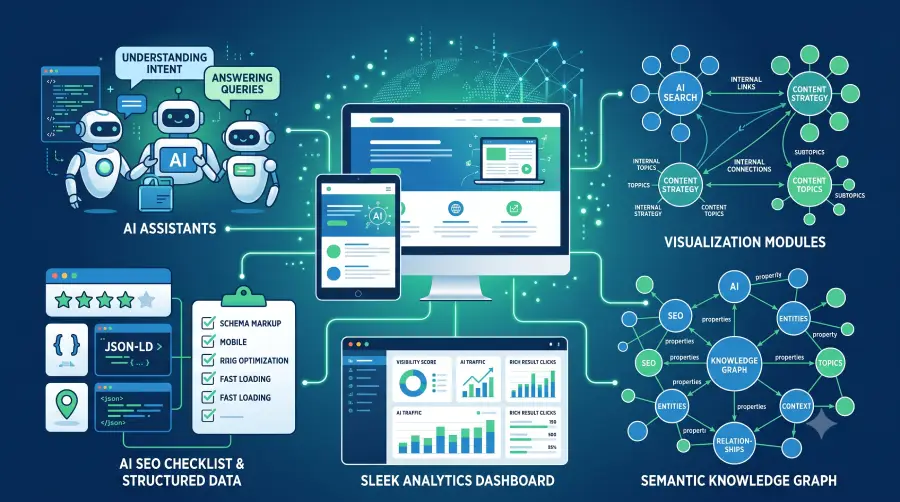
The way people search has changed. Instead of typing a couple of keywords into a search bar and clicking through a handful of sites, more and more users now ask a full question and expect a complete, direct answer back.
Whether someone is using Google AI Mode, ChatGPT Search, Microsoft Copilot, Perplexity AI, Google Gemini, or Claude, the expectation is the same: get an accurate, useful answer as fast as possible.
That shift raises an obvious question for anyone who runs a website: how do you stay visible when search itself works differently now?
The answer isn’t to throw out everything you know about SEO. It’s to build on those fundamentals and adapt with better structure, real topical authority, genuinely useful content, and a technically solid foundation underneath it all.
This guide walks through a practical, step-by-step framework for getting your website ready for AI search whether you run a personal blog, an e-commerce store, or a large content site.
Why AI Search Optimization Matters
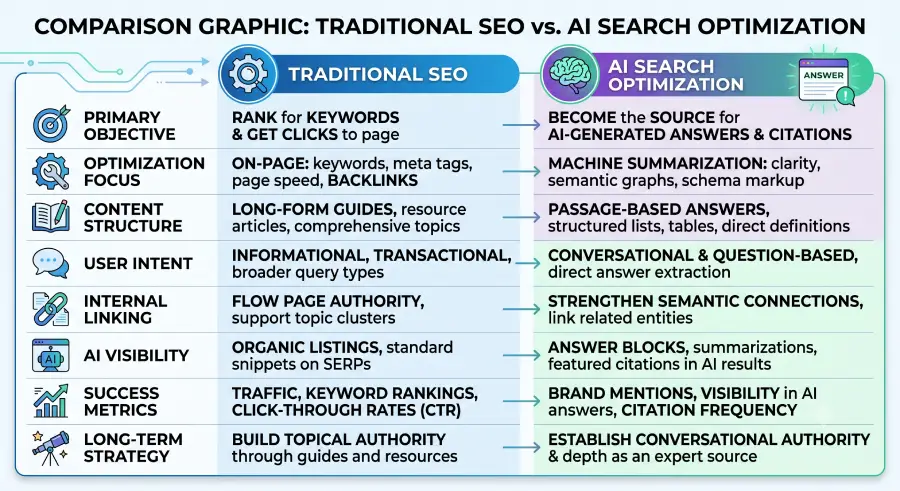
Traditional SEO is mostly built around one question: “How do I rank on Google?” AI search optimization asks a broader set of questions on top of that one:
- Can AI systems actually understand my content?
- Does it answer users’ questions clearly and completely?
- Is my site recognized as a trustworthy source?
- Have I built real topical authority, or just isolated posts?
- Is the content well-structured enough to be parsed easily?
As AI-powered search keeps expanding its share of how people find information, these questions matter more every quarter, not less.
How Search Itself Has Changed
Traditional search: keyword → list of links → user opens several sites → finds the answer somewhere in the middle.
AI search: conversational question → AI interprets intent → retrieves reliable information → generates an answer → user asks a natural follow-up.
Instead of re-searching with slightly different keywords, users can now just keep the conversation going until they get what they need. For more on this shift, see PostDune’s guides on How AI Is Changing User Search Behavior in 2026 and AI Search vs Traditional Search.
Is Traditional SEO Still Important?
Yes, unambiguously.
One of the most persistent misconceptions is that AI search has made SEO irrelevant. In reality, it leans on many of the same fundamentals that have always mattered:
- Genuinely helpful content
- Strong technical SEO
- Fast-loading pages
- Mobile-friendly design
- Logical site architecture
- Solid internal linking
- Trustworthy, accurate information
Traditional SEO is still the foundation. AI search optimization just extends those same principles to meet how AI-powered systems actually read and evaluate content.
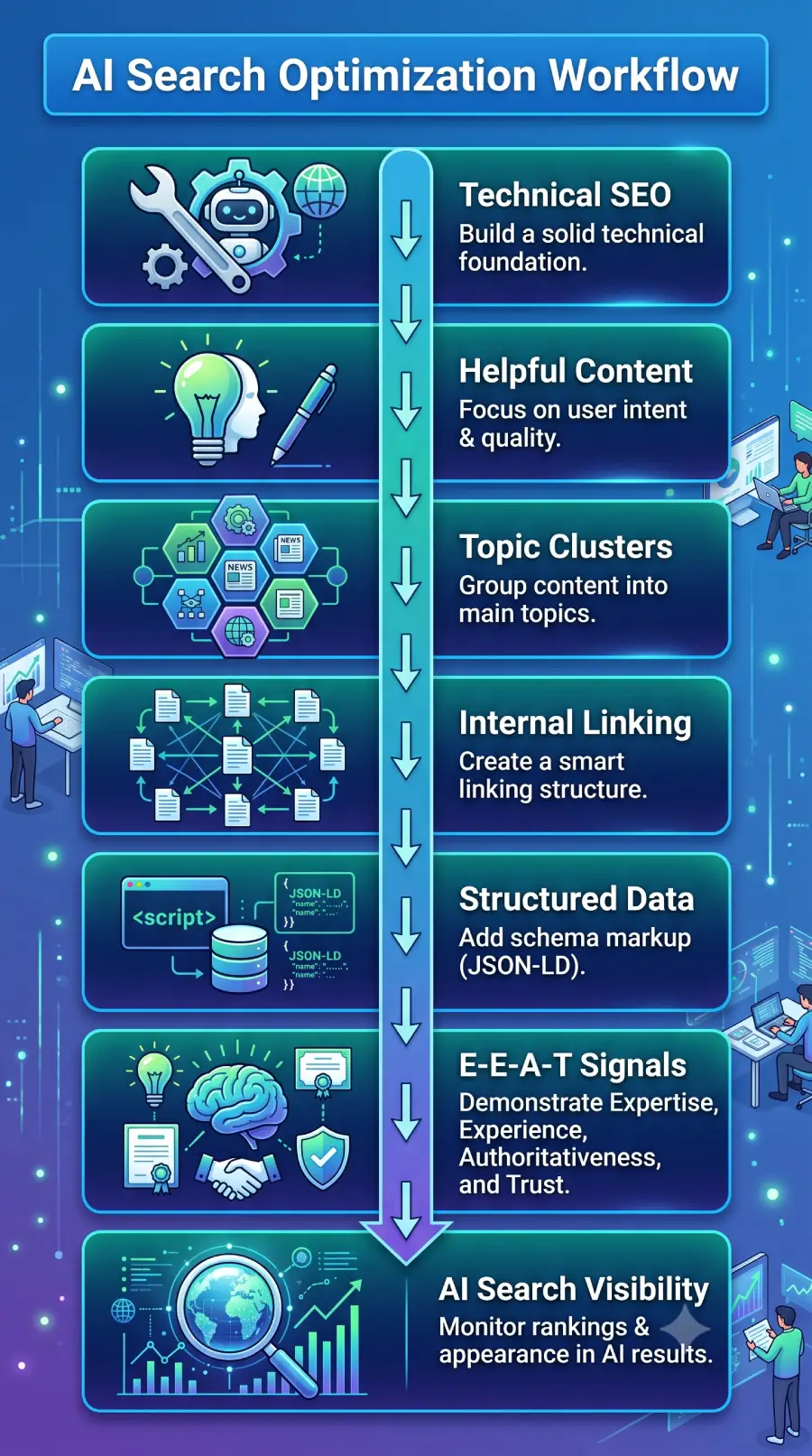
Step 1: Get Your SEO Foundation Right
Before layering on anything AI-specific, make sure your site covers the basics:
- HTTPS enabled
- Fast page loading
- Mobile-responsive design
- XML sitemap
- txt configured correctly
- Clean URL structure
- Canonical tags
- Optimized Core Web Vitals
- Proper heading hierarchy
- Accessible navigation
A technically sound site is easier for both traditional search engines and AI systems to access and understand everything else builds on this.
Step 2: Create Genuinely Helpful Content
AI systems are built to deliver useful answers, so the most reliable way to improve your visibility is to make content that actually helps people. That means it should:
- Solve a real problem
- Answer the questions people are actually asking
- Offer practical, usable advice
- Include real examples
- Stay accurate and current
- Cover the topic comprehensively, not just the surface
Don’t write purely to hit a keyword. Write to satisfy the reason someone searched in the first place the keyword follows naturally from that.
Step 3: Build Topic Clusters, Not Standalone Posts
A single isolated article rarely demonstrates real expertise. A network of connected articles does. A well-built AI Search cluster might include a pillar guide supported by pieces on core concepts, platform comparisons, and optimization frameworks all linking back and forth naturally.
For deeper background on the concepts underpinning this, see What Is AI Search? and How AI Search Works.
Step 4: Optimize for Intent, Not Just Keywords
Instead of “which keyword should I target,” ask “what problem is this reader actually trying to solve.” For every piece, identify the primary intent:
Informational: teaching or explaining a topic.
Navigational: helping someone find a specific site or tool.
Commercial investigation: comparing options before a decision.
Transactional : supporting someone who’s ready to act.
Content aligned with the right intent is both more useful to readers and easier for AI systems to interpret correctly.
Step 5: Strengthen Internal Linking
Internal linking is one of the highest-leverage, most underused SEO practices available. Done well, it improves navigation, crawlability, topical authority, page discovery, and how long people stay engaged with your site.
For a guide like this one, that might mean linking naturally to Generative Engine Optimization (GEO) and Answer Engine Optimization (AEO) wherever the context genuinely calls for it not wiring in every related URL regardless of fit.
Step 6: Write for People First
One of the most common SEO mistakes is writing exclusively for search engines. Instead:
- Use natural, conversational language
- Explain concepts clearly, without unnecessary jargon
- Keep paragraphs concise
- Use examples and visuals where they genuinely help
Content that genuinely helps readers tends to stay valuable regardless of how the underlying search technology shifts.
Step 7: Keep Evergreen Content Updated
AI and search technology move fast. Review your important articles on a regular cadence to update statistics, add new examples, refresh screenshots, expand thin sections, and remove anything outdated. Fresh content serves readers better and holds up longer.
Step 8: Implement Structured Data
Structured data helps search engines understand what your content actually means, not just what it says. Schema markup won’t guarantee a spot in an AI-generated answer, but it does improve machine readability and supports richer search features think of it as labeling each part of your page so a system doesn’t have to guess.
Worth implementing for most content sites:
- Article Schema: identifies blog posts and articles
- FAQ Schema: marks up frequently asked questions
- Breadcrumb Schema: shows page hierarchy
- Organization Schema: describes your site and publisher
- Author Schema: provides author information
- WebPage Schema: adds context to the page itself
- ImageObject Schema: describes important images
For tutorial-style content, consider HowTo Schema and, if you include video, VideoObject Schema. Validate everything with Google’s Rich Results Test before publishing.
Step 9: Strengthen Your E-E-A-T Signals
E-E-A-T Experience, Expertise, Authoritativeness, Trustworthiness isn’t a confirmed direct ranking factor, but it reflects the qualities both users and AI systems consistently favor.
Experience. Show the content is grounded in real practice: personal testing, case studies, screenshots, lessons actually learned.
Expertise. Cover topics comprehensively, explain technical concepts clearly, and connect related articles together.
Authoritativeness. Built over time through consistent publishing, real topic clusters, quality backlinks, and an accurate track record.
Trustworthiness. Visible author information, clear publish and update dates, HTTPS, cited sources, and a willingness to correct outdated information.
Step 10: Optimize Images and Multimedia
AI search is increasingly multimodal capable of interpreting images and video, not just text. A few habits worth building:
- Use descriptive filenames (ai-search-workflow-2026.webp, not image1.webp)
- Write alt text that actually describes what’s in the image
- Compress images with modern formats like WebP or AVIF
- Include genuinely useful visuals workflow diagrams, comparison tables, infographics, checklists
Step 11: Keep Technical SEO in Good Shape
AI search systems still lean heavily on traditional SEO fundamentals. Review regularly for:
- Fast page speed
- Mobile responsiveness
- Secure HTTPS
- Logical URL structure
- XML sitemap health
- txt configuration
- Canonical URLs
- Internal links
- Broken links
- Redirect issues
Step 12: Make Sure Your Site Is Easy to Crawl
- Submit an XML sitemap
- Avoid accidentally blocking important pages in robots.txt
- Fix crawl errors promptly
- Use descriptive internal link text
- Keep navigation simple and logical
- Avoid orphan pages with no internal links pointing to them
Discoverability starts with accessibility content Google or an AI system can’t reach doesn’t get a chance to be evaluated at all.
Step 13: Publish Original Insights
AI-generated summaries are becoming more common, which makes original material stand out more, not less. Publish original research, share first-hand experience, include real case studies, test strategies yourself, and offer practical templates or downloadable checklists. Generic summaries are replaceable; original insight isn’t.
Step 14: Build a Maintenance Schedule
Monthly: check for broken links, fix formatting issues, update screenshots where needed.
Quarterly: review statistics, add new examples, tighten internal linking, expand FAQs.
Every six months: rewrite outdated sections, account for new AI platforms, revisit search intent, refresh metadata.
An evergreen article is never really “finished” treat it as something you maintain, not something you publish once and forget.
Step 15: Monitor Performance and Adjust
Organic traffic: are people actually finding this content?
Engagement: are they sticking around to read it?
Bounce rate: are they leaving immediately?
Internal link clicks: are readers exploring related material?
Returning visitors: do people come back?
For a full framework on tracking this, see How to Measure AI Search Traffic and AI Mentions.
AI Search Readiness Checklist
Content: comprehensive coverage, quick answer to the primary question, real examples, descriptive headings.
SEO: optimized title, meta description, clean URL, internal links, image alt text.
Technical: mobile-friendly, fast loading, HTTPS, schema markup, crawlable pages.
Trust: author information, updated date, reliable sources, accurate claims.
Common Mistakes to Avoid
Publishing thin content: Comprehensive resources consistently outperform brief summaries.
Ignoring user intent: Always come back to what problem the reader is actually trying to solve.
Forgetting internal links. Related content should connect to related content.
Publishing AI drafts without review: AI can help with a first pass, but human review is what keeps it accurate, clear, and genuinely original.
Chasing unverified “AI ranking hacks:” There’s no secret formula focus on being genuinely useful instead.
Advanced Best Practices for Long-Term AI Search Visibility
Once your foundation, structured data, and content quality are in place, these habits help sustain visibility as AI search keeps evolving:
Build real topic clusters, not standalone posts: Connected articles demonstrate expertise far more convincingly than isolated pieces.
Cover topics in real depth: What, why, how, when, benefits, challenges, examples, best practices, FAQs comprehensive beats scattered.
Keep internal linking active on both sides: Related articles should link to each other, not just flow one direction from a pillar page.
Update content on a schedule, not sporadically: A visible ‘last updated’ date reinforces that your information is current.
Prioritize readability: Short paragraphs, clear headings, bullet lists, tables, plain language, logical flow.
Include original examples: Your own workflows, screenshots, and experiments are harder to replicate than generic advice.
Anticipate follow-up questions: Related questions, common misconceptions, and FAQs make a resource feel complete.
Lead with a concise answer, then expand: Serve both the reader who wants a quick answer and the one who wants full context.
Avoid over-optimization: Natural language beats forced keyword placement, for readers and AI systems alike.
Build brand authority gradually:Consistency compounds there’s no substitute for it.
Watch emerging AI search features: Adjust your strategy as new platforms and capabilities appear.
Invest in user experience: Fast pages, mobile responsiveness, accessible navigation, clean design.
Keep formatting consistent across related articles: Predictable structure helps readers navigate your whole content hub.
Write accurate, non-clickbait titles: Titles that overpromise erode trust the moment someone opens the page.
Write meta descriptions that set honest expectations: They should summarize the value, not just bait a click.
Use visuals that actually clarify: Infographics, comparison charts, and diagrams should aid comprehension, not decorate the page.
Build in accessibility from the start: Alt text, sufficient contrast, correct heading structure, meaningful link text.
Link to related content throughout the piece, not just at the end: Readers explore more when the option is presented where it’s relevant.
Keep URLs clean and descriptive: No unnecessary numbers or parameters.
Design for mobile readers specifically: Responsive layouts, readable font sizes, touch-friendly navigation.
Quick-Reference Optimization Checklist
| Category | Checklist Items |
| Content | Clear intent, comprehensive coverage, original insights, examples, FAQs, regular updates |
| SEO | Optimized title & meta description, clean URL, logical headings, internal links, alt text |
| Technical | HTTPS, XML sitemap, robots.txt, canonical tags, schema markup, no broken links |
| Authority & Trust | Author info, publish/update dates, reliable references, consistent branding, topic clusters |
| User Experience | Table of contents, comparison tables, infographics, accessible formatting, related articles |
Frequently Asked Questions
What is AI search optimization?
It’s the practice of shaping your website so AI-powered search systems can understand, evaluate, and surface your content when it’s genuinely relevant to what someone is asking.
Is traditional SEO still important?
Yes. Technical SEO, content quality, and user experience are still the foundation AI search builds on these rather than replacing them.
Does structured data guarantee AI visibility?
No. It helps search systems understand your content better, but it doesn’t guarantee inclusion in an AI-generated answer.
Should I rewrite all my existing articles?
Not necessarily. Start with your most valuable evergreen content improve its structure, internal linking, and accuracy before touching everything else.
How often should I update AI search content?
Every three to six months for your important articles, or sooner after a significant platform change.
What’s the biggest mistake website owners make?
Optimizing for keywords instead of genuinely answering the question the reader actually has.
Key Takeaways
- Build on strong SEO fundamentals rather than replacing them
- Create comprehensive, genuinely user-focused content
- Organize related articles into real topic clusters
- Strengthen internal linking in both directions
- Implement structured data where it fits, without overselling it
- Build real E-E-A-T signals through consistent, accurate publishing
- Keep evergreen content on an active update schedule
- Monitor performance and adjust based on trends, not single data points
- Prioritize long-term quality over short-term tactics
Conclusion
Optimizing your website for AI search was never about finding a shortcut or exploiting some hidden signal. It’s about publishing content that’s accurate, well-structured, easy to understand, and genuinely useful.
The same qualities that make content valuable to a human reader clear explanations, real depth, technical soundness, and trustworthy information are exactly what position it well for AI-powered search. As AI keeps reshaping discovery, the sites that keep publishing high-quality, well-connected content will be the ones that hold up.
For the surrounding strategy, see PostDune’s guides on Generative Engine Optimization (GEO), Answer Engine Optimization (AEO), and AI Search Statistics 2026 for the broader context behind these recommendations.