
Search has been built the same way for decades: rank higher, get the click, count the traffic. That’s still part of the picture, but it’s no longer the whole thing. AI-powered search can now synthesize information from multiple sources and hand back a direct answer, and users are increasingly having actual conversations with it asking follow-ups, expecting context, expecting the system to remember what they just asked.
That shift is what’s behind the growing conversation around Generative Engine Optimization (GEO) the practice of shaping content so AI-powered search systems can understand it, trust it, and reference it when generating an answer. GEO doesn’t replace traditional SEO. It builds directly on top of it, adding emphasis on content quality, topical authority, clear structure, and demonstrated expertise.
If you’re new to this space, start with PostDune’s Complete Guide to AI Search in 2026, What Is AI Search?, How AI Search Works, and AI Search vs Traditional Search they’ll give you the background this guide builds on.
What Is Generative Engine Optimization (GEO)?
GEO is the practice of creating and organizing content so AI-powered search systems can more easily understand, evaluate, and reference it when generating responses. Where traditional SEO is mostly aimed at improving rankings, GEO is aimed at increasing the odds that your content gets recognized as a trustworthy, useful source for an AI-generated answer.
Instead of optimizing purely for keywords, GEO emphasizes:
- Comprehensive topic coverage
- Clear, logical content structure
- High-quality, original information
- Real topical authority
- Internal linking between related content
- Demonstrated expertise and trustworthiness
- Information that’s actually kept current
The goal is content that’s genuinely useful to a human reader and, as a natural byproduct, easier for an AI system to interpret correctly.
Why GEO Is Becoming Important
AI Search Keeps Expanding
AI-generated search experiences are showing up across more platforms every quarter. Instead of a list of links, users increasingly get direct answers, summaries, comparisons, recommendations, and step-by-step instructions. That means sites are now competing not just for rankings, but for visibility inside the answer itself.
User Expectations Have Shifted
People now routinely expect AI to explain concepts, compare products, summarize articles, help plan projects, answer follow-ups, and actually solve problems. That raises the bar past keyword matching content needs to answer real questions clearly, in a way a system can pull from directly.
Authority Matters More, Not Less
AI systems are trying to identify information that reads as reliable, well-organized, comprehensive, current, and genuinely helpful. Publishing a scattering of short, unrelated articles tends to be far less effective than building real depth around a focused subject area a connected content hub sends a much stronger signal than any single standalone piece.
Compare
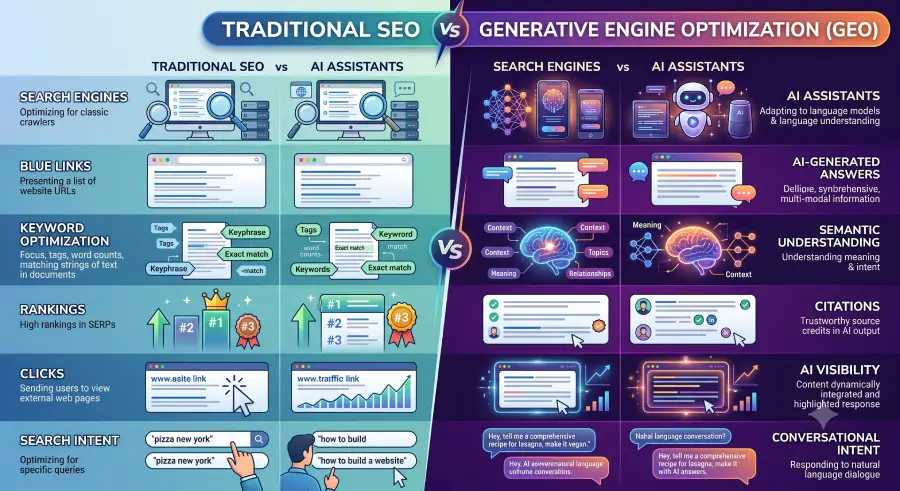
GEO vs. Traditional SEO
GEO and SEO share a lot of best practices, but they’re not the same discipline.
| Traditional SEO | Generative Engine Optimization (GEO) |
| Optimize for search rankings | Optimize for AI-generated answers |
| Focus on keywords | Focus on topics and user intent |
| Drive organic clicks | Increase AI visibility and citations |
| Improve SERP performance | Improve usefulness for AI systems |
| Ranking is a primary goal | Being referenced as a trusted source is the goal |
| Keyword targeting | Context and semantic understanding |
The two aren’t competing strong SEO builds the technical and content foundation, and GEO adapts that foundation for AI-powered search specifically.
Is GEO Replacing SEO?
No, and this is probably the most common misconception around GEO.
Technical SEO still matters. Site speed still matters. Mobile usability, structured data, internal linking, and high-quality content all still matter exactly as much as they did before. What’s actually changing is how users discover information in the first place. As AI-generated answers become more common, it’s worth thinking past rankings alone and toward whether your content could realistically become a source an AI system trusts.
How AI Search Differs From Traditional Search
Traditional search: keyword → indexed pages → ranked results → list of links → user picks a website.
AI-powered search: question → intent interpretation → retrieval of relevant sources → synthesis across multiple sources → a conversational answer → citations where the platform supports them.
That extra synthesis step is exactly why content clarity, quality, and authority carry more weight than they used to an AI system has to actually trust and understand your content well enough to use it in an answer, not just rank it.
Why Publishers Should Care About GEO
Ignoring AI search means missing a growing channel for reaching an audience. Publishers who lean into GEO principles tend to see better visibility in AI-powered experiences, stronger topical authority, more organized content, a better overall user experience, and content that holds its value longer. Rather than chasing every algorithm update, GEO points toward something more durable: content that’s genuinely useful to both readers and the AI systems reading on their behalf.
How AI Search Engines Evaluate Content
A question worth asking directly: how does an AI system decide which sites to actually use in its answers? Unlike a traditional search engine ranking pages against hundreds of signals, an AI-powered system first has to understand, retrieve, evaluate, and synthesize information before it can respond at all.
None of the major AI companies have published a complete ranking algorithm, but documentation and general industry observation point to a consistent pattern: these systems tend to favor content that’s relevant to the actual question, accurate and trustworthy, well-structured, comprehensive, current, written with clear expertise, and genuinely easy to understand.
There’s no secret GEO algorithm to reverse-engineer. The reliable path is creating content that’s honestly useful for a reader and an AI system at the same time.
How AI Search Works Behind the Scenes
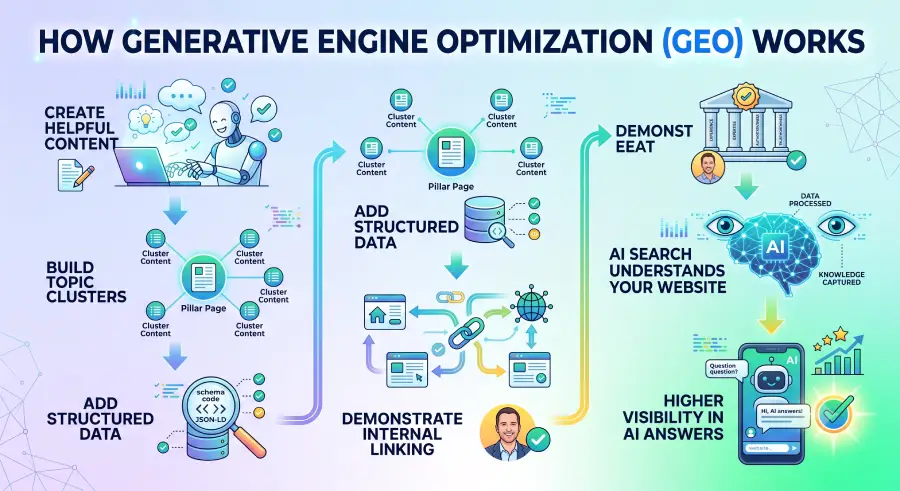
Most AI-powered search experiences follow a broadly similar workflow: a user asks a question, the system interprets intent, retrieves relevant sources, evaluates their quality, compares multiple sources against each other, generates a response, and includes citations where the platform supports it.
Implementations differ across platforms, but the underlying goal is consistent deliver a helpful, accurate answer instead of just a list of links. For a deeper technical breakdown, see How AI Search Works.
What Makes Content AI-Friendly?
A Clear Topical Focus
AI systems generally read content better when it sticks to one primary topic instead of trying to cover unrelated ground. A page titled “Google AI Mode Explained” is easier to interpret than one that tries to cover AI, health, finance, and fashion all at once. Give every page a single clear purpose.
Comprehensive Coverage
Thin articles usually answer only part of a question. A comprehensive piece covers the definition, how something actually works, benefits, limitations, examples, comparisons, best practices, and FAQs which is more useful for the reader and gives an AI system far richer context to draw from.
Logical Structure
Well-organized content is simply easier to interpret H2s, H3s, bullet lists, numbered steps, tables, summary boxes, and FAQ sections all help. Long unstructured blocks of text work against you here.
Original Value
AI systems exist to help users, not to repeat generic information back to them. Practical examples, real experience, case studies, original research, checklists, templates, and visual explanations are what separate your content from hundreds of similar articles saying roughly the same thing.
Why E-E-A-T Still Matters
Google’s Search Quality Rater Guidelines describe Experience, Expertise, Authoritativeness, and Trustworthiness (E-E-A-T) not a direct ranking algorithm, but a description of the qualities associated with genuinely high-quality content. Many of those same qualities carry real weight in AI-powered search too.
Experience: Show evidence of real, first-hand use how you’ve actually applied a strategy, not just how you’d define it.
Expertise: Cover subjects thoroughly. Shallow summaries rarely hold up next to genuinely deep coverage.
Authoritativeness: Built through topic clusters, consistent publishing, accurate information, and reputable references compounding over time, not overnight.
Trustworthiness: Keep articles updated, cite authoritative sources, correct errors when you find them, be transparent about authorship, and avoid misleading claims.
Why Topical Authority Matters
A single isolated article about AI search carries far less weight than a genuinely comprehensive content hub covering the fundamentals, the underlying technology, platform comparisons, user behavior, and adjacent topics like zero-click search all linked together. That interconnected structure demonstrates expertise across the whole subject, not just one narrow slice of it.
For related context on how search behavior itself is shifting, see How AI Is Changing User Search Behavior in 2026 and The Rise of Zero-Click Searches.
The Role of Entities in AI Search
AI systems don’t work from keywords alone they also recognize entities: identifiable people, organizations, products, technologies, and concepts. In an article about AI search, that might include specific companies, specific AI models, and specific technical concepts like large language models or retrieval-augmented generation. Using entities naturally and accurately adds real context. Stuffing in unrelated entities purely for SEO purposes does the opposite it just adds noise.
Structured Data Supports Better Understanding
Schema.org markup helps a search engine understand the purpose and content of a page. It won’t guarantee inclusion in an AI-generated answer, but it does improve machine readability and can support richer search features. Worth implementing: Article, FAQ, Breadcrumb, Organization, Author, WebPage, and ImageObject schema where relevant implemented per official documentation and kept consistent with what’s actually visible on the page.
Common GEO Misconceptions
Myth: GEO replaces SEO. Reality: it builds on SEO, it doesn’t substitute for it.
Myth: there’s a secret “GEO algorithm.” Reality: no such algorithm has been publicly confirmed by anyone. Focus on being genuinely helpful instead of chasing a formula.
Myth: more mentions of “AI” or specific tool names improve visibility. Reality: unnatural repetition doesn’t improve quality relevance and readability do.
Myth: AI will replace websites entirely. Reality: AI-generated answers still rely on information publishers actually create. Quality sites remain a core part of the information ecosystem.
Myth: one long article is enough. Reality: a network of related, internally linked articles consistently provides stronger topical coverage than a single page trying to do everything.
GEO Best Practices Worth Implementing
Understanding GEO is the easy part implementation is what actually improves your odds of being understood and referenced by AI-powered search. There’s no guaranteed formula, but these habits line up with both established SEO principles and how modern AI search systems actually process content:
Build real topical authority: Interconnected content clusters around a subject consistently outperform isolated articles.
Write for intent, not keywords: Ask what question the reader is actually trying to answer and what action they want to take next.
Publish genuinely original content: Personal experience, expert analysis, case studies, original research, and real screenshots can’t be replicated by a generic summary.
Use clear, descriptive headings: Good structure helps both readers and AI systems process the page faster.
Answer questions directly, then expand: Lead with a concise answer before adding depth and context.
Strengthen internal linking: Every article should connect naturally to genuinely related content, not link for its own sake.
Keep content updated: Review important articles every few months refresh statistics, update screenshots, remove anything outdated.
Demonstrate real experience: Share specifics from your own work rather than describing concepts in the abstract.
Prioritize readability: Short paragraphs, bullet lists, tables, images, and step-by-step instructions all help.
Implement structured data accurately: Article, FAQ, Breadcrumb, Organization, and Author schema, matched to what’s actually on the page.
Write descriptive, specific titles: “Generative Engine Optimization (GEO): The Complete Guide to Ranking in AI Search” beats “Everything About GEO.”
Optimize your images properly: Descriptive filenames, real alt text, captions where useful, compressed file sizes.
Strengthen E-E-A-T signals throughout: Author information, visible expertise, cited sources, editorial review, a clear update history.
Cite genuinely reliable sources: Official documentation, government publications, academic research, credible industry reports.
Avoid keyword stuffing: Natural language reads better and performs better than repetition.
Build real FAQ sections: They round out coverage and answer the follow-ups readers are likely to have.
Keep page speed fast: A faster site supports both user experience and broader SEO performance.
Design for mobile: Responsive layouts, readable typography, fast performance, accessible navigation.
Use consistent terminology: Switching between multiple names for the same concept without explanation just adds friction.
Cover topics completely, not just the definition: Benefits, limitations, examples, comparisons, best practices, and FAQs round out a resource.
Treat evergreen content as ongoing work: Continued relevance depends on continued maintenance.
Point readers toward related articles: Genuine further-reading suggestions keep people engaged with your broader content hub.
Track performance and adjust: Organic traffic, engagement, search queries, internal link clicks, and returning visitors all inform what to improve next.
Ask if the article would actually satisfy the reader: That single question cuts through most optimization noise.
Build a trusted brand over time: Consistent, reliable publishing earns more recognition than any short-term tactic.
Common GEO Mistakes
- Publishing thin content
- Ignoring user intent
- Overusing AI-generated text without real editing
- Neglecting internal linking
- Chasing unverified GEO “hacks”
- Letting evergreen articles go stale
- Using misleading titles
- Omitting author information
- Ignoring page experience
- Treating GEO as a replacement for SEO instead of an extension of it
GEO vs. AEO
GEO gets confused with Answer Engine Optimization (AEO) fairly often, since both deal with AI-powered search.
| Generative Engine Optimization (GEO) | Answer Engine Optimization (AEO) |
| Focuses on AI-generated search experiences | Focuses on direct question-and-answer systems |
| Optimizes comprehensive content | Optimizes concise answers |
| Supports conversational AI broadly | Supports featured answers and voice search |
| Emphasizes topical authority | Emphasizes answering specific questions |
| Complements SEO | Complements both SEO and GEO |
In practice, most sites benefit from applying both approaches together rather than picking one.
Where GEO Is Headed
As AI-powered search keeps maturing, GEO is likely to become an even more central complement to traditional SEO. Expect more conversational search experiences, greater emphasis on trustworthy sourcing, better understanding of entities and their relationships, deeper personalization, and more multimodal search spanning text, images, audio, and video.
The core principle underneath all of that isn’t likely to change: create content that genuinely helps the person on the other end of the question.
Frequently Asked Questions
What is Generative Engine Optimization?
GEO is the practice of improving content so AI-powered search systems can better understand, evaluate, and potentially reference it when generating answers.
Does GEO replace SEO?
No. GEO builds on traditional SEO rather than replacing it.
Is GEO only relevant for AI chatbots?
No. It applies broadly to AI-powered search experiences, including conversational assistants and search engines that incorporate generative AI.
How do I actually improve my AI visibility?
Focus on helpful content, real topical authority, solid internal linking, clear structure, trustworthy information, and regular updates.
Is keyword research still worth doing?
Yes. It’s still useful for understanding what people are searching for content just also needs to address broader topic context and intent.
Does structured data guarantee AI citations?
No. It helps search engines understand your content, but it doesn’t guarantee inclusion in an AI-generated response.
How often should I update GEO-focused content?
Every few months for your important evergreen articles, or sooner after a significant industry shift.
Can small websites realistically compete on GEO?
Yes. Smaller publishers can compete effectively by producing focused, genuinely authoritative content within a specific subject area.
Key Takeaways
- GEO complements traditional SEO rather than replacing it
- User intent matters more than keyword repetition
- Real topical authority strengthens visibility over the long run
- Helpful, well-structured content serves readers and AI systems at the same time
- E-E-A-T principles remain genuinely valuable
- Internal linking improves how discoverable your content actually is
- Regular updates keep evergreen resources relevant
- Trust and originality are what actually differentiate content in AI-powered search
Conclusion
Generative Engine Optimization isn’t about finding a shortcut or exploiting some hidden algorithm there isn’t one to find. It’s about adapting proven content and SEO practices for a search landscape where AI-powered experiences play a growing role.
Publishers who focus on accurate, comprehensive, genuinely trustworthy content will be better positioned across both traditional search engines and AI-assisted platforms. Rather than replacing SEO, GEO just asks for a broader perspective one that values real topical expertise, clear organization, and actual usefulness over shortcuts.
For the surrounding strategy, see PostDune’s guides on Answer Engine Optimization (AEO) and AI Search Statistics 2026.