Introduction
Think about the last time you typed a few keywords into Google and patiently clicked through page after page of results. Can you even remember? For a growing share of internet users worldwide, that experience is already a relic of the recent past.
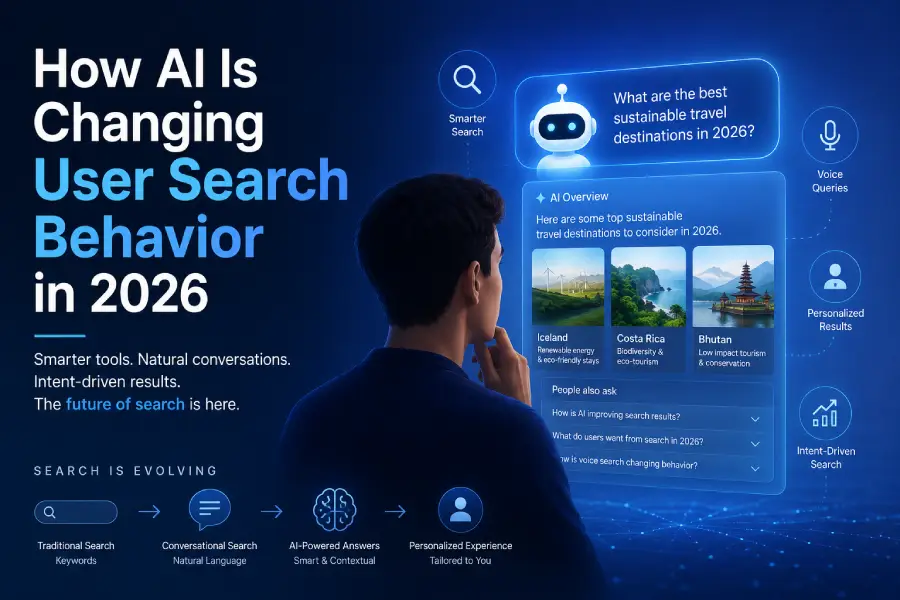
In 2026, the way people find information online has undergone the most profound transformation since the dawn of the search engine itself. Artificial intelligence is no longer a futuristic add-on to search it is search, at least for a rapidly expanding portion of global queries. Google AI Overviews now reach 1.5 billion monthly users. ChatGPT processes 2 billion queries every single day. Voice search accounts for more than one in four queries. And, in one of the most striking behavioral shifts ever recorded, over 93% of AI-powered search sessions end without a single click to an external website.
For businesses, digital marketers, SEO professionals, and content creators, this is not a moment for observation. It is a moment for action. The strategies that drove traffic and conversions just three years ago are becoming obsolete. A new set of rules centered on authority, structure, and citation readiness is taking their place.
This article breaks down exactly how AI is changing user search behavior in 2026, what the data tells us, and what you need to do about it right now. If you’re already familiar with the basics and want to jump straight into tactics, see our guide on How to Optimize Content for AI Search Engines.
The Evolution of Search: From Keywords to Conversations
To understand where search is heading, it helps to appreciate how far it has already traveled.
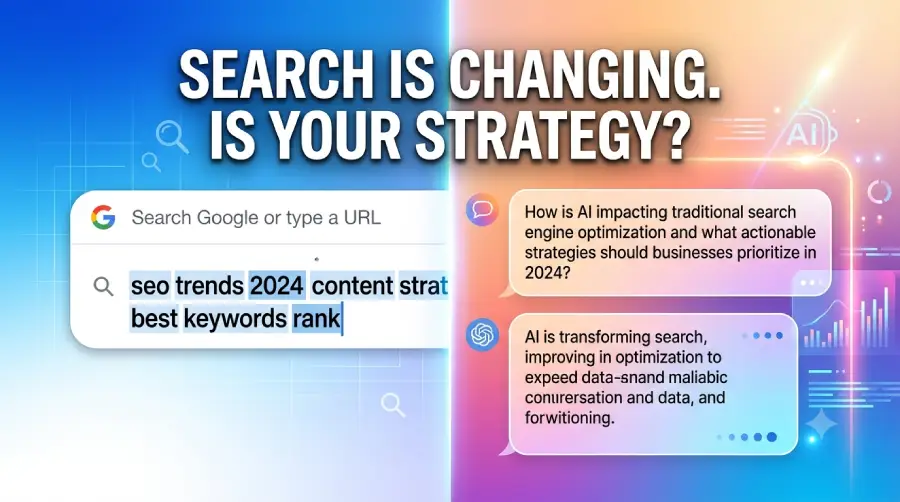
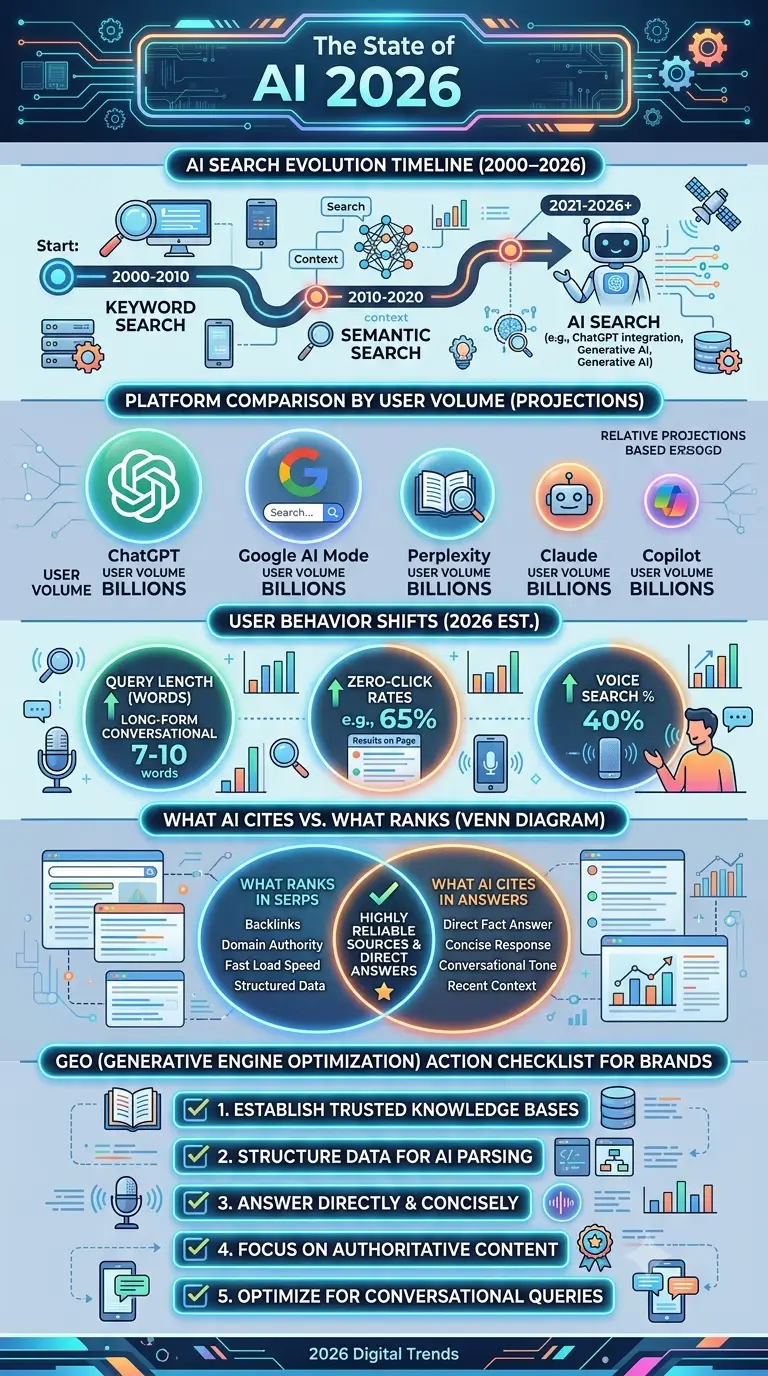
For most of the internet’s history, search was a matching game. A user typed a handful of keywords “best Italian restaurant NYC” and an algorithm compared those words against billions of indexed pages, returning a ranked list of links. Success, for both users and websites, was measured in clicks. Get to page one, get clicked. Simple.
That model began cracking with the rise of semantic search in the early 2010s, when Google’s Hummingbird update started interpreting the intent behind queries rather than just the literal words. Voice search accelerated this further, training users to speak naturally to devices rather than abbreviate their questions for a machine. But these were evolutionary steps, not a revolution.
The revolution came with generative AI. When OpenAI launched ChatGPT in late 2022, it demonstrated something genuinely new: a system that could hold a conversation, synthesize information from multiple sources, and deliver a direct, nuanced answer all without requiring the user to click a single link. Within months, Google, Microsoft, Anthropic, and dozens of other players had entered the race. By 2026, the search landscape has been permanently redrawn.
Why AI Is Reshaping Search Behavior
At the heart of this shift is a simple value proposition: AI search is faster, easier, and more satisfying for many types of queries than traditional search ever was.
Faster answers. Instead of scanning 10 blue links and clicking through to find the relevant paragraph, users receive a synthesized answer directly in the interface. No loading screens. No irrelevant content to scroll past.
Natural language queries. AI systems understand context, nuance, and follow-up questions. Users no longer need to translate their actual question into search-engine syntax. They simply ask, the way they would ask a knowledgeable friend.
Conversational interactions. Platforms like ChatGPT, Google’s AI Mode, Claude, and Gemini allow users to build on previous questions without repeating context. A user researching a business decision might ask ten interconnected questions in a single session, each building on the last.
Personalized experiences. AI systems increasingly tailor responses based on prior interactions, stated preferences, and inferred context offering an experience that traditional keyword-based search never could.
These advantages explain why ChatGPT has become the fifth most visited website globally as of January 2026, why Google’s AI Mode surpassed a billion monthly active users in its first year, and why Gartner projected that traditional search engine volume would drop 25% by the end of 2026 as users migrate toward generative AI platforms.
Key Ways AI Is Changing User Search Behavior
Users Ask Longer, More Complex Questions
One of the most measurable behavioral shifts in 2026 is the dramatic lengthening of search queries. According to Google’s own data analysis of AI Mode, the average AI-powered search is now three times the length of a traditional typed query. Searches containing eight or more words are seven times more likely to trigger a Google AI Overview than shorter queries.
The reason is intuitive: users have learned that more context produces better answers. Instead of typing “CRM software,” a user now asks: “What’s the best CRM for a mid-sized B2B company with a small sales team that integrates with HubSpot?” Instead of “pizza NYC,” the query becomes: “What’s the best pizza place in New York City for a romantic date night that won’t break the bank?” This shift has enormous implications for keyword strategy the short-tail terms that once drove SEO are losing relevance as long-tail, conversational queries dominate AI interfaces. For a deeper dive, see our guide on Zero-Click Searches: Why They Matter and What to Do About Them.
The Rise of Conversational Search
Conversational search is no longer a niche behavior it is the dominant mode of interaction with AI-powered platforms. As of 2026, 67% of all AI search queries are full questions or conversational phrases rather than traditional keyword strings, according to industry analysis.
What makes conversational search genuinely different from earlier forms is memory. Platforms like ChatGPT, Gemini, and Perplexity maintain context across multiple exchanges within a session. A user might begin with “explain renewable energy,” then follow up with “which countries are doing it best,” then ask “how does India compare?” and the AI understands each question in relation to the others without the user repeating a word. This creates a fundamentally different search journey: less like a series of isolated queries and more like a research conversation.
The Decline of Traditional Keyword Searches
The short-keyword era is not dead, but it is contracting. Users still turn to traditional Google for navigational queries (“amazon login,” “weather today”) and many transactional searches (“buy Nike Air Max”). But for informational research the broad, exploratory queries that historically drove content site traffic AI platforms are capturing an increasing share.
The shift is generational. Among US Gen Z users, nearly 35% now use AI chatbots as their primary search tool. Among all US adults, roughly three in four report searching with AI at least weekly. Semrush projects that AI-search visitors will overtake traditional search visitors entirely by 2028. The implication for content creators and SEO professionals is stark: optimizing only for traditional Google search means leaving a fast-growing audience unaddressed.
Growing Trust in AI Answers
Skepticism about AI accuracy is real and justified, as we’ll discuss in the challenges section. But behavioral data suggests that a significant portion of users are placing substantial trust in AI-generated answers. A 2026 study found that 47% of consumers say AI shapes which brands they trust, and enterprise buyers increasingly arrive at sales calls with a shortlist generated by ChatGPT or Claude rather than from independent research.
This trust has a compounding effect: when AI systems are the default starting point for research, the brands and sources they cite gain an authority signal that is difficult to replicate through traditional channels. Being omitted from AI responses is no longer a neutral outcome it increasingly means being absent from the consideration set entirely.
Multi-Step Search Journeys
Traditional search behavior was largely episodic: a user asked a question, evaluated the results, and either satisfied their need or started a new query. AI search is enabling something more sophisticated multi-step research journeys in which users brainstorm, plan, compare options, and make decisions within a single extended conversation.
Google’s data on AI Mode is telling: planning-related queries have outpaced overall AI growth by 80% over the past six months. Users are leaning on AI not just for facts, but to map out complex, multi-step tasks planning a business launch, researching a medical condition, evaluating investment options. This compresses what was once a multi-session, multi-day research process into a single extended AI conversation, with significant implications for how and when brands can influence the decision.
Voice Search and AI Assistants
Voice search crossed 27% of all queries in 2026 a number that was a projection just two years ago and now reflects daily behavior across smartphones, smart speakers, and AI-integrated devices. More than 1 in 6 US users now combine voice interaction with AI search features, according to recent Google data.
The convergence of voice and generative AI is creating a new interaction paradigm. Voice users ask natural, conversational questions and expect immediate spoken answers a use case where AI-generated summaries are particularly well-suited. For content to win in voice search, it must be structured for direct extraction: clear question-and-answer formats, FAQ sections, and content optimized for the featured snippet slot that voice assistants read aloud.
Personalized Search Experiences
AI search is moving rapidly toward genuine personalization responses tailored not just to the query, but to the individual’s context, history, and stated preferences. This marks a significant departure from traditional search, where personalization was limited to location signals and browsing history.
For marketers, personalized AI search creates both an opportunity and a challenge. The opportunity: brands that genuinely understand their audience can create content that resonates across a range of personalized contexts. The challenge: brands have far less visibility into how AI presents their information across different user segments, making performance measurement more complex than a traditional rankings report.
Increased Use of AI Chatbots Instead of Search Engines
Perhaps the most structurally significant trend is the direct substitution of AI chatbots for traditional search engines among a growing user segment. The 2026 AI + Search Behavior Study by Eight Oh Two Marketing, which surveyed 500 active AI users, found that 37% of consumers now start their search journey with an AI tool rather than Google or Bing.
The reason, respondents noted, is not novelty it is genuine preference. Traditional search, for many users, has become “too noisy, too effortful, and too slow.” AI platforms answer the actual question, in natural language, with a synthesized response that typically satisfies the immediate need without requiring additional clicks. For informational queries especially, the traditional search experience is increasingly failing to compete.
AI Search Statistics and Data for 2026
The following table summarizes the most significant verified data points on AI search adoption and behavior as of mid-2026.
| Metric | Figure | Source |
|---|---|---|
| ChatGPT monthly users | 883 million (Jan 2026) | OpenAI |
| ChatGPT daily queries | 2 billion | OpenAI |
| ChatGPT AI chatbot market share | 80.49% | StatCounter |
| Google AI Overviews monthly users | 1.5 billion | Search Engine Land |
| Google AI Mode daily active users | 75 million+ | |
| % of queries triggering AI Overviews | ~25% (Q1 2026) | Conductor |
| Zero-click AI search sessions | ~93% | Industry analysis |
| AI referral traffic growth (YoY) | +527% | Multiple sources |
| Voice search share of all queries | 27% | Digital Applied |
| Gen Z using AI as primary search tool | 35% | Industry surveys |
| Consumers starting search with AI | 37% | Eight Oh Two |
| AI search traffic conversion rate | 14.2% vs Google’s 2.8% | Industry benchmark |
| Content with citations gaining AI visibility | +30–40% more | Princeton GEO research |
| Traditional search volume drop (Gartner proj.) | -25% by end of 2026 | Gartner |
| AI search visitors overtaking traditional | Projected 2028 | Semrush |
| GEO market value (2025) | $848 million | Dimension Market Research |
| GEO market projected value (2034) | $33.7 billion | Dimension Market Research |
The Impact of Google AI Overviews
Google AI Overviews (formerly Search Generative Experience, or SGE) represent the search giant’s most consequential attempt to integrate generative AI directly into the traditional search experience and in 2026, their impact on user behavior and website traffic is undeniable.
What AI Overviews are: When a user submits a query that triggers an AI Overview, Google generates a synthesized, multi-sentence answer at the top of the search results page, drawing on multiple indexed sources. The answer appears above all organic results, above ads, and above featured snippets.
How they work: AI Overviews synthesize information from multiple sources typically three or more, according to Pew Research analysis presenting a consolidated response rather than a list of links. Roughly 88% of these summaries cite multiple sources, and only 1% rely on a single one.
Effects on user behavior: The presence of an AI Overview fundamentally changes how users interact with the search results page. Around 50% of US search queries now generate an AI Overview response, and 58% of users report encountering at least one AI Overview in a given month. The most significant behavioral impact is on click-through behavior: AI Overviews reduce clicks to the top-ranking page by approximately 58%, and one 2026 field experiment measured a 38% drop in organic CTR when an AI Overview was present.
Effects on website traffic: The aggregate impact on organic traffic is real but nuanced. US organic traffic has declined roughly 2.5% year-over-year a moderate figure that masks sharper drops for specific query types. For purely informational queries, where AI Overviews are nearly ubiquitous, the traffic impact is far more severe. For transactional and navigational queries, where AI Overviews appear less frequently, the impact has been modest.
Effects on SEO: Perhaps the most strategically important shift is that traditional page-one rankings no longer reliably translate into AI Overview citations. The citation source pool has widened dramatically: 40% of sources appearing in AI Overviews rank between positions 11 and 20 in traditional search, meaning pages outside the top 10 can still gain significant AI visibility. This fundamentally changes what SEO optimization means in 2026 it is no longer sufficient to rank; content must also be structured to be cited. Our in-depth guide on Google AI Overviews: What They Mean for Your Organic Traffic covers this in full detail.
Expert perspective: As noted across multiple industry analyses, pages that win AI Overview citations tend to share common characteristics: clear definitions, direct answer paragraphs, structured data markup, and genuine topical depth. Traditional long-form content without a clearly extractable answer block increasingly loses citation slots even when it ranks well in traditional search.
How ChatGPT, Gemini, Claude, and Copilot Are Changing Search
AI search is not monolithic. The major platforms differ significantly in their approach, user base, and citation behavior and understanding those differences is critical for brands seeking to maximize AI visibility.
| Platform | User Base | Search Approach | Key Strengths | Limitations |
|---|---|---|---|---|
| ChatGPT | 883M monthly users; 80.49% AI chatbot market share | Conversational + web retrieval via Bing index | Largest user base; versatile; strong for complex tasks | Hallucination risk; heavy B2C skew; citations less transparent |
| Google AI Mode / AI Overviews | 1.5B monthly (Overviews); 75M daily (AI Mode) | Integrated into Google Search; synthesizes from indexed web | Unmatched reach; integrated shopping/local/maps signals | Can displace organic traffic; citation pool changing rapidly |
| Gemini | Part of Google ecosystem; broad integration | Multimodal; integrated with Google Workspace | Excellent for multimedia queries; native Google data access | Newer platform; still building third-party trust signals |
| Claude (Anthropic) | Significant enterprise adoption | Focus on accuracy, safety, long documents | Strong reasoning; enterprise-grade; high citation trust | Smaller consumer-facing market share vs. ChatGPT |
| Microsoft Copilot | ~80–120M search-intent queries/week | Bing-powered; deep Microsoft 365 integration | Strong workplace/enterprise usage; transparent citations | Lower consumer market share; skews enterprise |
| Perplexity | 22M+ monthly active users | Real-time retrieval; citation-first | Most transparent citations; favored by technical/research users | Smaller user base; 21% US-centric traffic |
One notable pattern across all platforms: AI search traffic converts at significantly higher rates than traditional search. AI platforms delivered a 14.2% conversion rate in recent benchmarks, compared to Google’s 2.8% a nearly 5x difference that reflects the intent-rich, further-along-the-funnel nature of AI-assisted search journeys.
How AI Is Changing Search Intent
Search intent has always been the backbone of SEO strategy. In 2026, AI is subtly but significantly shifting how users express and satisfy each category of intent.
Informational intent has been most dramatically transformed. Users seeking to understand a topic, learn a concept, or research an issue are the primary adopters of AI search and they’re getting their answers without leaving the interface. For publishers relying on informational content to drive top-of-funnel traffic, this is the most immediate challenge. The good news: informational content that earns AI citations gains visibility at a scale that’s difficult to achieve through traditional rankings alone.
Navigational intent: searches for a specific brand, website, or location remains largely in Google’s domain. AI platforms are generally less useful for navigating directly to a destination. For brands, this means branded search health is still primarily measured in traditional search.
Commercial intent: researching a purchase decision is where AI is creating the most interesting behavioral shifts. Enterprise buyers are now arriving at sales conversations with AI-generated shortlists, having already eliminated brands that AI didn’t surface during their research. AI Overview appearances for commercial queries grew from 8% to 18% of relevant searches in late 2025, a trend that is continuing into 2026. Being present in AI-generated shortlists is becoming a prerequisite for serious commercial consideration.
Transactional intent: ready-to-buy searches is still Google Search territory for most categories. However, AI agents are beginning to close this gap, particularly in categories like travel, software, and financial services, where AI tools can complete research and comparison steps that were once separate from the purchase itself.
What This Means for Website Owners and Marketers
The behavioral shifts described above have concrete implications for how you create content, structure your site, and measure digital performance. Here’s what adaptation looks like in practice.
Embrace Generative Engine Optimization (GEO)
Generative Engine Optimization (GEO) sometimes called Answer Engine Optimization (AEO) or Large Language Model Optimization (LLMO) is the practice of structuring content so AI systems can extract, cite, and recommend it. Unlike traditional SEO, which targets a ranking position, GEO is more binary: you’re either cited or you’re not. For a step-by-step breakdown of how to build this into your workflow, see our What Is GEO? A Beginner’s Guide to Generative Engine Optimization.
The GEO market, valued at $848 million in 2025, is projected to reach $33.7 billion by 2034, growing at a 50.5% CAGR a trajectory that reflects how rapidly this discipline is becoming central to digital strategy. As of January 2026, 54% of US marketers plan to implement GEO within the next three to six months. The Search Engine Land GEO Guide is an excellent companion resource for practitioners building out a GEO strategy from scratch.
Prioritize E-E-A-T at Every Level
Google’s E-E-A-T framework (Experience, Expertise, Authoritativeness, Trustworthiness) has never mattered more. In 2026, entity recognition has become the differentiator: AI systems interpret who said something as much as what they said. Websites with verified author schema are three times more likely to appear in AI answers, according to BrightEdge research. Consistent expert bylines, verified credentials, author pages, and cross-platform thought leadership all contribute to the entity signals that influence AI citation. See our guide on E-E-A-T in 2026: How to Build Authority for AI Search for a full implementation checklist.
Structure Content for Extraction
AI systems retrieve and cite content differently from how search crawlers index it. Content that wins in AI environments shares a clear structural logic: a direct answer to the implied question in the opening paragraph, well-organized headers that mirror natural questions, FAQ sections, structured data markup (especially Article, FAQ, HowTo, and Organization schema), and data points that can serve as standalone citations. Google’s own documentation on creating helpful, people-first content reinforces why this structural clarity matters across both traditional and AI-powered search.
Sites implementing structured data and FAQ blocks saw a 44% increase in AI search citations, according to BrightEdge research. Pages updated within 60 days are 1.9x more likely to appear in AI answers than older content making freshness a genuine optimization signal.
Invest in Earned Media and Third-Party Authority
One of the most surprising findings from 2026 AI citation research is the dominant role of earned media. A Muck Rack Generative Pulse analysis of over 25 million links found that 84% of AI citations come from earned editorial coverage not brand-owned content and not paid placements. The implication is significant: traditional digital PR, thought leadership, and third-party coverage are now ranking factors in the AI citation ecosystem. Brands that invest in genuine expertise and earn coverage in authoritative publications gain AI visibility that no amount of on-site optimization can fully replicate.
Rethink KPIs
Zero-click behavior is now the baseline for many query types. Measuring SEO success purely by organic traffic will increasingly undercount the true impact of AI-era visibility. Forward-thinking marketers are adding AI citation monitoring, branded search growth (which tends to rise 60-90 days after AI citation frequency increases), and AI referral traffic as distinct line items in their performance dashboards.
Build for Topical Authority
Thin, surface-level content fails in AI search environments. AI systems increasingly favor content that demonstrates genuine expertise across an entire topic domain not just individual pages that answer individual questions. Building content clusters, covering related subtopics thoroughly, and refreshing cornerstone content regularly are all tactics that improve both traditional rankings and AI citation rates.
Challenges and Risks of AI-Powered Search
The shift toward AI search is not without serious risks for users, brands, and the broader information ecosystem.
Hallucinations and misinformation. AI systems can generate confident, well-structured answers that are factually wrong. When those answers appear at the top of a search results page or inside a conversational interface, users may accept them without verification. Studies show that 60–70% of SEO and marketing leaders worry about the accuracy of AI Overviews and the potential for misattribution of their brand’s information.
Bias in citations. AI systems do not cite sources neutrally. They favor authoritative, well-structured, frequently-cited sources which means dominant brands have a structural advantage, and smaller or newer entrants face a steeper climb to AI visibility. One industry snapshot found that 26% of brands had zero mentions in AI Overviews in their category.
Reduced website traffic. For content publishers, the zero-click revolution is an existential challenge. When 93% of AI search sessions end without a click, the advertising-supported, traffic-dependent publishing model faces severe structural pressure. Publishers are responding with paywalls, membership models, direct email relationships, and direct API partnerships but no single solution has emerged.
Privacy concerns. Conversational AI search involves users sharing detailed, context-rich information with AI platforms the nature of their health questions, financial situations, purchase intentions, and personal circumstances. The privacy implications of that data collection are significant and not yet fully addressed by regulation.
Volatility and unpredictability. AI Overview content changes roughly 70% of the time for the same query, and when an answer updates, nearly half of the citations are replaced. Only about 30% of brands remain visible in back-to-back AI responses for the same query, according to AirOps research. This makes AI search visibility far less stable than a traditional rankings position and harder to monitor.
The Future of Search Beyond 2026
Several trends are already shaping what search will look like in the years ahead.
AI agents as search interfaces. The next frontier is not AI that answers questions but AI that takes actions. AI agents autonomous systems that research, compare, recommend, and even transact on behalf of users are beginning to enter the search journey. Google has signaled contextually aligned AI Mode ads OpenAI has launched ChatGPT Atlas for browsing-integrated assistance. For brands in e-commerce and services, the implication is that AI systems may soon complete purchase journeys, not just influence them.
Multimodal search. AI doesn’t just read text anymore. It processes images, video, audio, and structured data. Users are beginning to search by uploading photos, describing visual concepts, and asking questions about content they’re looking at in real time. Multimodal search capabilities are accelerating across all major platforms, meaning content optimization in 2026 and beyond must extend to images, video transcripts, and visual assets not just written text.
Predictive search. AI systems are learning to anticipate what users will ask before they ask it, surfacing relevant information proactively based on context signals. Early implementations exist in Google and Microsoft’s consumer products; more sophisticated versions are coming. Brands that establish strong entity presence now will be better positioned when predictive AI surfaces them to relevant audiences without a query being typed at all.
Convergence of SEO and GEO. The sharp distinction between “traditional SEO” and “AI search optimization” is likely to blur as both Google and AI platforms increasingly reward the same underlying signals: genuine expertise, authoritative sourcing, structured content, and a strong entity presence. The winning strategy in 2026 and beyond is not an either/or it is a parallel-track approach that maintains traditional search performance while systematically building the citation readiness that AI platforms require. Our comparison of GEO vs. SEO: Which Should You Prioritize? explores the strategic trade-offs in detail.
Growing regulatory attention. Governments and regulatory bodies are beginning to scrutinize AI search for accuracy, bias, and privacy. EU AI Act implementation, FTC guidance on AI-generated commercial recommendations, and evolving transparency requirements will shape how AI platforms cite sources and disclose commercial relationships in search contexts over the coming years.
Frequently Asked Questions
1. Is AI replacing Google Search? Not entirely and not yet. Google still holds approximately 80% of global search query volume, particularly for navigational, transactional, and local queries. However, AI platforms are capturing a meaningful and growing share of informational queries the research, learning, and commercial investigation searches that historically drove content site traffic. Gartner projects that traditional search volume will drop 25% by the end of 2026 as users migrate to AI-powered alternatives. It is more accurate to say AI is supplementing and transforming Google rather than replacing it outright, though the long-term trajectory points to deeper disruption.
2. How does AI change user search behavior? AI changes search behavior in several interconnected ways: users ask longer, more conversational questions; they expect direct answers rather than lists of links to click through; they engage in multi-turn research conversations rather than isolated queries; they increasingly start research on AI platforms rather than traditional search engines; and they make decisions based on AI-generated summaries and recommendations. Behaviorally, 37% of consumers now start their search journey with an AI tool, and 67% of all AI queries are conversational phrases rather than keywords.
3. What are Google AI Overviews? Google AI Overviews are AI-generated summaries that appear at the top of Google Search results pages, synthesizing information from multiple sources to provide a direct answer to the user’s query. They appear for approximately 25% of all Google queries as of Q1 2026, and reach 1.5 billion monthly users. They are particularly common on informational queries, where they appear for up to 48% of searches in some analyses, and reduce click-through rates to traditional organic results by approximately 38–58%.
4. What is Generative Engine Optimization (GEO)? Generative Engine Optimization (GEO) is the practice of optimizing content and digital presence so that AI-powered search platforms including ChatGPT, Google AI Overviews, Perplexity, Claude, and Microsoft Copilot can retrieve, cite, and recommend your brand in their generated responses. Unlike traditional SEO, which targets a ranking position, GEO is more binary: you either appear as a cited source in AI responses or you don’t. GEO strategies include content structuring for extraction, schema markup implementation, earned media building, entity optimization, and regular content freshness updates. The discipline was formally defined in a Princeton University GEO research paper, which remains the foundational academic reference for practitioners.
5. What is zero-click search, and is it growing? Zero-click search refers to searches that end without the user clicking through to an external website the user gets their answer directly from the search interface. Zero-click behavior predates AI (it was already common with featured snippets), but AI has dramatically accelerated it. Semrush reports that over 65% of informational queries now resolve without a website visit. For AI-specific platforms, the figure is even higher: approximately 93% of AI search sessions end without an external click. This doesn’t mean brands are invisible it means that visibility now means being cited in the AI response, not generating a click.
6. How is AI affecting SEO? AI is creating a parallel discipline to traditional SEO rather than replacing it. Traditional SEO (rankings, backlinks, technical optimization, keyword targeting) remains important for transactional and navigational queries. But for informational queries where AI Overviews and AI platforms dominate the new optimization target is AI citation. Being cited in AI responses requires: structured, extractable content; strong entity and E-E-A-T signals; earned media presence; fresh, regularly updated content; and technical accessibility to AI crawlers. The drop in AI citation rate from the top 10 (from 76% to 38% of AI citations coming from top-10 results) means traditional rankings alone no longer guarantee AI visibility.
7. Which AI search platform has the largest market share? ChatGPT dominates AI chatbot market share at approximately 80.49%, according to StatCounter, with 883 million monthly users as of January 2026. Within Google’s ecosystem, Google AI Overviews reach 1.5 billion monthly users making Google’s AI products the largest AI search surface by sheer reach, though Google AI Mode’s 75 million daily active users reflects a newer product. Microsoft Copilot processes 80–120 million search-intent queries per week, with a stronger skew toward enterprise and workplace use cases.
8. How does AI search affect website traffic? The impact varies significantly by query type and industry. Aggregate US organic traffic declined approximately 2.5% year-over-year, but informational publishers relying on top-of-funnel traffic have experienced sharper declines. The significant counterbalance: AI referral traffic, while currently representing about 1% of total global web traffic, converts at 14.2% nearly five times Google’s 2.8% conversion rate. AI search is currently a volume-reduction but quality-improvement story for web traffic, with the balance likely to shift as AI referral volumes grow.
9. What is the difference between AEO and GEO? Answer Engine Optimization (AEO) and Generative Engine Optimization (GEO) describe essentially the same discipline under different names structuring content to be cited and surfaced by AI-powered answer engines. “AEO” tends to emphasize the answer-first content approach, while “GEO” is the more widely adopted industry term for the full discipline. Both share core practices: direct answer structuring, schema markup, E-E-A-T signaling, earned media building, and topical authority development. The industry has not fully standardized on terminology; Large Language Model Optimization (LLMO) is also used in some contexts.
10. How should small businesses adapt to AI search? Small businesses face a specific challenge in AI search: the systems favor well-known, frequently cited brands, creating a visibility advantage for larger players. The most effective counter-strategies include: building genuine topical expertise in a specific niche (where AI systems can establish clear authority associations); pursuing consistent earned media in industry publications and authoritative local outlets; implementing structured data markup to help AI crawlers interpret your content correctly; ensuring your content answers specific, niche questions that larger competitors haven’t fully addressed; and refreshing existing content regularly to signal recency to AI retrieval systems.
Conclusion
The data in 2026 is clear: AI is not simply an add-on to search it is fundamentally reshaping how people find, evaluate, and act on information. The behavioral shifts are real, measurable, and accelerating. Users are asking longer questions, having research conversations, getting answers without clicking, and starting their information journeys on AI platforms instead of traditional search engines.
For businesses, the imperative is adaptation not abandonment of what has worked, but genuine evolution of strategy. The brands that will win in this environment share a few characteristics: they create genuinely authoritative content that AI systems trust and cite; they invest in earned media and third-party credibility that AI algorithms favor over brand-owned content; they structure their information for extraction, not just for reading; and they measure visibility in AI interfaces as rigorously as they measure traditional search rankings.
For SEO professionals: Build a parallel GEO practice alongside your traditional SEO work. Monitor AI citation rates for your most important queries. Audit your site’s accessibility to AI crawlers. Make schema markup a standard part of every content deployment. Our guide on How to Optimize Content for AI Search Engines is a practical starting point.
For content creators and publishers: Shift from traffic optimization to authority optimization. Invest in original research, expert sourcing, and first-party data the types of content AI systems disproportionately cite. Structure every piece with extractable answer blocks, clear headings, and direct responses to the implied question.
For business owners: Understand that your next customer may first encounter your brand inside an AI-generated response. Whether you appear in that response and how you’re characterized is increasingly determinative of whether you enter the consideration set at all. AI visibility is no longer optional infrastructure; it is core to digital brand strategy.
For everyone: The rules of search have been rewritten. The organizations that recognize this early and adapt accordingly will compound authority advantages that will only become harder to replicate as the market matures. The window for early-mover advantage is open now but it won’t stay open forever.