
Search behavior has quietly shifted. A growing number of people now open ChatGPT instead of a search engine, type a full question the way they’d ask a colleague, and expect a direct, usable answer not a page of links to sift through.
That shift raises an obvious question for anyone who publishes online: “How do I get my site to show up in ChatGPT Search?”
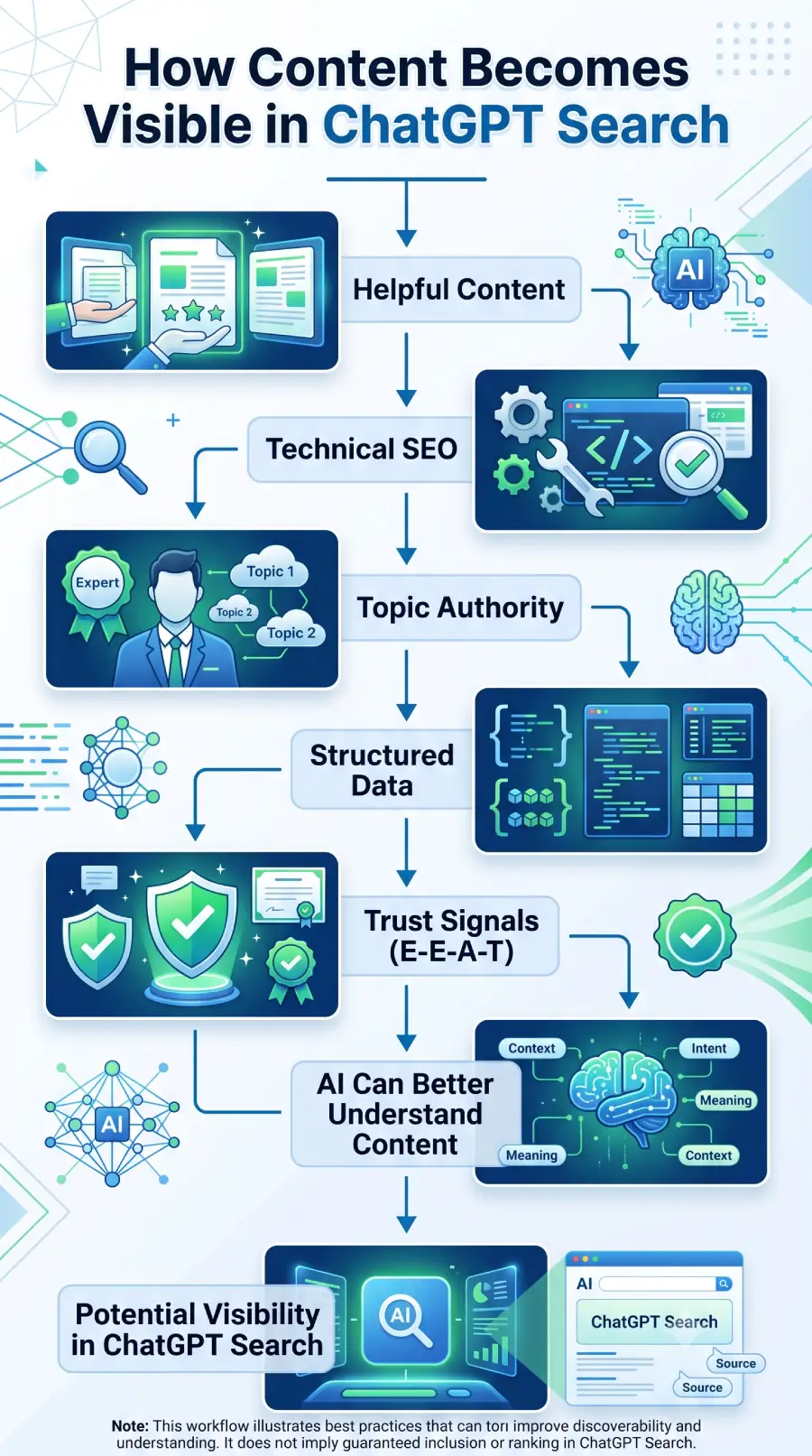
The honest answer is that you can’t optimize for it the same way you’d optimize for a traditional search engine. There’s no results page to climb, no fixed position to chase. ChatGPT Search generates an answer and, where it’s useful, points to the sources that informed it. Your job isn’t to win a ranking slot it’s to become the kind of source worth citing.
That means aiming for content that is:
- Helpful
- Accurate
- Well-structured
- Easy to understand
- Technically accessible
- Trustworthy
- Comprehensive
This guide breaks down what actually influences that outcome from foundational SEO to structured data to the trust signals AI systems seem to weigh heavily. If you want more background first, PostDune’s Complete Guide to AI Search in 2026 and ChatGPT Search Explained guides are a good starting point.
What Is ChatGPT Search, Exactly?
ChatGPT Search is a conversational search experience it combines natural language understanding with the ability to pull in current information from the web when a question calls for it. Instead of a results page, it answers directly, in plain conversational language.
Ask it something like “What are the best AI search engines in 2026?” and instead of ten separate links, you’ll typically get a synthesized answer drawing on several sources at once sometimes with those sources cited.
That changes the target. You’re not competing purely for position anymore. You’re trying to become a source an AI system can understand clearly enough, and trust enough, to actually reference.
Can You Really “Rank” in ChatGPT Search?
This is the most common misconception people bring to this topic. Unlike a traditional search engine, ChatGPT Search doesn’t produce a fixed, ranked list of pages the way a SERP does. There’s no public algorithm to reverse-engineer and no guaranteed slot to aim for.
What actually seems to matter is a mix of:
- Relevance to the question being asked
- Overall content quality
- Trustworthiness of the source
- Clarity of the writing
- Topical authority
- Freshness, for anything time-sensitive
- Whether reliable supporting information is available
A more useful way to frame the goal: make your content the kind of thing that’s easy for an AI system to understand and comfortable to rely on not something engineered to hit a ranking target that doesn’t really exist.
How ChatGPT Search Finds Useful Information
The internal mechanics aren’t public, but the rough shape of the process looks like this:
- A user asks a question
- The system interprets what they actually want
- Relevant information gets retrieved
- Candidate sources are weighed for reliability
- A response is generated
- Sources may be cited alongside it
Notice what’s absent from that list: keyword matching as the driving force. The emphasis is on answering the question well, not on hitting a target phrase a certain number of times.
Why Traditional SEO Still Matters Here
A common assumption is that AI search has made conventional SEO irrelevant. It hasn’t. A technically sound site is still the foundation everything else stands on good SEO is what lets any system, human or AI, actually find, crawl, and understand your content in the first place.
The same fundamentals that help you in traditional search also help you here:
- Clear, descriptive page titles
- A logical heading structure
- Fast-loading pages
- Mobile-friendly design
- Clean URLs
- Solid internal linking
- Genuinely helpful content
- A strong overall user experience
Think of AI search optimization as an extension of good SEO, not a replacement for it.
Step 1: Get Your Technical SEO Foundation Right
Before you think about anything ChatGPT-specific, make sure the basics are handled:
- HTTPS enabled
- XML sitemap submitted
- txt configured correctly
- Fast page speed
- Mobile responsiveness
- Canonical URLs in place
- Clean, logical navigation
- Fully crawlable pages
- Healthy Core Web Vitals
- Proper heading hierarchy
Skip these and even genuinely excellent content becomes harder for any search system to find.
Step 2: Publish Content That’s Actually Helpful
The single question worth asking before you hit publish: does this article genuinely answer the reader’s question?
Content that holds up over time tends to:
- Solve a real problem
- Explain concepts clearly, without unnecessary jargon
- Include concrete examples
- Anticipate and answer follow-up questions
- Stay accurate
- Get updated as things change
Write for the person reading it, not for a keyword list. That’s the strategy that keeps working regardless of how the algorithms shift underneath it.
Step 3: Cover Topics Comprehensively, Not Superficially
A short, surface-level article rarely establishes real expertise. Depth does. If your core topic is ChatGPT Search, for example, it’s worth surrounding that piece with related coverage how AI search works generally, platform comparisons, GEO and AEO fundamentals, and how to measure results so the topic is addressed from every angle a reader might need.
Step 4: Build Real Topic Clusters
Isolated articles carry limited weight on their own. A cluster a central guide supported by a network of connected pieces reinforces itself and everything linked to it.
AI Search Guide (Pillar)
- ChatGPT Search Explained
- What Is AI Search?
- How AI Search Works
- Generative Engine Optimization (GEO)
- Answer Engine Optimization (AEO)
- AI Search Analytics
- Website Optimization
Step 5: Optimize for Intent, Not Isolated Keywords
Rather than chasing a specific phrase, work backward from the question behind the search. For every piece, ask:
- What does the reader actually want to know?
- What problem are they trying to solve?
- What will they naturally ask next?
Content that satisfies real intent tends to stay relevant longer than content built around a keyword that may fade in popularity.
Step 6: Tighten Up Internal Linking
Internal links do two jobs at once they help readers explore related material, and they help search systems understand how your content fits together. Within an AI Search cluster, that might mean linking naturally to guides like How to Optimize Your Website for AI Search or How to Measure AI Search Traffic and AI Mentions wherever the context genuinely calls for it not by forcing every link into every article.
Step 7: Write for Humans First
AI systems are built to surface content that genuinely helps people, so writing for people first is also, functionally, writing for the AI. That means:
- Short paragraphs
- Descriptive headings
- Bullet points where they add clarity
- Tables for comparisons
- Concrete examples
- Visuals where they actually help
Skip unnecessary complexity and skip keyword stuffing. Neither reads well, and neither performs well.
Step 8: Strengthen Your E-E-A-T Signals
There’s no public evidence that ChatGPT Search runs on Google’s E-E-A-T framework directly. But the underlying qualities Experience, Expertise, Authoritativeness, Trustworthiness line up closely with what both readers and AI systems seem to value: information that’s accurate, well-supported, and credible.
Experience. Show your work. Original tutorials, real screenshots, case studies, and first-hand testing carry more weight than a repackaged summary.
Expertise. Cover topics thoroughly, define your terms, and keep articles current. Expertise is demonstrated through a body of work, not a single post.
Authoritativeness. This compounds over time through consistent publishing, earned backlinks, and a track record other sites and readers recognize.
Trustworthiness. Author information, visible publish and update dates, HTTPS, and cited sources all help here. So does honest framing a headline like “Guaranteed #1 Ranking in ChatGPT Search” undermines trust the moment a reader spots it; “Best Practices to Improve Your Visibility in ChatGPT Search” doesn’t.
Step 9: Add Structured Data (Without Overpromising What It Does)
There’s no confirmed evidence that schema markup alone gets your site cited by ChatGPT Search. What it does reliably do is improve machine readability, which supports discoverability more broadly. Worth implementing:
- Article Schema
- FAQ Schema
- Breadcrumb Schema
- Organization Schema
- Author Schema
- ImageObject Schema
- WebPage Schema
For certain content types, HowTo, VideoObject, or Product schema may also apply. Validate everything before it goes live broken markup is worse than none at all.
Step 10: Format for Both Readers and Machines
Good formatting benefits everyone reading your content, human or otherwise.
Use a clean heading hierarchy H1, then H2, then H3, without skipping levels.
Keep paragraphs short two to four sentences is a reasonable target.
Reach for lists over dense prose bullets, numbered steps, and checklists read faster than one long paragraph trying to do too much.
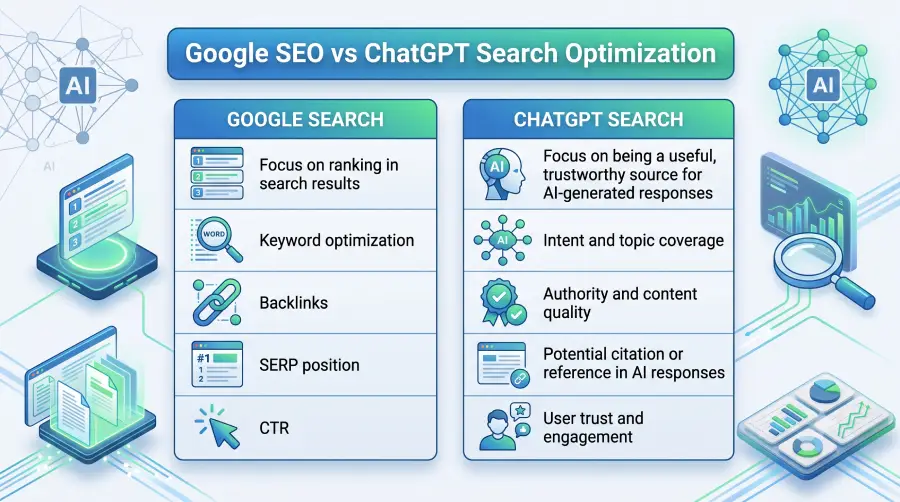
Use comparison tables where relevant:
| Traditional SEO | ChatGPT Search Optimization |
| Keywords | User intent |
| Rankings | Helpful answers |
| SERPs | Conversational responses |
| Backlinks | Authority and trust |
Step 11: Optimize Your Images
- Use descriptive filenames (chatgpt-search-seo-guide.webp, not image01.webp)
- Write alt text that describes the image, not a keyword string
- Compress images using WebP or AVIF
- Add genuinely useful visuals workflow diagrams, comparison charts, checklists
Step 12: Keep Technical SEO in Good Shape
Review regularly for:
- Page speed
- HTTPS
- XML sitemap health
- txt accuracy
- Mobile responsiveness
- Core Web Vitals
- Crawl errors
- Broken links
- Redirect issues
Step 13: Keep Content Fresh
AI search evolves quickly. Revisit important evergreen articles every few months and update statistics, examples, screenshots, internal links, and anything tied to platform changes. A visible “Last Updated” date also signals currency to readers.
Step 14: Measure What You Can
No single tool captures the full picture of AI-driven visibility. Combine Google Analytics 4 (organic sessions, referral traffic, engagement, conversions), Google Search Console (clicks, impressions, queries, indexed pages), and Bing Webmaster Tools (crawl health, index coverage) for a fuller view. For a deeper walkthrough, see How to Measure AI Search Traffic and AI Mentions.
Not every AI interaction is directly measurable, so treat this as directional rather than exact.
Common Mistakes That Undercut Visibility
Publishing thin content. Short, low-value articles rarely establish authority.
Ignoring user intent. Solve the reader’s actual problem, not just the keyword.
Keyword stuffing. Natural language reads better and performs better.
Weak internal linking. Disconnected articles waste an easy authority-building opportunity.
Neglecting technical SEO. Great content still needs to be crawlable and indexable to matter.
Chasing unsupported ranking tricks. There’s no documented formula that guarantees inclusion in ChatGPT Search. Be skeptical of anyone who says otherwise.
Quick Optimization Checklist
Content
- Comprehensive topic coverage
- Clear, direct answers
- Original insights or examples
- Updated information
- Helpful visuals
SEO
- Optimized title and meta description
- Clean URL
- Internal links
- Image alt text
Technical
- HTTPS
- Fast loading
- Mobile responsiveness
- Schema markup
Trust
- Author information
- Publication and update dates
- Reliable citations
Frequently Asked Questions
Can I guarantee my website will appear in ChatGPT Search?
No. There’s no publicly documented method that guarantees inclusion or a specific position. Focus on creating high-quality, trustworthy content relevant to what users are actually asking.
Does traditional SEO still matter?
Yes. Technical SEO, content quality, and user experience remain the foundation everything else builds on.
Is keyword optimization enough on its own?
No. Modern AI search prioritizes understanding intent and delivering comprehensive answers over keyword frequency.
Should I bother with structured data?
Yes. It helps search systems understand your content better, even though it doesn’t guarantee AI citations.
How often should I update my content?
Every three to six months for cornerstone articles, or sooner after a significant industry or platform change.
Does internal linking actually help?
Yes. A logical internal linking structure improves navigation, reinforces topical authority, and helps readers find related content.
Key Takeaways
- Create content that genuinely solves the reader’s problem
- Build topical authority through connected content clusters, not standalone posts
- Keep technical SEO and site performance solid
- Demonstrate real expertise and trustworthiness
- Use structured data where it fits, without overselling what it does
- Refresh content on a regular schedule
- Measure results with more than one tool, and think in trends
- Be skeptical of anyone promising guaranteed ChatGPT rankings
Conclusion
Optimizing for ChatGPT Search was never really about finding a hidden ranking factor. It’s about consistently publishing content that’s accurate, useful, and trustworthy enough that an AI system and the person using it can rely on it.
The qualities that make content valuable to a human reader clarity, depth, honest organization, credibility, a technically sound foundation are the same qualities that make it easier for AI systems to understand and reference. Combine those fundamentals with the platform-specific habits in this guide, and you’re building visibility that holds up regardless of how any single algorithm shifts.
Measure your progress through engagement, topical authority, and real business outcomes not through promises of guaranteed rankings. For more on the surrounding strategy, see PostDune’s guides on Generative Engine Optimization (GEO) and Answer Engine Optimization (AEO).