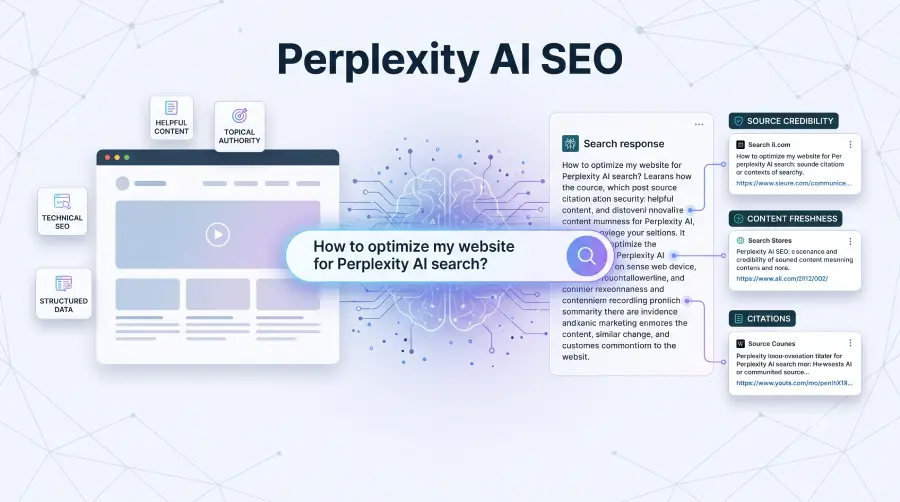
Perplexity has changed how a lot of people find answers online. Instead of scrolling through a page of blue links, you ask a question and get a written answer with sources attached. If you run a website, that raises a fair question: how do you get your content noticed by a tool like this?
This guide answers that question in plain terms. You’ll learn what Perplexity actually is, how it seems to choose its sources, and what practical steps make a page more likely to be found, understood, and used. None of this is a shortcut. There’s no trick that guarantees a citation from Perplexity or any other AI search tool. But there are habits that put your content in a much better position and they’re the same habits that tend to make a website genuinely useful to real people, too. For a broader look at how this shift is playing out across search generally, The Complete Guide to AI Search in 2026 covers the wider landscape this article sits inside.
What Is Perplexity AI?
Perplexity is what’s often called an AI answer engine. You type in a question, and instead of a results page, you get a direct written response usually with small numbered citations you can click to see where each piece of information came from.
A few things make it different from a typical search engine:
- You can ask it questions the way you’d ask a person. There’s no need to think in short keyword phrases.
- Sources are shown alongside the answer. You can check exactly where a claim came from.
- It supports follow-up questions. You can keep asking, and it remembers the context of the conversation.
- It mixes live web search with AI writing. Perplexity searches the web in real time, then uses a language model to turn what it finds into a readable answer.
For website owners, this matters because the goal isn’t only “get clicked” anymore. Being named as a source inside an AI-generated answer even without a click still puts your brand in front of someone who’s actively researching a topic. That’s a different kind of win than the one traditional SEO was built around, and it’s worth understanding on its own terms. If you want to see how this same shift is reshaping search habits more broadly, How AI Is Changing User Search Behavior in 2026 digs into that trend directly.
How Does Perplexity Search Work?
Nobody outside Perplexity knows the exact details of how it ranks or chooses sources. That system is proprietary, and like any search tool, it changes over time. So take the explanation below as a general idea of the process, not a confirmed technical breakdown.
Roughly speaking, here’s what seems to happen:
You ask a question → Perplexity figures out what you actually want to know → it searches the web for relevant pages → it checks how reliable and relevant those pages look → it writes an answer pulling the useful parts together → it adds citations so you can double-check the claims.
If you’re a website owner, don’t spend your time trying to reverse-engineer this. It’s not realistic, and it’s not the best use of your effort. Focus instead on making sure your content is easy to find, easy to read, and easy to trust. Those three things matter no matter how the underlying system changes.
Can You Actually Rank in Perplexity?
Not in the way you’d rank in Google. There’s no numbered list for a keyword, no “position one” to fight for. Instead, Perplexity picks a set of sources for each question as it’s asked, based on what looks relevant and credible at that moment. Ask the same question tomorrow, and it might pull from slightly different sources.
A few things worth knowing about Perplexity ranking:
- There’s no fixed position to hold onto, since answers are generated fresh each time.
- Whether your page gets used depends a lot on whether it clearly and honestly answers the question being asked.
- Being genuinely relevant and trustworthy matters more than targeting exact keyword phrases.
- Good SEO gets your content into the running it doesn’t guarantee it’ll be picked.
- Ranking on page one of Google doesn’t automatically mean Perplexity will cite you. The two work differently under the hood.
If you want a more useful question to ask yourself, try this one: “Would an AI system reasonably want to use my page to answer this question?” That framing tends to lead to better content decisions than chasing a ranking number that doesn’t really exist here.
Perplexity vs. Google Search vs. ChatGPT Search
It’s easy to lump these three together, but they don’t behave the same way. Google is still mostly link-based, with AI summaries added on top in certain situations. ChatGPT Search is a conversational assistant that can browse the web when needed. Perplexity, on the other hand, was built specifically around giving direct, cited answers that’s its main feature, not an add-on.
| Feature | Google Search | ChatGPT Search | Perplexity |
|---|---|---|---|
| Traditional results | Strong | Limited/contextual | Limited/contextual |
| Conversational answers | Increasing | Strong | Strong |
| Web retrieval | Strong | Available | Core experience |
| Source citations | Common | Often available | Important |
| Follow-up questions | Increasing | Strong | Strong |
| Traditional SEO | Important | Still relevant | Still relevant |
| AI-generated summaries | Increasing | Core feature | Core feature |
Keep in mind that all three platforms update frequently, so none of them work exactly the same way forever. If you want visibility across all of them, don’t try to game one platform’s specific quirks. Aim instead for content that’s clear, accurate, and well-organized those qualities tend to travel well across every search system. If ChatGPT Search is also on your radar, How to Rank in ChatGPT Search walks through that platform specifically, and Google AI Mode SEO covers the same territory for Google’s AI-generated results.
Why Perplexity Matters If You Run a Website
The old path was simple: someone searches, sees a results page, clicks a link. The newer path looks more like: someone asks a question, an AI tool researches it, writes an answer, credits its sources, and the person maybe visits one of them.
That “maybe” is the part worth sitting with. A page can be used inside an AI answer and never get a click. That’s still worth something brand visibility, credibility, and a mention in front of someone who’s actively interested in the topic even if it doesn’t show up neatly in your analytics. This “maybe” is essentially the same shift covered in The Rise of Zero-Click Searches: What It Means for Websites, and it’s worth reading alongside this section if the click-vs-citation distinction feels new.
In practice, this means your content now has two audiences: the people reading it, and the systems deciding whether it’s worth surfacing. The good news is they want the same basic things content that’s clear, honest, and actually useful.
Does Regular SEO Still Matter for Perplexity?
Yes, it does. AI search hasn’t made traditional SEO pointless it’s just changed what SEO alone can promise. Good SEO gets your page seen and read; it doesn’t guarantee an AI tool will pick it as a source. A few fundamentals still carry real weight:
- Being technically accessible. If a page can’t be crawled properly, nothing else on this list matters, because it can’t even be evaluated.
- Offering real value. Genuinely useful pages consistently beat pages stuffed with keywords.
- Having built-up authority. A track record of solid, credible content earns trust over time both with readers and with search systems.
- Giving people a good experience. Fast-loading, well-organized, easy-to-read pages serve everyone, human or machine.
- Linking your content together sensibly. Internal links help establish how your pages relate to one another.
One thing not to assume: that ranking well on Google means Perplexity will automatically cite you. Think of solid SEO as a ticket to be considered, not a guarantee you’ll be chosen.
How to Optimize Your Website for Perplexity
There’s no single tactic that unlocks a citation. But these practices, taken together, make your content easier to find, easier to trust, and more likely to be exactly what an AI system needs to answer a question:
- Write content that actually helps. Solve a real problem instead of writing just to hit a word count or a keyword target.
- Answer the question first. Lead with the direct answer, then explain the details afterward.
- Match what the reader is really trying to do. A search for “best budget laptop” and “how does RAM affect laptop speed” need very different kinds of pages.
- Cover a topic thoroughly, not just once. A group of connected articles on a subject builds more authority than one standalone post.
- Show real expertise. Specific, accurate detail beats vague, generic statements every time.
- Share original research when you can. Even a small original survey or dataset stands out more than recycled statistics everyone else is using.
- Back up your claims. Link to credible sources whenever you state a fact.
- Keep your content current. Go back and update old pages so they don’t quietly become wrong.
- Link your pages to each other. This helps readers explore a topic and gives context to any system reading your site.
- Take care of the technical basics. Site speed, mobile-friendliness, and clean indexing all matter.
- Use structured data, but only where it’s accurate. Schema markup should describe what’s really on the page nothing more.
- Make the page pleasant to read. Clear layout, readable fonts, no aggressive pop-ups interrupting the content.
- Don’t skip image details. Descriptive file names and alt text help both accessibility and understanding of your content.
- Keep your brand information consistent. Your name, author details, and business info should match everywhere they appear online.
- Build topic clusters. A central “pillar” page supported by related, linked subtopics shows real depth on a subject.
None of these guarantee anything on their own. Together, though, they build a site that’s easier to crawl, easier to trust, and more likely to have the specific, well-supported answer a search system is looking for. If you want the fuller version of this checklist applied across AI search generally, not just Perplexity, How to Optimize Your Website for AI Search goes deeper on the same fundamentals.
What Makes Content Worth Citing?
Content earns a citation when it offers something a reader or an AI system assembling an answer can’t easily find in five other, nearly identical articles. That usually looks like: real data you collected yourself, explanations that are genuinely clearer than what’s already out there, actual research findings, expert insight, properly sourced statistics, practical examples, first-hand experience, and honest comparisons between options.
The common thread across all of these is originality. Rewriting information that’s already everywhere online doesn’t add much value not to a reader, and not to a system trying to pick the best source among many similar ones.
Structure Your Content Around Clear Answers
Here’s a small example of what a direct answer looks like:
What is Perplexity AI? Perplexity AI is an answer engine that combines real-time web search with AI-generated writing, giving users a direct, cited response instead of a list of links to click through.
Notice that the answer comes first, in a sentence or two, before any extra context. That structure makes content easier to scan for a reader in a hurry, and easier for a system to pull a clean answer from. It’s not a guaranteed path to a citation it’s just a habit that makes your content more usable, for people and machines alike.
Build Topical Authority Around Your Niche
Authority tends to come from a body of connected content, not one great article sitting on its own. A simple way to picture this is a pillar-and-cluster structure one broad overview page, supported by several linked pages that each go deeper into a specific angle. Readers can move from general to specific (or the other way around) without leaving your site, and your overall footprint on the topic gets stronger with every connected page you add.
What Is E-E-A-T, and Does It Matter Here?
E-E-A-T stands for Experience, Expertise, Authoritativeness, and Trustworthiness. It’s a quality framework that Google popularized not a confirmed Perplexity ranking factor but it’s still a genuinely useful lens for checking your own content.
- Experience means showing first-hand involvement: real testing, screenshots, or direct observations, rather than describing something you’ve only read about.
- Expertise means going deep enough on a subject that it’s obvious you know what you’re talking about.
- Authoritativeness builds slowly, through a track record of solid, credible work over time.
- Trustworthiness comes from accuracy, clear authorship, and honest sourcing.
Treat E-E-A-T as a standard for producing genuinely credible work, not a checklist to game.
Technical SEO and Structured Data, in Plain Terms
Technical SEO is the foundation that decides whether your content can be found in the first place. The basics include HTTPS, a working XML sitemap, correctly configured robots.txt rules, canonical URLs to avoid duplicate content issues, mobile-friendly design, fast page speed, and clean, accessible code.
Structured data (also called schema markup) is a bit of code added behind the scenes that describes what a page is about for example, marking a page as an Article, or identifying the author as a Person. It helps systems interpret your content correctly. It doesn’t guarantee a citation, and it should only describe what’s genuinely on the page don’t mark something as an FAQ, for instance, unless there’s an actual FAQ section there.
Keep Your Content Fresh
Freshness matters more in fields that change quickly technology, AI, finance, product comparisons, and anything tied to current events or software versions. The key habit here: update the actual facts, not just the “last updated” date. Changing a timestamp without updating anything meaningful is a surface-level trick that readers (and search systems) can usually tell apart from real maintenance.
Common Mistakes to Avoid
A handful of habits tend to undercut everything else on this list:
- Stuffing keywords in unnatural ways
- Publishing thin content that doesn’t really answer anything
- Copying what competitors have already written
- Leaving outdated statistics on the page
- Making claims without backing them up
- Ignoring basic technical SEO
- Skipping internal links between related pages
- Leaving out author information
- Failing to cite sources for facts and figures
- Writing only for AI systems while ignoring human readers
- Promising guaranteed citations no one can honestly make that promise, including this guide
How Do You Measure Perplexity Visibility?
This is genuinely harder to track than a traditional Google ranking, since there’s no public position to check. A few signals still help: referral traffic showing up in your analytics, changes in direct traffic that might be AI-driven, brand mentions appearing inside AI answers, your general search performance, and simply asking Perplexity relevant questions yourself now and then to see how (or whether) your site comes up. Treat all of this as a rough signal, not a precise metric this whole area is still fairly new. For a deeper walkthrough of tracking this kind of traffic across AI platforms generally, How to Measure AI Search Traffic and AI Mentions covers the analytics side in more detail.
A Few More Habits Worth Building
Beyond the basics, some smaller habits add up over time: write around the actual questions your readers ask, rather than short keyword fragments. Use clear, descriptive headings. Put the important information first, and explain the “why” afterward. Publish and revisit content on a steady schedule instead of only writing something new. Keep author bios detailed and genuine, not generic. Link directly to the original source behind any data point you mention. Avoid publishing near-duplicate pages that compete with each other. And don’t forget your older, high-value pages they deserve regular check-ins too, not just your newest posts.
Frequently Asked Questions
What is Perplexity AI? An AI-powered answer engine that searches the web in real time and writes a direct, cited answer instead of showing a list of links.
How does Perplexity Search work? It interprets what you’re really asking, searches the web, evaluates the sources it finds, and writes an answer with citations attached. The exact internal process isn’t public.
Can websites rank in Perplexity? Not in the traditional sense. There’s no fixed position sources are chosen fresh for each question.
How can I optimize my website for Perplexity? Focus on helpful, original content, clear direct answers, solid technical SEO, topical depth, and trustworthy sourcing.
How do I get cited by Perplexity? There’s no guaranteed way. Publishing original, well-sourced, clearly written content gives you the best realistic chance.
Does Google SEO help with Perplexity SEO? The fundamentals still help, but a high Google ranking doesn’t guarantee a Perplexity citation the two systems don’t work the same way.
Does schema markup help Perplexity ranking? It can help a system understand your page more clearly, but it won’t guarantee a citation, and it should always match what’s actually on the page.
Does Perplexity use backlinks? Backlinks likely support general site authority, similar to traditional SEO, but exactly how much weight they carry in Perplexity’s process isn’t confirmed publicly.
How important is topical authority? Very. A connected body of work on a subject tends to carry more weight than a single standalone article.
How can I measure Perplexity traffic? Watch referral and direct traffic patterns, track brand mentions, and periodically check how your site shows up when you ask Perplexity relevant questions yourself.
Is Perplexity replacing Google? Not currently. Google still handles far more search volume overall, and Perplexity is better understood as a growing, distinct category of AI answer engine.
What is Perplexity SEO? Perplexity SEO is the practice of shaping your website’s content and technical setup so it’s easier for Perplexity’s AI system to find, understand, and potentially use as a source.
The Bottom Line
Perplexity is a real shift in how people find information, but it doesn’t call for some secret playbook. The same qualities that make content genuinely useful to a reader clarity, honesty, and depth are what make it useful to an AI system deciding what to cite.
If you’re just getting started with Perplexity SEO, focus on the fundamentals: write content that actually helps people, answer questions directly, build depth around your topics, keep your technical SEO in good shape, and be transparent about your sources. Skip anything that promises guaranteed rankings or citations nobody can honestly deliver on that.
Build a site that would deserve to be cited, whether or not any particular AI tool picks it today. That approach holds up no matter how Perplexity, or any other AI search platform, changes in the future. For the bigger picture this article fits into, The Complete Guide to AI Search in 2026 and Why Users Are Switching from Google Search to AI Chatbots are both worth reading next.