
Search is changing shape. For two decades, “ranking on Google” meant landing on a page of ten blue links and hoping people clicked yours. That’s no longer the whole picture. With Google AI Mode, a growing share of searches now return a conversational, synthesized answer instead of a results list and that shift has publishers, marketers, and SEOs asking the same question in different words:
“How do I get my site to show up in Google’s AI answers?”
There’s no shortcut hiding in this guide. Anyone promising a guaranteed method to appear in AI Mode is selling something. What actually works is less exotic but more durable: build a site Google’s systems can trust to be accurate, well-organized, and genuinely useful because that’s the raw material AI Mode draws from when it assembles an answer.
This guide walks through what AI Mode actually is, how it differs from the search experience you already know, and the concrete steps you can take from content strategy to schema markup to give your site a realistic shot at being part of the answer.
If AI-powered search is new territory for you, it’s worth reading these foundational PostDune guides first:
- The Complete Guide to AI Search in 2026
- What Is AI Search?
- How AI Search Works
- Google AI Mode Explained
- Generative Engine Optimization (GEO): The Complete Guide
- Answer Engine Optimization (AEO): The Complete Guide
- How to Optimize Your Website for AI Search
They’ll give you the vocabulary and context this guide builds on.
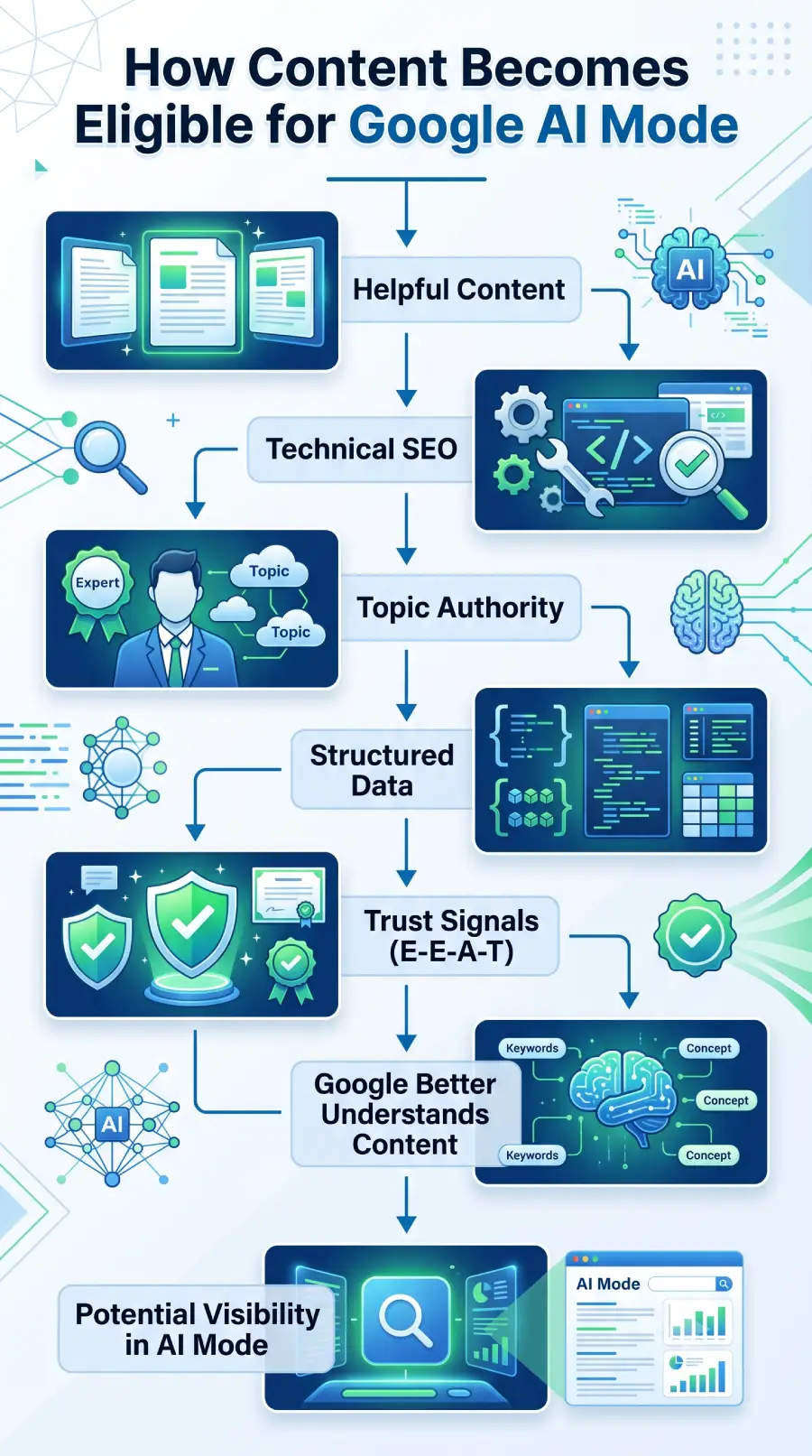
What Is Google AI Mode?
Google AI Mode is a search experience built around conversation rather than navigation. Instead of handing you a stack of links to sort through, it tries to understand what you’re actually asking, pull together relevant information, and hand back a direct, readable answer often with links to the sources it drew from.
In practice, that means AI Mode can:
- Parse a question phrased in ordinary, natural language
- Break a multi-part query into its component pieces
- Produce a synthesized, conversational response
- Prompt you toward useful follow-up questions
- Point to source pages when it’s helpful to do so
Picture someone typing: “What’s the best way to optimize a site for AI search?” A traditional results page would hand them ten separate articles to sift through. AI Mode, by contrast, might stitch together a single answer pulling from several trustworthy sources at once.
That’s a meaningful shift for anyone who publishes online. The competition isn’t purely about outranking other pages anymore it’s about producing content solid enough that an AI system finds it worth drawing from in the first place.
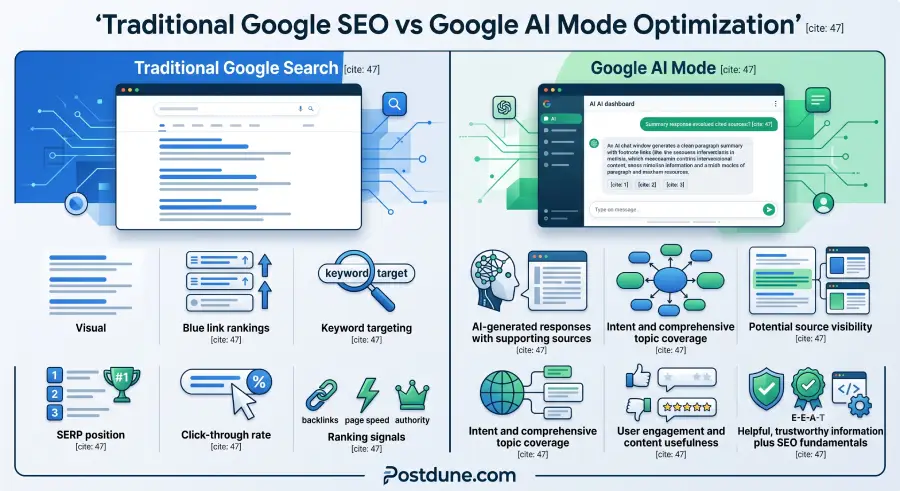
Google AI Mode vs. Traditional Search
Both experiences run on Google’s underlying infrastructure, but they solve the user’s problem differently.
| Traditional Google Search | Google AI Mode |
| Shows a ranked list of pages | Produces a conversational answer |
| User compares links manually | AI does the synthesis work |
| Rankings carry a lot of weight | Relevance and usefulness carry more weight |
| Keyword matching still matters | Understanding intent matters more |
| Multiple page visits per query | The answer may satisfy the query on its own |
None of this makes traditional SEO obsolete. It just means quality, clarity, and depth now pull more weight than they used to.
Can You Actually “Rank” in Google AI Mode?
Here’s a common misunderstanding worth clearing up early: there is no published, fixed ranking system for AI Mode the way there is for classic search results. Google hasn’t released an “AI Mode algorithm” you can reverse-engineer.
Instead, AI-generated answers draw on the same underlying signals Google already uses to judge whether content is relevant and trustworthy. Which means there’s no guaranteed formula for inclusion but there are things that meaningfully improve your odds:
- Genuinely helpful content
- Solid technical SEO
- Demonstrated authority on your topic
- Clear, logical organization
- Accurate, verifiable information
- A smooth, fast user experience
The mindset shift that matters most: stop chasing a specific SERP position and start building your site into a source Google’s systems can confidently rely on.
How Google AI Mode Chooses What to Cite
The exact mechanics are proprietary, but the general shape of the process looks something like this:
- A user asks a question
- Google interprets the intent behind it
- Relevant information across the web gets identified
- Candidate sources are evaluated for reliability
- The AI assembles a response
- Supporting sources may be referenced in that response
The takeaway isn’t the pipeline itself it’s what the pipeline is optimizing for: content that’s useful, accurate, and clearly relevant to what the person actually asked.
Get the SEO Fundamentals Right First
AI Mode doesn’t replace traditional SEO it sits on top of it. A technically sound website is still the foundation everything else gets built on. Before layering on AI-specific tactics, make sure the basics are covered:
- HTTPS enabled
- Mobile-friendly layout
- Fast page load times
- A working XML sitemap
- A clean robots.txt
- Correct canonical URLs
- Logical site structure
- Solid internal linking
- Fully crawlable pages
- Healthy Core Web Vitals
Skip these, and even excellent content becomes harder for Google to find and trust.
Write Content That Actually Helps People
Google has said, repeatedly and in different ways, the same core thing: content that genuinely serves the reader gets rewarded. That principle hasn’t changed with AI Mode if anything, it matters more.
Before publishing anything, ask:
- What problem is this reader trying to solve?
- What information are they actually looking for?
- What will they naturally want to ask next?
- Does this piece answer all of that, completely?
Writing to satisfy a keyword is a losing strategy in this environment. Writing to solve the reader’s actual problem better than anyone else has is the one that compounds.
Go Deep, Not Just Wide
AI Mode tends to draw more heavily from resources that treat a topic thoroughly rather than skim its surface. A 600-word overview rarely gives an AI system enough to work with. A guide that covers definitions, mechanics, real examples, comparisons, common pitfalls, and the questions people actually ask does.
If your core topic is Google AI Mode, for instance, depth means also covering adjacent ground Generative Engine Optimization (GEO), Answer Engine Optimization (AEO), technical SEO, semantic SEO, and AI Search Statistics 2026 so the topic is addressed from every angle a reader (or an AI model) might need.
Build Topic Clusters, Not Isolated Posts
A single strong article rarely carries much weight on its own. What tends to work is a cluster: a pillar page supported by a network of related articles that all reinforce each other.
AI Search Guide (Pillar)
- Google AI Mode Explained
- ChatGPT Search Explained
- Perplexity AI Explained
- Generative Engine Optimization (GEO)
- Answer Engine Optimization (AEO)
- AI Search Analytics
- Technical SEO
Each supporting piece adds weight to the cluster as a whole and to every other article inside it.
Optimize for What People Actually Want to Know
AI Mode is built to answer questions, not to match strings of keywords. Before you write a word, figure out:
- What’s the reader’s real goal here?
- What related questions will come up naturally?
- What misconceptions might they be carrying?
- What’s the practical, actionable answer?
- What real-world examples would make this concrete?
Content that fully resolves intent will consistently outperform content that just repeats a target phrase a dozen times.
Link Your Content Together Deliberately
Internal links do double duty: they help readers navigate, and they signal to Google how your content relates across your site. For a piece like this one, that means linking naturally to:
Core AI Search guides
- The Complete Guide to AI Search in 2026
- What Is AI Search?
- How AI Search Works
- Best AI Search Engines in 2026
Optimization guides
- Generative Engine Optimization (GEO)
- Answer Engine Optimization (AEO)
- How to Optimize Your Website for AI Search
- How to Measure AI Search Traffic and AI Mentions
Platform guides
- Google AI Mode Explained
- ChatGPT Search Explained
- Perplexity AI Explained
- Google Gemini Explained
- Microsoft Copilot Explained
- Claude AI Explained
Related reading
- AI Search vs Traditional Search
- How AI Is Changing User Search Behavior in 2026
- Why Users Are Switching from Google Search to AI Chatbots
- How ChatGPT Is Influencing Consumer Search Decisions
- The Rise of Zero-Click Searches: What It Means for Websites
Done well, this turns your site into a connected knowledge hub rather than a pile of unrelated posts.
Write for the Reader First, the Algorithm Second
The content that performs best in AI-powered search is, unsurprisingly, the content that reads best to an actual human. That means:
- Plain, direct language
- Short paragraphs
- Headings that describe what’s actually in the section
- Bullet points where a list is clearer than prose
- Comparison tables for anything with multiple options
- Original visuals, not stock filler
- Concrete examples over abstract claims
If your content is genuinely easy to use, it earns its place in both traditional rankings and AI-generated answers.
Strengthen Your E-E-A-T Signals
E-E-A-T Experience, Expertise, Authoritativeness, Trustworthiness isn’t a scoring system Google has published for AI Mode specifically. But it maps closely onto the broader qualities Google has said it values in helpful content, so it’s worth treating seriously.
Experience. Show that you’ve actually done the thing you’re writing about. First-hand testing, original screenshots, case studies, and real implementation details carry more weight than a generic summary ever will.
Expertise. Explain concepts clearly, define your terms, cover the subject completely, and keep the content current. One article rarely establishes expertise on its own a body of consistent, connected work does.
Authoritativeness. This builds slowly, through consistent publishing, earned backlinks, original research, and a track record of being a source people in your niche actually trust.
Trustworthiness. Accurate claims, visible author information, clear publish and update dates, and reliable references all send this signal. So does your phrasing compare a claim like “Guaranteed Google AI Mode Rankings” against “Best Practices to Improve Visibility in Google AI Mode.” The second is accurate. The first isn’t, and readers (and Google) can tell the difference over time.
Add Structured Data But Don’t Expect Miracles From It
Schema markup gives search engines explicit context about your content. It won’t guarantee a spot in an AI-generated answer, but it removes ambiguity that might otherwise work against you.
Worth implementing where relevant:
- Article
- FAQ
- Breadcrumb
- Organization
- Author
- WebPage
- ImageObject
Depending on the content, you might also add HowTo, Product, Review, VideoObject, or Event schema. Whatever you implement, validate it broken schema is worse than no schema.
Format for Readability
Google AI Mode has to parse and understand your content efficiently, which means the same formatting habits that help human readers also help the systems reading on their behalf.
Use a real heading hierarchy. H1 for the title, H2s for major sections, H3s nested underneath where needed. Don’t skip levels just because a smaller heading looks better visually.
Keep paragraphs short. Two to four sentences is a reasonable target. Dense blocks of text lose readers fast.
Reach for lists over long sentences. If you’re explaining several related points, a bulleted or numbered list is almost always clearer than cramming them into one paragraph.
Use comparison tables. When two or more things are being weighed against each other, a table communicates it faster than prose can.
Optimize Your Images Properly
Visual content pulls double duty it improves comprehension and keeps people engaged. A few habits that matter:
- Name files descriptively (“google-ai-mode-seo-guide.webp”, not “image123.webp”)
- Write alt text that actually describes the image, not a keyword dump
- Use modern, compressed formats like WebP or AVIF
- Include genuinely useful visuals: workflow diagrams, comparison charts, checklists, decision trees
Keep Your Technical SEO in Good Shape
None of the content work above matters much if Google can’t crawl and render your site properly. Keep a regular eye on:
- Page speed
- HTTPS status
- Mobile usability
- XML sitemap health
- txt accuracy
- Crawl errors
- Redirect chains
- Canonical tags
- Core Web Vitals
- Broken links
Refresh Content on a Schedule
AI search moves fast, and stale content shows. Set a recurring review cycle every few months for your most important pages and update:
- Statistics
- Screenshots
- Examples
- Internal links
- FAQs
- Anything tied to platform changes
Track the Right Metrics
No single tool captures the full picture of AI-driven visibility, so lean on a few in combination. See our guide on How to Measure AI Search Traffic and AI Mentions for a deeper walkthrough.
Google Analytics 4 organic traffic, engagement, conversions, referral traffic where it’s available.
Google Search Console clicks, impressions, search queries, indexing status, coverage issues.
Bing Webmaster Tools crawl health, search performance, and indexing on Bing’s side of things.
Look at trends over weeks and months rather than reacting to daily noise.
Mistakes That Undercut Your AI Mode Visibility
Chasing a guaranteed ranking. There isn’t one. Time spent hunting for a shortcut is time not spent improving actual quality.
Publishing thin content. Short, generic posts rarely establish the kind of authority AI Mode draws from.
Ignoring search intent. Know why someone is searching before you start writing the answer.
Weak internal linking. Disconnected articles miss an easy authority-building opportunity.
Letting content go stale. AI search evolves quickly; your evergreen pages need to keep pace.
Neglecting user experience. Slow pages, poor mobile design, and confusing navigation undercut everything else you do right.
Quick-Reference Checklist
Content
- Helpful, direct introduction
- Complete topic coverage
- Original examples
- Current information
- FAQ section
- Strong conclusion
SEO
- Optimized title and meta description
- Clean URL
- Internal links
- Descriptive image alt text
- Proper heading structure
Technical
- HTTPS
- Fast load times
- Mobile-friendly design
- Valid schema markup
- Working XML sitemap
- Fully crawlable pages
Trust
- Visible author information
- Publish date
- Last-updated date
- Reliable references
- Clear editorial standards
Frequently Asked Questions
Can I guarantee my site will show up in Google AI Mode?
No, Google hasn’t published a method that guarantees inclusion. The realistic goal is consistently high-quality, trustworthy content that improves your odds over time.
Is AI Mode replacing traditional SEO?
No. It builds on the same foundation technical health, content quality, and user experience all still matter.
Does adding schema markup guarantee visibility in AI Mode?
No. It helps Google understand your content more precisely, but it’s not a guarantee of citation.
Should I abandon keyword research?
No. Keywords still help you understand what people are searching for just use them naturally within content built to genuinely satisfy that intent.
How often should I update my AI search content?
Every three to six months for cornerstone pages, or sooner if a platform makes a major change that affects the topic.
Key Takeaways
- AI Mode rewards content that’s helpful, relevant, and trustworthy not tricks
- Traditional SEO fundamentals are still the foundation, not a relic
- Interconnected topic clusters outperform isolated articles
- Search intent matters more than keyword repetition
- Structured data helps machine understanding but doesn’t guarantee placement
- Technical health and speed remain non-negotiable
- Regular content refreshes keep you relevant as the landscape shifts
- Multiple analytics sources give a fuller picture than any single tool
- Be skeptical of anyone promising guaranteed AI Mode rankings
Conclusion
Google AI Mode isn’t a replacement for everything you already know about good content it’s an extension of it. The publishers who do well here are the ones already doing the fundamentals right: solving real problems, organizing information clearly, backing claims with evidence, and keeping their sites technically sound.
There’s no trick that substitutes for that work. But there is a reliable path: build depth into your topics, connect your content into real clusters, strengthen your trust signals, and keep refining as the landscape shifts. That’s a strategy that holds up regardless of how AI Mode itself continues to evolve.
For a deeper foundation, continue with PostDune’s The Complete Guide to AI Search in 2026, or dig into our companion guides on Generative Engine Optimization (GEO), Answer Engine Optimization (AEO), and platform-specific optimization for ChatGPT Search, Perplexity, Gemini, Copilot, and Claude.