
Search is going through one of its biggest changes since Google’s original search engine launched. For decades, the pattern was simple: type a few keywords, click through several websites, piece together an answer from whatever you found.
AI is changing that experience directly inside Google itself. Instead of only showing a list of links, Google is increasingly weaving in AI capability that can understand complex questions, work through information, and generate a conversational response and one of the most significant pieces of that shift is Google AI Mode.
AI Mode is built to let people explore a topic more naturally. Instead of running several separate searches with slightly different keywords, someone can ask a detailed question, get an AI-generated summary, and keep the conversation going with follow-ups.
Instead of separately searching “best laptop for students,” “laptop battery life,” “laptop for programming,” and “laptop under $1,000,” someone can just ask: “I’m a computer science student with a budget of $1,000. I need a laptop for programming, good battery life, and occasional gaming. What are my best options?” AI Mode is built to understand that full request and return one structured answer instead of four separate searches worth of legwork.
If AI-powered search is new to you, start with PostDune’s What Is AI Search? and the Complete Guide to AI Search in 2026, the cornerstone of PostDune’s AI Search content hub.
This guide covers what Google AI Mode actually is, how it works, its major features, real limitations, and what it means for SEO professionals, publishers, and businesses.
What Is Google AI Mode?
Google AI Mode is an AI-powered search experience combining Google’s existing search technology with generative AI to help people find information more efficiently. Rather than only returning a list of webpages, it’s built to understand natural language questions, interpret intent, retrieve relevant information, generate a conversational response, support follow-ups, and help people explore a topic more deeply. Instead of thinking in keywords, people can just talk to Google in complete sentences.
A Quick Example
Instead of searching “best DSLR camera beginner,” someone can ask: “I’m learning photography and have a budget of $800. Which DSLR camera would you recommend, and why?” AI Mode weighs budget, skill level, and intended use, then returns a structured response considerably easier to work with than a plain list of links.
Why Did Google Introduce AI Mode?
Search habits have shifted noticeably over the past few years. A lot of people now expect a search engine to answer questions directly, explain complex topics, compare products, summarize information, understand conversational phrasing, and support follow-ups rather than making them run several separate searches to get there.
AI Mode is Google’s answer to that shift part of the broader move toward conversational search covered in PostDune’s How AI Is Changing User Search Behavior in 2026.
How Google AI Mode Works
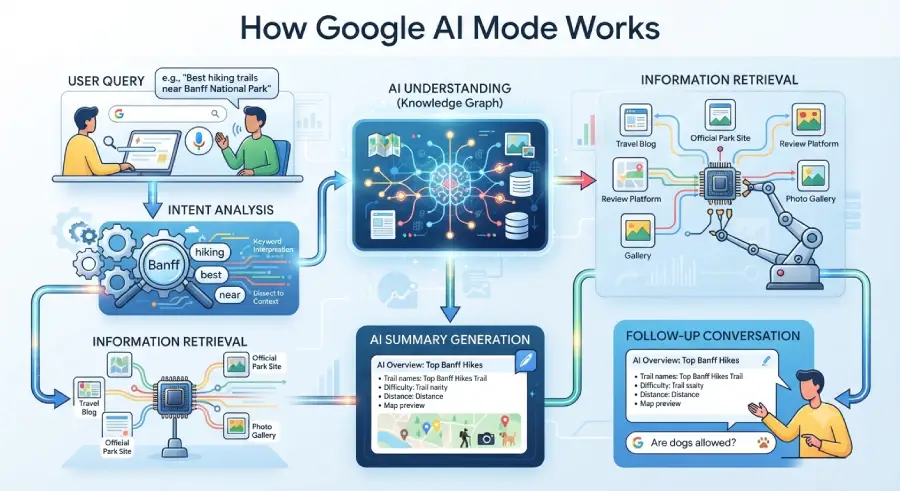
AI Mode looks simple from the outside, but several AI technologies work together behind it: question → intent analysis → natural language processing → information retrieval → reasoning → response generation → follow-up conversation.
Step 1: Understanding Intent
Every search starts with figuring out what someone’s actually trying to accomplish intent analysis. Take “what’s the best smartphone for travel photography under $700?” AI Mode picks out several distinct pieces: a recommendation is wanted, the budget is $700, photography is the priority, and travel use matters. Rather than matching just “smartphone” or “camera,” it reads the whole request as one connected goal this is one of the biggest differences between AI-powered search and old-fashioned keyword matching.
Step 2: Natural Language Processing
Once intent is identified, AI Mode uses natural language processing to work through the language itself grammar, sentence structure, context, synonyms, and how words relate to each other. That’s why people no longer need short keyword phrases. Instead of “best wireless earbuds,” someone can ask “which wireless earbuds would you recommend for someone who travels frequently and needs excellent noise cancellation?” and AI Mode understands both, while picking up the extra context in the second.
Step 3: Information Retrieval
After parsing the query, Google searches for relevant information. Rather than relying only on what the AI already knows, AI Mode pulls from Google’s actual search systems and combines that with reasoning producing responses genuinely tied to the question while still surfacing original web content where it’s useful.
Step 4: Reasoning
One of the bigger improvements AI-powered search brings is analyzing information before answering, rather than just echoing a single page. Asked to “compare mirrorless cameras for wildlife photography,” AI Mode might organize the response around image quality, autofocus, battery life, lens availability, price, and recommended models a structure that makes a genuinely complex topic easier to work through.
Step 5: Response Generation
Finally, AI Mode generates a conversational response summaries, comparisons, recommendations, explanations, lists, or step-by-step guidance instead of forcing someone to open several separate pages. From there, people can keep asking follow-ups without starting a new search.
Follow-Up Conversations
One of AI Mode’s bigger strengths is holding onto conversational context. “Recommend a beginner drone” followed by “which one has the best battery life?” gets understood as a question about the drones just suggested a noticeably smoother experience than typing a fresh keyword search each time.
Key Features of Google AI Mode
Conversational search ask naturally instead of thinking in keywords.
AI-generated summaries structured explanations combining relevant information into one concise response.
Follow-up questions continue the conversation without repeating the original search.
Multi-step queries handling detailed requests with multiple conditions, like “I’m visiting Italy for 10 days, love history and food, and have a moderate budget which cities should I visit?”
Context awareness remembering earlier parts of the conversation for more relevant follow-ups.
Personalized exploration suggesting related questions and topics rather than stopping at a single answer.
Why Google AI Mode Matters
AI Mode is more than a feature bolt-on it changes how people interact with information inside Google itself, making search more conversational, more intuitive, more efficient, more personalized, and better suited to genuinely complex questions. As AI search becomes the norm, people are drifting away from short keyword searches toward longer, more detailed conversations.
This trend is explored further in PostDune’s Why Users Are Switching from Google Search to AI Chatbots.
Google AI Mode vs. Traditional Google Search
AI Mode is built on Google’s existing search technology, but it changes the interaction model instead of a ranked list of webpages, it’s centered on understanding intent and generating a conversational response. Both approaches have real strengths, suited to different kinds of queries.
| Feature | Google AI Mode | Traditional Google Search |
| Search Style | Conversational | Keyword-based |
| Response | AI-generated summaries with supporting information | Ranked list of webpages |
| Follow-Up Questions | Supported | Not part of the same session |
| Complex Queries | Excellent | Often needs multiple searches |
| Research Assistance | High | Manual research across pages |
| Best For | Explanations, comparisons, planning, brainstorming | Official sites, local businesses, breaking news, specific pages |
A traditional search for “best budget smartphone for photography” typically returns product pages, review sites, videos, and shopping results to sort through manually. With AI Mode, someone can instead ask “I need a smartphone under $500 with a great camera and long battery life which models should I consider, and why?” and get one organized answer instead of a page of links to click through.
Google AI Mode vs. ChatGPT Search
Both AI Mode and ChatGPT Search offer conversational search, but they differ in focus and typical use.
| Feature | Google AI Mode | ChatGPT Search |
| Primary Focus | AI-powered web search | Conversational AI assistant with web search |
| Search Experience | Integrated with Google’s search ecosystem | Interactive, contextual conversation |
| Follow-Up Questions | Yes | Yes |
| Writing Assistance | Basic to moderate | Excellent |
| Brainstorming | Good | Excellent |
| Coding Help | Good | Excellent |
| Research Support | Strong | Strong |
| General Web Search | Excellent | Strong |
Choose Google AI Mode if you: prefer Google’s ecosystem, frequently search for products, travel, local businesses, or general web content, or want AI-enhanced search while keeping access to traditional results.
Choose ChatGPT Search if you: need help with writing, brainstorming, coding, or long-form explanations, or want an assistant that supports productivity beyond search. A lot of people genuinely benefit from using both, picking whichever fits the task. For a broader platform comparison, see Best AI Search Engines in 2026.
Benefits of Google AI Mode
Faster Access to Information
Instead of reading through several webpages, people get a concise AI-generated summary hitting the key points meaningfully cutting the time spent on common questions.
Better Handling of Complex Topics
AI Mode can explain technical subjects in a structured, conversational way. Instead of searching several separate pages about renewable energy, someone can ask “explain how solar panels work and compare them with wind turbines for residential use” and get an organized explanation back.
Genuinely Natural Conversations
People aren’t limited to short keyword phrases anymore they can ask detailed questions in everyday language and refine the discussion through follow-ups.
More Efficient Research
AI Mode can summarize information pulled from across the web, helping people identify the key ideas before digging into original sources in more depth particularly useful in the early stages of research.
Personalized Exploration
Rather than stopping at a single answer, AI Mode nudges people toward related topics through follow-up suggestions, creating a more interactive experience overall.
Better Support for Multi-Step Questions
Traditional search often needs several separate queries to cover a complex request. AI Mode can respond directly to something like “plan a five-day trip to Japan with a moderate budget, focusing on food, history, and public transportation” in one pass.
Limitations of Google AI Mode
Responses Aren’t Always Perfect
Like any generative AI system, AI Mode can occasionally produce responses that are incomplete, outdated, or inaccurate. Verify anything important especially medical, financial, legal, or safety-related against authoritative sources.
Some Topics Still Need Original Sources
AI-generated summaries are useful starting points, but they shouldn’t substitute for official documentation, research papers, or expert guidance when accuracy genuinely matters.
Availability Varies
Features, supported regions, languages, and account access can shift over time as Google keeps expanding and refining AI Mode.
Fewer Website Clicks
Because AI-generated summaries often answer questions directly, people click through to websites less often contributing to the broader rise of zero-click search, with real implications for publishers and SEO. Learn more in PostDune’s The Rise of Zero-Click Searches: What It Means for Websites.
Privacy Considerations
As with most AI-powered services, it’s worth reviewing Google’s privacy settings and understanding how interactions might be used to improve or personalize the service.
How Google AI Mode Impacts SEO
AI Mode is changing how sites earn visibility. Instead of optimizing purely for a spot among the blue links, publishers increasingly need content AI systems can understand, summarize, and reference accurately.
Helpful Content Matters Even More
Content needs to answer real questions clearly and completely. Articles that genuinely solve a problem are far more likely to be useful inside AI-assisted search.
Topical Authority Is Increasingly Important
A single article rarely cuts it for competitive topics anymore. Interconnected content clusters demonstrate real expertise a hub built around What Is AI Search?, How AI Search Works, Best AI Search Engines in 2026, and AI Search vs Traditional Search strengthens both topical authority and the overall reader experience.
Structured Content Improves Readability
Well-organized content with descriptive headings, bullet points, comparison tables, and concise summaries is easier for both readers and AI systems to work with.
Strong E-E-A-T Signals Still Matter
Google continues to weigh Experience, Expertise, Authoritativeness, and Trustworthiness. Publishers should demonstrate these through accurate, well-researched, regularly updated content.
Clear, Direct Answers Improve AI Visibility
Many AI systems favor content that answers the core question directly before adding detail. “Google AI Mode is an AI-powered search experience that combines Google’s search technology with generative AI to provide conversational answers, summaries, and support for follow-up questions” is the kind of concise definition that improves readability and helps people orient quickly.
Internal Linking Is More Valuable Than Ever
A thoughtful internal linking strategy helps readers find related content while giving search engines useful context. Genuinely related resources How AI Is Changing User Search Behavior in 2026, How ChatGPT Is Influencing Consumer Search Decisions, and The Rise of Zero-Click Searches turn isolated articles into a genuine knowledge hub.
Frequently Asked Questions
What is Google AI Mode?
Google AI Mode is an AI-powered search experience that lets people ask questions in natural language and get conversational, AI-generated responses alongside relevant web information built to simplify complex searches and make finding information more interactive.
Is Google AI Mode different from regular Google Search?
Yes. Traditional Google Search mainly shows a ranked list of webpages, while AI Mode focuses on understanding intent and generating a conversational answer. It’s still built on Google’s underlying search technology and still helps people discover web content.
Is Google AI Mode free?
Google offers a lot of its AI-powered search features without a separate fee, though availability can depend on region, account type, and which features are currently rolling out. Some advanced capabilities across Google’s broader ecosystem may require an eligible plan or subscription.
How does Google AI Mode actually work?
It combines natural language processing, machine learning, large language models, Google’s core search systems, and AI-generated summarization together interpreting a question, retrieving relevant information, and generating a conversational response.
Can Google AI Mode handle follow-up questions?
Yes, maintaining conversational context is one of its core strengths, letting people keep refining or expanding a discussion instead of starting a brand-new search each time.
Is Google AI Mode accurate?
It can produce genuinely helpful summaries, but like any AI system it can occasionally get things wrong or leave something out. For anything involving health, law, finance, or safety, verify against authoritative sources.
Does AI Mode replace traditional Google Search?
No. Traditional search remains valuable for official websites, breaking news, local businesses, product pages, and original sources. AI Mode complements it rather than replacing it outright.
How does Google AI Mode affect SEO?
It puts more weight on high-quality content, genuinely helpful answers, topical authority, strong internal linking, clear structure, and demonstrated expertise and trustworthiness. Publishers focused on comprehensive, user-first content are better positioned as AI-powered search keeps evolving.
Can websites still get traffic from Google AI Mode?
Yes. AI-generated summaries may reduce clicks for some purely informational queries, but sites publishing original research, expert insight, in-depth guides, and genuinely unique perspectives can still earn solid organic traffic. Strong branding and content that goes beyond a basic summary matter more than ever.
How should businesses prepare for Google AI Mode?
Create genuinely helpful content, build real topic clusters instead of isolated posts, keep information current, strengthen internal linking, demonstrate expertise through accurate content, and optimize for people and search engines together rather than leaning on keyword stuffing.
Key Takeaways
- Google AI Mode brings conversational AI directly into the core search experience
- People can ask detailed questions instead of relying on short keyword searches
- AI Mode supports follow-up conversations and more personalized exploration
- Traditional Google Search remains valuable for navigation, official resources, and breaking news
- High-quality, well-structured, trustworthy content continues to drive search visibility
- Building real topical authority through interconnected content matters more, not less
- Businesses and publishers should adapt content strategy to fit evolving AI search experiences
Conclusion
Google AI Mode marks a real step in how online search is evolving. Instead of expecting people to sift through dozens of webpages, it’s built to understand complex questions, organize information, and deliver a conversational response that saves time and improves the overall experience.
For everyday users, that means faster access to information and a more intuitive way to explore a topic. For businesses, publishers, and marketers, it brings both new opportunity and new challenge.
Success in this environment has less to do with optimizing for individual keywords and more to do with creating content that genuinely demonstrates expertise, answers real questions, and helps people get where they’re trying to go. AI-generated responses may change how people first encounter information, but original reporting, real expert analysis, and comprehensive resources remain essential sites that invest in those qualities build the kind of lasting trust that holds up as search technology keeps changing.
AI Mode is best understood as one piece of a broader shift toward conversational, intent-driven search. Publishers who lean into that shift and keep producing genuinely helpful, authoritative content will be well positioned for whatever comes next.