AI is changing how people search for information. Instead of typing a few keywords and clicking through several web pages, people can now ask a full question and get a detailed, conversational answer back in seconds.
Whether you’re using ChatGPT Search, Google AI Mode, Microsoft Copilot, Gemini, or Perplexity AI, the experience feels almost effortless you ask, it answers. But behind that simplicity is a genuinely sophisticated process involving several AI technologies working in sequence.
Where a traditional search engine mostly matches keywords against indexed pages, AI-powered search analyzes intent, works through natural language, retrieves relevant information, and generates a response actually shaped by the conversation. That’s what lets people explore a topic naturally instead of constantly rephrasing the same search.
If this is new territory for you, start with PostDune’s What Is AI Search? and the Complete Guide to AI Search in 2026 for the broader picture.
This guide walks through exactly how AI search works the technologies involved, how they interact, and why this approach is reshaping search.
What Actually Happens When You Ask an AI Search Engine a Question?
Asking an AI assistant a question can feel almost like magic. Ask “I’m planning a seven-day trip to Japan in October which cities should I visit if I enjoy food, history, and autumn scenery?” and within seconds you get a personalized itinerary instead of a page of travel sites to sort through yourself.
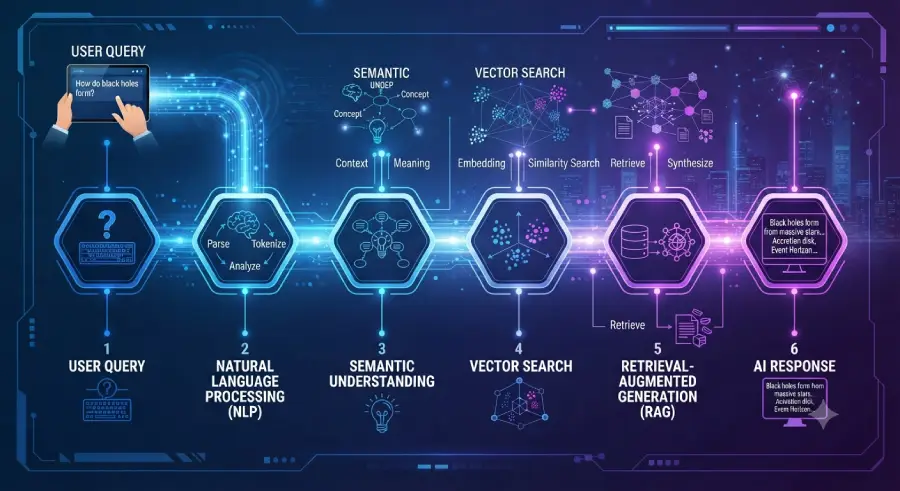
That instant response hides several genuinely sophisticated steps happening behind the scenes: question → intent analysis → natural language processing → semantic understanding → information retrieval → the language model → response generation → follow-up conversation. Each stage plays a real role in turning a human question into a useful answer worth walking through one at a time.
Step 1: Understanding User Intent
The first task is figuring out what someone is actually trying to accomplish intent recognition. Traditional search leaned heavily on keyword matching; modern AI search interprets the underlying goal instead.
Asked “I’m studying computer science and have a budget of $900 which laptop would you recommend for programming?”, the AI pulls out several distinct pieces: a recommendation is wanted, the primary use is programming, the budget is $900, the user is a student, and price-to-performance probably matters. Instead of weighing every word equally, it reads the relationship between them which is exactly why conversational search feels so much more natural than old-fashioned keyword search.
This shift toward understanding intent is reshaping search behavior broadly covered in more depth in PostDune’s How AI Is Changing User Search Behavior in 2026.
The Four Common Types of Search Intent
Informational: The user wants to learn something. “What is quantum computing?” “How does AI search work?”
Navigational : The user wants to reach a specific site or service. “Open Gmail.” “Visit the Microsoft website.”
Commercial investigation: The user is comparing options before deciding. “Best DSLR camera under $1,000.” “ChatGPT vs Gemini.”
Transactional: The user wants to complete an action. “Buy an iPhone.” “Book a hotel.”
Recognizing which of these is in play lets an AI system shape its response to actually match the goal, not just the words.
Step 2: Natural Language Processing (NLP)
Once intent is identified, the next step is understanding the language itself Natural Language Processing, the branch of AI focused on interpreting and generating human language.
Rather than fixating on individual keywords, NLP analyzes grammar, sentence structure, context, synonyms, word relationships, tone, and meaning. That’s why these four questions all get read as expressing the same basic intent, despite different wording:
- Which laptop is best for students?
- Recommend a good student laptop.
- What’s the best laptop for college?
- I need a laptop for university.
That flexibility is a big part of what makes AI search feel more forgiving than traditional keyword search.
Why NLP Actually Matters
Without it, AI search would struggle badly with everyday language. Ask “can you explain blockchain as if I were a beginner?” and NLP is what lets the system understand you want a simplified explanation not articles containing the literal phrase “blockchain beginner.” It can then adjust the response to match your actual level of familiarity with the topic.
Where NLP Shows Up in Everyday AI Search
- Understanding follow-up questions
- Automatically correcting spelling mistakes
- Recognizing abbreviations
- Identifying entities people, places, products, organizations
- Translating between languages
- Summarizing long documents
- Interpreting conversational, loosely-phrased requests
Because of NLP, people don’t need to think like a search engine anymore they can just talk the way they normally would.
From Keywords to Actual Conversations
Traditional search trained people to shorten everything “weather Delhi tomorrow.” Today’s AI search lets someone ask “will I need an umbrella if I’m visiting Delhi tomorrow afternoon?” instead. Both are after the same information, but the second one is just how a person actually talks.
This conversational shift is one of the biggest reasons people are moving toward AI-powered search explored further in PostDune’s Why Users Are Switching from Google Search to AI Chatbots.
Step 3: Semantic Search Understanding Meaning, Not Just Words
After intent and language processing, the next layer is semantic search understanding the meaning of a question rather than just matching the exact words typed.
Traditional search leaned heavily on keyword matching; if a query didn’t closely match the words on a page, relevance suffered. AI search instead looks at relationships between words, context, and underlying concepts to figure out what’s really being asked.
A Simple Example
“Best affordable smartphone,” “cheap phone with a good camera,” “budget mobile for photography,” and “best phone under $400 for pictures” are worded completely differently, but semantic search recognizes they’re all after roughly the same thing: a budget-friendly phone with a strong camera. Instead of treating these as unrelated searches, it connects them through meaning.
What Semantic Search Actually Improves
- Understanding synonyms and related phrasing
- Recognizing the context of an ongoing conversation
- Interpreting genuinely ambiguous questions
- Handling long, conversational queries
- Delivering more relevant answers overall
This is a big part of why AI-powered search feels more human than old keyword-based search ever did.
Step 4: Vector Search Finding Similar Information
Once the AI understands what a question actually means, it needs to find relevant information fast this is where vector search comes in.
Instead of storing information as plain keywords, modern AI systems convert text into numerical representations called vectors essentially a mathematical description of a sentence’s meaning. Instead of asking “does this document contain the exact word?”, vector search asks “does this document express a similar idea?”
A Simple Example
Ask “which laptop is good for programming?” and the system might retrieve documents about software development laptops, coding computers, “best notebooks for developers,” or programming workstations none of which necessarily use the literal phrase “good for programming,” but all conceptually related.
Why This Matters
- Better context understanding
- Improved search accuracy
- Higher-quality recommendations
- Better discovery of genuinely similar content
- More coherent follow-up responses
Vector search lets AI retrieve based on meaning instead of exact wording a meaningful upgrade over literal text matching.
Step 5: Retrieval-Augmented Generation (RAG)
One real challenge with language models is that their internal training doesn’t always include the latest information. Retrieval-Augmented Generation addresses that by combining AI-generated language with information pulled from external sources in real time instead of relying purely on what it already learned, the system searches for relevant, current information before actually generating a response.
Simplified Workflow
Question → retrieve relevant information → combine that data with the model’s own knowledge → generate the final answer.
Example
Ask “what are the latest AI search trends in 2026?” and a modern platform will typically retrieve recent information about AI search developments before generating its answer producing something considerably more current than knowledge alone could provide.
What RAG Actually Buys You
- Access to more current information
- Stronger factual grounding for the response
- Better answers on genuinely current events
- Improved reliability specifically when recent data matters
Because it combines retrieval with generation, RAG is a core piece of most modern AI search systems.
Step 6: Large Language Models (LLMs)
After retrieving the most relevant information, a Large Language Model handles the final step turning that collected information into a clear, coherent, conversational response. Rather than copying content word for word, the model works through what it has and generates a fresh explanation shaped to the specific question and context.
What an LLM Actually Does
- Explain genuinely difficult concepts clearly
- Summarize long documents
- Compare products and services
- Generate step-by-step guides
- Translate between languages
- Answer follow-up questions coherently
- Adapt explanations for different audiences
Example
Ask “explain cloud computing to a 10-year-old” and the model recognizes the audience and produces something noticeably simpler than it would for an IT professional asking the identical underlying question. That ability to adapt is one of the defining strengths of AI-powered search.
How All These Technologies Actually Work Together
Discussed separately, each piece sounds like its own system in practice, AI search runs them together as one workflow: question → intent recognition → NLP → semantic understanding → vector search → retrieval via RAG → the LLM generates a response → the user gets a conversational answer. Each stage builds on the one before it to produce something both relevant and genuinely easy to understand.
How AI Handles Follow-Up Questions
One of the clearest differences between AI search and traditional search is holding context across a conversation. “Recommend a mirrorless camera for beginners” followed by “which one has the best battery life?” gets understood as a question about the cameras just suggested no need to restate the original question. That conversational memory is what makes the whole experience feel smoother and considerably more efficient.
A Real-World Example: Planning a Trip
Take the earlier example in full: “I’m visiting Japan in October for ten days. I enjoy food, history, and autumn scenery. Which cities should I visit?”
Intent recognition: the AI identifies this as a request for personalized travel recommendations.
Natural language processing: it works out sentence structure, trip duration, interests, and destination.
Semantic search: it recognizes concepts like “autumn scenery,” “historical attractions,” and “food experiences.”
Vector search: it retrieves relevant travel information based on meaning, not exact keyword matches.
Retrieval-augmented generation: recent travel details get incorporated where they’re available.
The language model: finally generates a personalized itinerary Kyoto for autumn foliage, Osaka for food, Nara for cultural sites with a sensible travel sequence tying it together.
Instead of a page of links, the result is one structured answer built specifically around the request.
AI Search vs. Traditional Search Workflow
| Traditional Search | AI Search |
| Matches keywords | Understands intent |
| Displays webpages | Generates answers |
| User compares sources | AI summarizes information |
| Limited context | Maintains conversational context |
| New search for every question | Supports follow-up questions |
| Keyword-focused | Meaning-focused |
For a deeper look at this comparison strengths, limitations, and best use cases for each see PostDune’s AI Search vs Traditional Search.
Why Understanding This Workflow Actually Matters
Students can use AI more effectively for learning and research.
Content creators can write articles that answer real questions clearly and completely.
Business owners can build content that actually aligns with how conversational search works.
SEO professionals can shift strategy toward user intent and real topical authority instead of leaning purely on keywords.
Everyday users can ask more detailed questions and get more out of follow-up conversation.
As AI search keeps spreading, understanding how these pieces fit together is becoming a genuinely useful skill in its own right.
Benefits of AI Search Technology
AI search is more than a new interface for the same old search box it changes how people discover, understand, and actually use information. Combining language understanding with intelligent retrieval offers real advantages over keyword-only search.
Faster Access to Answers
Instead of opening five separate articles about “best project management software” and comparing them manually, an AI assistant can compare the leading options, explain their strengths, and recommend the one that actually fits your situation.
Genuinely Natural Conversations
People no longer have to think in keywords. “I’m starting a small online business with a limited budget which website builder should I choose?” gets understood in full, with reasoning attached to whatever gets recommended.
Better Handling of Complex Topics
AI search is particularly strong for learning explaining technical concepts in plain language, breaking large topics into manageable pieces, offering real examples, comparing related ideas, and handling follow-ups. Genuinely useful for students, professionals, and anyone learning something new.
Context-Aware Responses
“Recommend a beginner-friendly DSLR camera” followed by “which one is best for wildlife photography?” gets read as a follow-up about the cameras already discussed a smoother, more intuitive experience than starting fresh every time.
Real Productivity Gains
Professionals increasingly use AI search to research unfamiliar topics, summarize reports, compare software, brainstorm content ideas, draft emails, and organize information cutting down on repetitive research so there’s more room for actual decision-making and creative work.
Challenges and Limitations of AI Search
Information Isn’t Always Accurate
AI systems can occasionally produce information that’s incorrect, incomplete, or outdated especially for fast-changing topics. For anything involving health, finance, law, or safety, always check authoritative sources and qualified professionals.
Source Transparency Varies
Some platforms provide links or citations to supporting sources; others focus mainly on generating a summarized answer. Whenever sources are available, checking the original material helps verify accuracy and adds useful context.
Real-Time Knowledge Has Limits
Many systems rely on retrieval mechanisms or external data to stay current without access to recent data, a model may not reflect the latest developments, which is exactly why modern AI search increasingly pairs language models with RAG.
Privacy Is Worth Thinking About
Avoid entering genuinely confidential information passwords, banking details, personal ID numbers, confidential business documents, or sensitive customer data. It’s worth understanding a platform’s privacy policy before sharing anything sensitive.
Impact on Website Traffic
As AI search delivers direct answers, some informational searches generate fewer clicks to individual sites closely tied to the growth of zero-click search, where people get what they need without visiting a webpage at all. See PostDune’s The Rise of Zero-Click Searches: What It Means for Websites for how publishers are adapting.
How This Is Shaping SEO and Content Creation
The rise of AI search is pushing website owners to rethink how they build content. Instead of optimizing purely around keywords, what’s working now emphasizes comprehensive topic coverage articles that genuinely, completely answer a question tend to be useful for both readers and AI systems alike and clear structure: descriptive headings, logical organization, comparison tables, and concise explanations that improve readability and discoverability at the same time.
Frequently Asked Questions
How does AI search actually understand my question?
It uses natural language processing to identify intent, context, and meaning, then retrieves relevant information and generates a response shaped by all of that.
What is semantic search?
It’s the practice of understanding the meaning behind a query instead of matching exact keywords which lets AI deliver relevant results even when different people phrase the same idea completely differently.
What is vector search?
It represents text as numerical vectors so AI can retrieve information based on semantic similarity rather than requiring an exact keyword match.
What is Retrieval-Augmented Generation (RAG)?
It combines information retrieval with language generation before answering, the AI retrieves relevant external information to improve accuracy and relevance, especially for anything current.
What role do large language models actually play?
They analyze the question and generate a natural, conversational response built from whatever information the system has gathered.
Is AI search replacing traditional search engines?
No, it complements traditional search rather than replacing it. Traditional search is still the better tool for official websites, local businesses, current news, and original source material.
Why does AI search feel so much more conversational?
Because it holds context across multiple questions, letting people continue a conversation naturally instead of repeating earlier information every time.
Can AI search actually get things wrong?
Yes. Even as it keeps improving, responses should still be verified for anything important especially healthcare, legal, or financial decisions.
Is AI search genuinely useful for businesses?
Yes, commonly used for market research, customer support, competitive analysis, brainstorming, and general productivity gains.
What skills matter more in an AI search world?
Understanding conversational search, evaluating information critically, producing genuinely high-quality content, and building real topical expertise are all becoming more valuable as AI search keeps maturing.
Conclusion
AI search represents a real evolution in how people discover information online. By combining natural language processing, semantic search, vector search, retrieval-augmented generation, and large language models, modern AI search delivers a noticeably more intuitive, conversational experience than keyword-based search ever could on its own.
Understanding this workflow helps people ask better questions, evaluate AI-generated answers more critically, and appreciate what’s actually powering the platforms they use every day.
For businesses, marketers, and publishers, this shift underscores something simple: comprehensive, trustworthy, genuinely user-focused content matters more, not less. As AI search keeps evolving, sites that demonstrate real expertise, answer questions clearly, and build strong topical authority will stay visible.
AI search isn’t replacing traditional search so much as expanding how people access information in the first place. The future of search looks like both approaches working side by side, each helping people find what they need a little more efficiently.