There is a number in the tech industry right now that is hard to ignore.
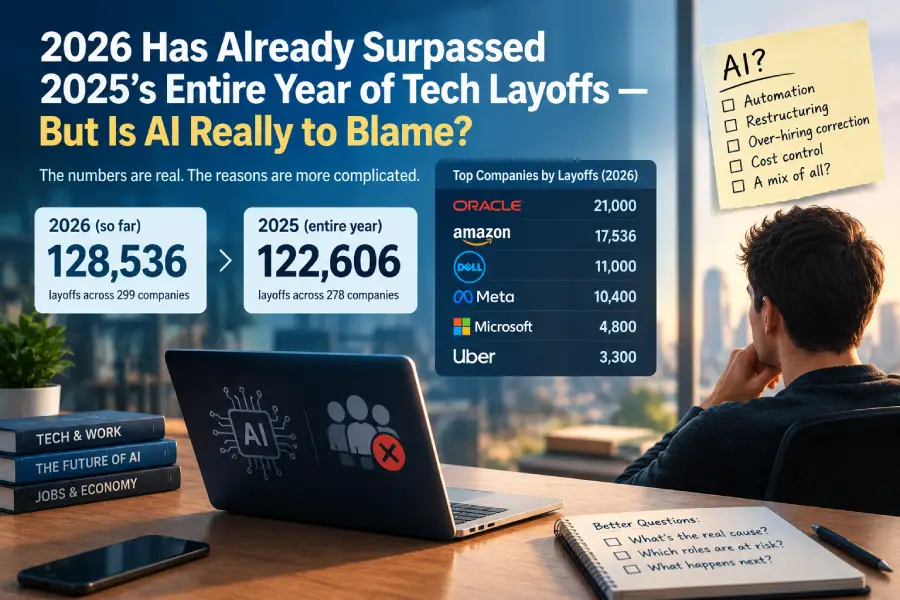
By September 10, 2026, more than 128,500 technology workers had been laid off across 299 companies, according to Layoffs.fyi. That has already surpassed the 122,606 layoffs recorded across 278 companies during all of 2025 with months still left in the year.
It would be easy to turn that statistic into a familiar headline:
AI is taking tech jobs.
But the reality is more complicated.
AI is clearly part of the story. Some companies have explicitly linked workforce reductions to AI-driven efficiency and automation. Others are restructuring, cutting costs, correcting years of aggressive hiring, or redirecting investment toward new parts of their businesses.
Putting all of those layoffs under the “AI” label risks missing what is actually happening in the technology labor market.
The companies behind the numbers
Some of the biggest names in technology are responsible for a large share of this year’s cuts.
According to Layoffs.fyi’s current tracking:
- Oracle: 21,000
- Amazon: 17,536
- Dell: 11,000
- Meta: 10,400
- Microsoft: 4,800
- Uber: 3,300
The exact numbers can change as companies make additional announcements and trackers update their records. But the overall picture is clear: the 2026 wave is being driven heavily by large technology companies.
And that makes the AI explanation tempting.
These are also many of the companies spending enormous amounts of money on artificial intelligence.
But correlation is not the same thing as causation.
AI is part of the story but it isn’t the whole story
There are real examples of companies connecting workforce changes to AI.
Oracle, for example, has acknowledged in regulatory filings that the adoption and deployment of AI technologies can contribute to workforce reductions. The company has also been investing heavily in cloud infrastructure and AI-related capacity.
Meta has also pursued major changes to its workforce and organizational structure around AI, although its experience shows how difficult it can be to translate AI ambitions into actual organizational transformation.
But other layoffs have much more familiar explanations.
Companies are still dealing with the consequences of the post-pandemic hiring boom. Between 2020 and 2022, technology companies expanded aggressively as demand for digital products and services surged. When economic conditions changed, many organizations began cutting costs and reassessing those hiring decisions.
That correction did not suddenly disappear when generative AI arrived.
In fact, the two forces are now happening at the same time.
A company might eliminate a position because it wants to reduce costs, while simultaneously investing in AI that allows a smaller team to handle more work.
So what caused the layoff?
The honest answer may be: more than one thing.
Why the AI headline can be misleading
There is an important difference between three statements:
“AI replaced this job.”
“AI helped the company become more efficient.”
“The company is restructuring while investing heavily in AI.”
Those statements can describe very different situations.
A company might eliminate 1,000 positions because revenue expectations changed. It might then use AI to automate some of the work that remains.
Another company might eliminate jobs specifically because new AI tools can perform tasks previously handled by employees.
A third might cut staff simply because management believes the company became too large during the pandemic-era expansion.
All three could appear in the same year’s layoff statistics.
That is why a single number cannot tell us how many jobs AI has actually replaced.
The 128,000 number still matters
None of this makes the 2026 layoffs insignificant.
The scale is substantial.
Layoffs.fyi’s current count puts 2026 at 128,536 technology layoffs across 299 companies, already above 2025’s full-year total of 122,606. The tracker also shows that 2023 remains considerably higher, at 265,660 layoffs.
That context matters.
The current numbers represent a major wave of workforce reductions, but they are not yet evidence of an unprecedented AI-driven collapse in technology employment.
They are better understood as a combination of restructuring, cost control, post-pandemic corrections, business failures, strategic shifts, and increasingly AI-related changes.
The more interesting question is what happens next
The biggest impact of AI on employment may not show up as a simple “AI layoffs” number.
It may appear gradually.
Companies may hire fewer people for certain roles. Teams may become smaller because employees can accomplish more with AI tools. Some entry-level work may disappear while new technical and oversight roles emerge.
That makes the labor-market impact harder to measure than a traditional layoff announcement.
And there is another complication: companies can use AI to reduce headcount in one part of the business while hiring elsewhere.
Gartner, for example, now expects that by 2029, 30% of employees laid off specifically because of AI replacement may eventually need to be rehired, reflecting the difficulty of predicting exactly which jobs AI will eliminate versus transform.
So even an AI-linked layoff does not necessarily mean that the underlying work disappears permanently.
What workers and businesses should actually watch
Rather than asking only how many people were laid off “because of AI,” there are better questions to ask.
Are companies reducing hiring for roles that AI can increasingly perform?
Are existing employees being asked to manage larger workloads with AI tools?
Which tasks are being automated rather than entire jobs?
Are companies replacing workers, or simply changing the skills they expect from them?
And perhaps most importantly:
Are productivity gains from AI creating new jobs and business opportunities fast enough to offset the work being eliminated?
Those questions will tell us much more about AI’s impact on employment than a single annual layoff figure.
The bottom line
The 128,536 vs. 122,606 comparison is real, and it is a significant milestone. But the statistic does not, by itself, prove that AI is responsible for most of the job losses.
AI is clearly influencing workforce decisions at some major technology companies. At the same time, post-pandemic over-hiring, cost-cutting, restructuring, weaker business conditions, and strategic changes remain important parts of the explanation.
The more accurate story is therefore less dramatic than “AI is taking 128,000 tech jobs.”
Tech companies are cutting heavily in 2026, and AI is one of the forces reshaping those decisions but it is not the only one.
The bigger story may be what happens after the layoffs: whether companies actually become more productive with smaller teams, whether AI creates enough new work to offset what disappears, and which roles survive the transition.
That part of the story is only beginning.