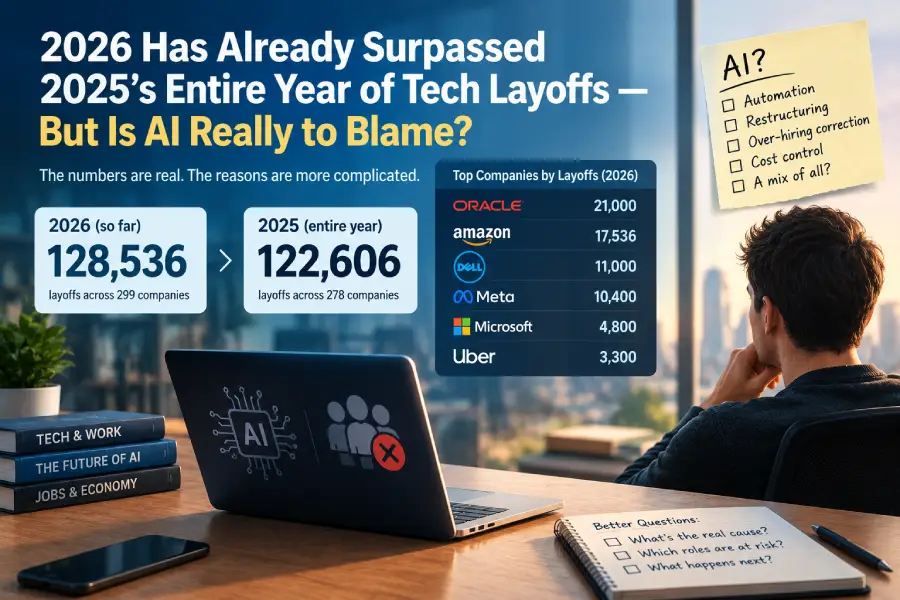
Quick answer: Tech layoffs in 2026 have already passed the whole of 2025. Layoffs.fyi counted 134,917 tech workers laid off at 328 companies by 21 October 2026, against 122,606 for all of 2025. AI is part of the reason, but cost-cutting, post-pandemic over-hiring and the huge cost of AI investment itself explain much of what is happening.
It is easy to turn the 2026 layoff numbers into a simple headline: AI is taking tech jobs. The reality is more complicated, and more useful to understand, whether you work in tech, hire in tech or invest in it.
2026 tech layoffs in numbers
| Measure | Figure | Source |
|---|---|---|
| Tech workers laid off in 2026 (to 21 Oct) | 134,917 at 328 companies | Layoffs.fyi |
| Tech workers laid off in all of 2025 | 122,606 at 278 companies | Layoffs.fyi |
| Point when 2026 passed 2025 | Late July 2026 | Layoffs.fyi via press reports |
| Announced US tech-sector job cuts, Jan–Sep 2026 | 165,925 | Challenger, Gray & Christmas |
| Record year for comparison (2023) | 265,660 | Layoffs.fyi |
Two things stand out. First, 2026 is well ahead of 2025: by late July, the monthly pace was roughly 17,500 cuts against about 10,200 a month in 2025. Second, 2026 is still unlikely to reach the 2023 peak. This is a big wave, not yet an unprecedented collapse.
Trackers count differently. Layoffs.fyi tracks publicly reported tech layoffs worldwide, while Challenger counts announced US job cuts in the technology industry, so the numbers will not match exactly.
Which companies are driving the cuts?
Large technology companies account for much of the total. Two of the most cited examples:
- Oracle disclosed about 21,000 job cuts in its annual report in June, and linked them to AI.
- Block cut about 4,000 roles, around 40% of its workforce, in February.
Companies headquartered in the San Francisco Bay Area account for nearly 59,000 of the 2026 layoffs counted by July, according to press analysis of Layoffs.fyi data.
Is AI really to blame?
AI is clearly part of the story. Some companies, Oracle included, now say openly that AI adoption contributes to workforce reductions. But “AI” covers three very different situations:
- AI replaced the work. A task that people did is now done by software.
- AI made the team more efficient. Fewer people can handle the same workload, so roles are not refilled.
- AI is expensive, so other costs are cut. Companies spending heavily on data centres and chips cut headcount to protect margins.
The third point is often missed. As analyst Rob Enderle put it to reporters this year, “It’s the cost of AI that’s causing the income statements to get out of whack.” In other words, some jobs are being cut to pay for AI rather than being replaced by it.
On top of that, the post-pandemic correction has not finished. Tech companies hired aggressively in 2020–2022 and many are still resizing.
Why the “AI layoffs” headline can mislead
A single layoff total cannot tell you how many jobs AI has actually replaced. One company may cut 1,000 roles because revenue forecasts fell and then use AI on the remaining work. Another may cut jobs specifically because AI now does them. A third may simply have grown too big. All three end up in the same annual statistic.
Investors have also changed their reaction. Earlier in the decade, layoff announcements often lifted share prices. In 2026, companies including Oracle and Cloudflare lost value after announcing cuts, which suggests markets are more sceptical of “efficiency” stories.
What happens next
The largest impact of AI on jobs may not show up as layoffs at all. It may show up as:
- Slower hiring for roles AI can partly do, such as support, junior coding and content production;
- Smaller teams handling bigger workloads with AI tools;
- Fewer entry-level openings, making it harder for new graduates to get a first job;
- New roles in AI operations, evaluation, security and governance.
That makes the true labour-market effect harder to measure than any tracker total.
What workers should do
- Learn to use AI tools in your own role. People who can direct AI well are harder to replace than people who compete with it.
- Build skills AI struggles with: judgement, client relationships, cross-team coordination and accountability for results.
- Keep an eye on hiring trends in your function, not only layoff news.
What businesses should ask
- Which tasks, not jobs, can AI reliably handle today?
- Are productivity gains real and measured, or assumed?
- Where will the people who understand our customers and systems come from if we stop hiring juniors?
How to tell whether AI is really replacing jobs at a company
When a company announces cuts and mentions AI, a few signals help separate genuine automation from a convenient explanation:
- Which teams are cut. If the reductions fall mostly on support, operations, content or junior engineering, where AI tools are already widely used, automation is more likely to be a real factor. Cuts spread evenly across sales, HR and product point more to cost control.
- Whether hiring continues elsewhere. Many companies cutting staff in 2026 are still hiring AI engineers and infrastructure specialists. That is a reallocation of budget, not a fall in demand for people.
- What the company spends on AI. Heavy capital spending on data centres and chips puts pressure on operating costs. Layoffs that follow big AI spending announcements are often about margins.
- What the filings say. Annual reports and regulatory filings are more careful than press releases. Oracle’s AI link, for example, appeared in its annual report.
- Whether roles are refilled later. If work comes back as contractor or outsourced roles months later, AI did not really replace it.
How to read layoff trackers
Layoff trackers are useful but imperfect. Layoffs.fyi relies on public reports, so it misses quiet cuts and small companies, and it counts global tech layoffs. Challenger, Gray & Christmas measures announced US job cuts by industry and includes some non-tech roles at tech companies. Government data such as the US Bureau of Labor Statistics JOLTS survey covers whole industries and is revised later. When you see a headline figure, check which tracker it comes from and what period it covers before comparing it with another number.
The bottom line
2026 has been a heavy year for tech layoffs, and AI is one of the forces reshaping those decisions. But the evidence points to a mix of causes: AI automation, AI spending pressure, restructuring and a long post-pandemic correction. The more useful story is not “AI took 135,000 jobs” but how companies and workers adapt as AI changes what work looks like.
Frequently asked questions
How many tech layoffs have there been in 2026?
Layoffs.fyi counted 134,917 tech employees laid off at 328 companies as of 21 October 2026.
Have 2026 tech layoffs passed 2025?
Yes. The 2026 total passed 2025’s full-year figure of 122,606 in late July 2026.
Is AI causing the 2026 tech layoffs?
Partly. Some companies cite AI directly, but cost-cutting, over-hiring corrections and the high cost of AI investment are also major factors.
Will 2026 be the worst year for tech layoffs?
Probably not. The 2023 total of 265,660 remains the record, and 2026 is not on pace to exceed it.
Related reading on PostDune
- OpenAI’s trillion-dollar IPO and its losses
- Why AI backlash is becoming a midterm election issue
- When the people building AI say “slow down”