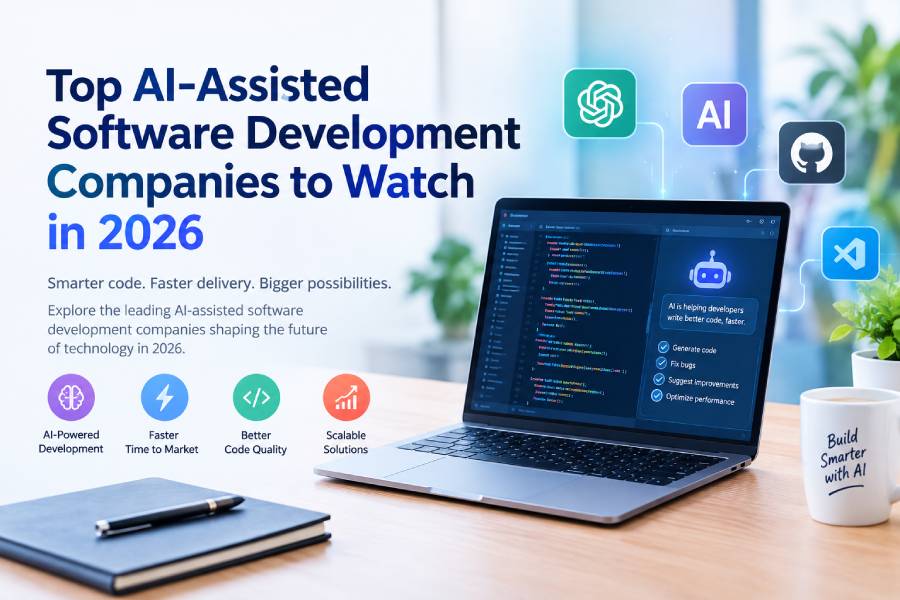
Two years ago, most software buyers asked a vendor whether its developers used AI coding tools. In 2026, that question sounds almost quaint. Nearly every serious engineering firm now uses AI somewhere in its delivery process. The better question is how well they use it, and whether that use actually shows up in your timeline, your code quality, and your invoice.
That shift has split the services market. On one side are firms that bolted a chatbot onto their sales deck. On the other are companies that rebuilt their delivery methods around AI agents, retrained thousands of engineers, and built governance to keep machine-written code safe and maintainable.
This guide looks at the second group. It explains why AI-assisted development matters for buyers this year, profiles the companies worth watching, and gives you a practical checklist for choosing a partner. The list mixes global IT services giants with mid-sized engineering specialists, because the right fit depends heavily on the size and shape of your project.
One note before we start: this is not a paid ranking, and the order is not a score. Company details below are drawn from public announcements and company pages, and you should confirm current offerings directly with any firm you shortlist.
Why AI-Assisted Development Matters in 2026
AI-assisted development means using AI models across the software lifecycle: writing and reviewing code, generating tests, documenting systems, analyzing old codebases, and increasingly, running multi-step tasks through AI agents. Human engineers still own the architecture, the decisions, and the final sign-off. The AI handles more of the repetitive and exploratory work in between.
Adoption is no longer the question
The numbers leave little doubt that AI is now standard practice. Google’s 2025 DORA report on AI-assisted software development, based on a survey of nearly 5,000 technology professionals, found that 90% now use AI at work, spending a median of about two hours a day with it. More than 80% said it improved their productivity, and 59% reported a positive effect on code quality.
The 2025 Stack Overflow Developer Survey tells a similar story: 84% of respondents use or plan to use AI tools, and about half of professional developers use them daily.
So when you hire a development firm in 2026, you are almost certainly hiring a team that uses AI. What separates vendors is maturity, not adoption.
The trust gap is the real story
Here’s the part vendors don’t always put in their pitch. The same Stack Overflow survey found that only 29% of developers trust the accuracy of AI output, and a large share said AI answers are often almost right but not quite. The DORA team reached a related conclusion: AI acts as an amplifier. Strong engineering cultures get stronger, while teams with weak testing, messy codebases, or unclear processes can simply produce problems faster.
That’s exactly why the choice of partner matters. A mature AI-assisted firm doesn’t just hand developers a coding assistant. It wraps AI output in code review, automated testing, security scanning, and clear accountability.
Where buyers actually feel the benefit
When it’s done well, AI-assisted delivery tends to help in a few specific places:
- Faster starts. Discovery, requirements analysis, and early prototypes can move quicker when AI helps draft specs, user stories, and scaffolding code.
- Better test coverage. Generating unit tests and test data is one of the areas where AI tools are most useful, which can lift quality on projects that historically skimped on testing.
- Legacy understanding. AI can read and summarize large, poorly documented codebases. For companies stuck on old COBOL, Java, or .NET systems, this is often the biggest win.
- Documentation that actually exists. AI makes it cheaper to keep documentation current, which lowers the cost of handing a system to a new team later.
The shift toward agents
The newer development in 2025 and 2026 is agentic AI: systems that can plan and carry out multi-step engineering tasks, such as upgrading a dependency across a codebase or migrating a module, with humans reviewing the results. Most large services firms now pitch some version of agent-driven delivery. Treat these claims with healthy skepticism and ask for evidence, but don’t ignore them. Agents are where much of the next round of productivity gains is likely to come from.
Top AI-Assisted Software Development Companies
The firms below were chosen because each has made specific, public moves in AI-assisted engineering: a named delivery platform, a major AI lab partnership, a new pricing model, or large-scale workforce training. Glossy marketing claims alone didn’t qualify anyone.
1. Accenture
Best for: Large enterprises running AI-assisted development across many teams at once.
Accenture is the biggest name here, with roughly 779,000 people worldwide. Its most notable 2025 move was a multi-year partnership with Anthropic, announced in December. The deal created a dedicated Accenture Anthropic Business Group, with about 30,000 professionals set to be trained on Claude and tens of thousands of Accenture developers getting access to Claude Code.
The two companies also announced a joint offering aimed at CIOs, focused on measuring the value of AI-powered software development and scaling it across an organization. Early industry solutions target regulated sectors such as financial services, life sciences, health, and the public sector. Accenture has a separate agreement with OpenAI too, so it isn’t tied to one model provider.
The trade-off is familiar: Accenture is built for large, multi-year programs. Smaller buyers may find the engagement model heavier and pricier than they need.
2. Cognizant
Best for: Enterprises that want AI embedded in a structured engineering platform, especially in financial services, insurance, and life sciences.
Cognizant has leaned hard into AI-assisted delivery. In November 2025, it announced it would roll out Anthropic’s Claude to up to 350,000 associates and use Claude Code for coding, testing, documentation, and DevOps work. The models plug into Flowsource, Cognizant’s engineering platform.
The relationship deepened in July 2026, when Cognizant became a Global Premier Partner in Anthropic’s Claude Partner Network. According to ITBrief’s coverage, more than 30,000 staff had completed Claude training by then, and Flowsource now pairs an agentic workforce with human engineers. Cognizant describes its approach as model-agnostic, which matters if you don’t want to be locked to one AI vendor.
3. Infosys
Best for: Large-scale engineering and modernization programs, particularly for companies already working with Indian IT services providers.
Infosys has organized its AI work under Infosys Topaz, and its agentic services suite, Topaz Fabric, sits at the center of its delivery approach. In 2026, the company signed two notable engineering partnerships. The first, with Cognition, integrates the Devin AI software engineer into Infosys’s internal teams and client delivery, after six months of internal use. The second, announced in April 2026, is an OpenAI collaboration centered on Codex, with an early focus on software engineering, legacy modernization, and DevOps automation.
That multi-vendor approach is a real strength. Infosys can match different tools to different jobs rather than pushing one assistant everywhere. Its February 2026 AI-first framework also lists agentic legacy modernization as a core offering, using agents to reverse-engineer old systems before changing them.
4. EPAM Systems
Best for: Complex product engineering and companies that want to build AI-native ways of working inside their own teams.
EPAM has deep engineering roots, having been founded in 1993, and it has turned that into a structured AI methodology called AI/Run. The approach bundles AI assistants, workflow libraries, and a GenAI orchestration platform (DIAL) that works across public and proprietary models.
Testing is a standout area. In late 2025, EPAM launched Agentic QA, which uses purpose-built agents to build and maintain regression test suites and bridge the gap between manual and automated testing. For buyers worried about AI-generated code quality, a vendor with serious testing automation is a sensible pick.
5. Thoughtworks
Best for: Enterprises with tangled legacy estates that also want strong engineering discipline.
Thoughtworks has long been known for its influence on agile and continuous delivery practices. In January 2026, it launched AI/works, an agentic development platform built for messy, hybrid enterprise environments rather than clean-slate projects.
AI/works uses AI-assisted reverse engineering to read legacy applications and turn them into structured specifications. Those specs then drive agent workflows that generate code, tests, and deployment pipelines. A collaboration with Mechanical Orchard extends the platform to mainframe modernization. Thoughtworks says early clients have compressed modernization timelines from years to months, though that’s a company claim you should test against references. At launch, access was through a co-innovation program, so confirm current availability.
6. Globant
Best for: Buyers who want outcome-linked or subscription pricing instead of classic time-and-materials billing.
Globant’s most interesting move is commercial as much as technical. In June 2025, it introduced AI Pods, a subscription model where clients pay monthly for AI-powered delivery capacity measured in tokens rather than billed hours. The work is performed by agents running on Globant Enterprise AI and supervised by Globant experts.
The platform is model-agnostic, and its Coda agent suite covers code generation, testing, and deployment. Globant also describes itself as Latin America’s largest Preferred Claude Services Partner. For North American buyers, its nearshore base in Latin America offers time-zone overlap. The subscription model is new, so read the contract terms around scope, quality guarantees, and what happens when token capacity runs out.
7. Endava
Best for: Mid-to-large organizations in financial services, payments, and travel that want governance built into AI delivery.
Endava has rebuilt its delivery process around Dava.Flow, an AI-native engagement methodology with four phases: Signal, Explore, Govern, and Evolve. The emphasis is on control, with policy checks in the pipeline and human oversight at key gates.
In February 2026, Endava expanded its partnership with Cognition, bringing the Devin agent and the Windsurf agentic IDE into Dava.Flow. A useful detail: Endava shapes “agent-ready” backlogs early, so AI tools work on well-defined tasks rather than vague tickets. That’s a practical sign of maturity.
8. Netguru
Best for: Startups and mid-sized companies building digital products or AI-powered features on a moderate budget.
Not every project needs a global giant. Netguru, based in Poznań, Poland, is a product development company that lists AI development and AI agent development among its core services, alongside product design, web development, and commerce engineering. Its services cover RAG, AI assistants, agent orchestration, guardrails, and monitoring.
Netguru hasn’t announced a named agentic platform on the scale of the firms above, so treat it as a strong option for building AI-enabled products rather than for transforming a huge engineering organization. For a focused product build, a smaller team can mean more senior attention and faster decisions.
Quick comparison
| Company | Headquarters | Notable AI initiative | Best fit |
|---|---|---|---|
| Accenture | Dublin, Ireland | Accenture Anthropic Business Group; OpenAI agreement | Enterprise-wide AI programs |
| Cognizant | Teaneck, New Jersey, US | Claude across Flowsource; Global Premier Partner | Platform-led enterprise delivery |
| Infosys | Bengaluru, India | Topaz Fabric; Cognition and OpenAI partnerships | Large engineering and modernization |
| EPAM Systems | Newtown, Pennsylvania, US | AI/Run methodology; Agentic QA | Complex product engineering |
| Thoughtworks | Chicago, Illinois, US | AI/works agentic platform | Legacy-heavy enterprises |
| Globant | Luxembourg | AI Pods subscription model | Outcome-based pricing |
| Endava | London, UK | Dava.Flow; Cognition partnership | Governed delivery in regulated sectors |
| Netguru | Poznań, Poland | AI and agent development services | Startups and mid-sized product builds |
How to Choose the Right AI-Assisted Development Firm
Every vendor on the shortlist will tell you it’s AI-native. Your job is to find out what that means in practice. These are the areas that separate real capability from a rebranded sales deck.
1. Ask to see the workflow, not the slide
Request a walkthrough of how AI fits into their delivery process from requirements to release. Where do agents act on their own? Where does a human review and approve? Who is accountable when AI-generated code causes a production issue? A mature firm will answer these questions quickly and specifically. Vague answers are a warning sign.
2. Check how they protect code quality
Remember the trust gap from earlier: most developers don’t fully trust AI output. Good partners compensate with strong engineering hygiene. Ask about mandatory code review, automated test coverage targets, static analysis, and security scanning on AI-generated code. Ask how they measure rework and defect rates, and whether those numbers changed after AI adoption.
3. Clarify data security and IP ownership
This is where contracts matter most. Confirm which AI tools and models will touch your code, where your data is processed, and whether it could be used to train any model. Get clear written terms on who owns AI-generated code and how the vendor handles open-source licensing risks in generated output. If you work in a regulated sector, check alignment with your compliance obligations, such as data residency rules.
4. Look for model flexibility
The AI model market moves fast. A model that leads today may be overtaken within months. Firms that work across several providers, as Infosys, Cognizant, and Globant say they do, can switch tools without rebuilding your project. Ask whether you can require a specific model or keep everything inside your own cloud account.
5. Demand evidence behind productivity claims
You’ll hear numbers like “50% faster” or “modernization in months, not years.” Some may be true. But ask for client references with projects similar to yours, and ask how the vendor measured the gain. A pilot is the most reliable test: give two or three shortlisted firms a small, well-defined piece of work and compare speed, quality, and communication.
6. Understand the pricing model
AI changes the economics of delivery. If a vendor’s engineers are genuinely faster, billing purely by the hour may no longer make sense for you. Explore fixed-scope, outcome-based, or subscription options like Globant’s AI Pods. Whatever the model, make sure you know how scope changes, quality issues, and overruns are handled.
7. Match the firm’s size to your project
A global integrator brings scale, compliance depth, and industry frameworks, which suits a bank modernizing dozens of systems. A mid-sized specialist often brings senior attention and faster decisions, which suits a startup building a new product. Neither is better in the abstract. Pick the one whose typical client looks like you.
8. Check how they’ll upskill your team
The best engagements leave your internal team stronger. Ask whether the vendor will share its AI workflows, prompts, and guardrails, and whether it offers training. Otherwise, you risk becoming dependent on a partner’s tooling that walks out the door when the contract ends.
Questions to bring to your first call
- Which AI tools and models will your team use on our project, and who approves that list?
- How much of the code is AI-generated, and how is every line reviewed?
- What test coverage and security checks apply to AI-written code?
- Who owns the code, and can our data be used for model training?
- Can you share a reference client with a similar project and scope?
- How does your pricing reflect AI-driven productivity gains?
Final Thoughts
The AI-assisted development market in 2026 rewards buyers who look past the labels. Nearly every firm uses AI now. The companies worth watching are the ones that pair AI speed with engineering discipline: clear human accountability, serious testing, transparent data practices, and pricing that shares the gains with clients.
The firms in this guide are taking different routes. Accenture and Cognizant are betting on scale and deep AI lab partnerships. Thoughtworks and Infosys are pushing hard on agentic legacy modernization. Globant is rethinking how services are priced. EPAM and Endava are building methodology and governance around agents, while Netguru offers a lighter-weight option for product builds.
Start with your own situation, whether that’s a legacy platform, a new product, or a regulated environment. Then shortlist two or three firms, run a small paid pilot, and let real results decide.
Frequently Asked Questions
What is an AI-assisted software development company?
It’s a development firm that uses AI tools and agents throughout its delivery process, including coding, testing, documentation, and code analysis, while human engineers keep responsibility for architecture, review, and final decisions.
Is AI-generated code safe for production use?
It can be, but only with safeguards. Treat AI output like code from a fast but fallible junior developer: it needs review, automated testing, and security scanning before release. Ask any vendor exactly how they apply these checks.
Does AI-assisted development cost less?
Not automatically. AI can reduce effort on some tasks, but whether you save money depends on the pricing model. Time-and-materials contracts may not pass savings on, so consider fixed-scope or outcome-based terms.
Will AI replace the developers at these firms?
Not in the near term. Current evidence points to AI changing how engineers work rather than removing the need for them. Engineers spend more time on design, review, and orchestrating agents, and less on routine coding.
How do I verify a vendor’s AI claims?
Ask for a live demo of their workflow, reference clients with similar projects, and the metrics they used to measure productivity. A short paid pilot remains the most reliable test.