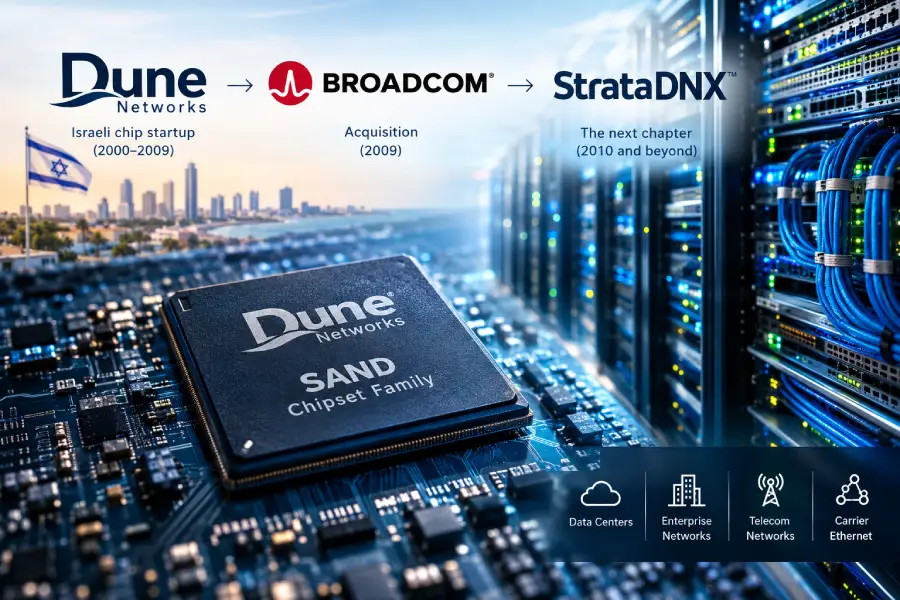
Dune Networks may not be a name most people recognize, but its technology has played a lasting role in modern networking infrastructure. The Israeli semiconductor startup was founded in 2000 and focused on a difficult problem: building networking chips capable of handling enormous amounts of data while allowing large systems to scale efficiently.
Dune Networks never became a consumer technology brand. Instead, its products were designed for the infrastructure behind data centers, telecommunications networks, enterprise systems, and other large-scale networking environments.
The company was eventually acquired by Broadcom in 2009 for a deal valued at approximately $178 million in cash, according to Broadcom’s disclosure at the time. After the acquisition, Dune’s technology became part of Broadcom’s networking portfolio and evolved into the StrataDNX product family.
What makes the Dune Networks story particularly interesting is that its technology did not simply disappear after the acquisition. Broadcom continued developing the architecture for years, while Dune’s founders later went on to build another networking semiconductor company that was acquired by Cisco.
Here’s a closer look at Dune Networks, its SAND chipset, the Broadcom acquisition, its technology’s evolution, and what happened to its founders.
What Was Dune Networks?
Dune Networks was an Israeli fabless semiconductor company founded in October 2000 by Eyal Dagan and Ofer Iny.
The company focused on networking silicon rather than consumer electronics. Its goal was to develop chips capable of powering high-performance networking equipment used by telecommunications providers, enterprises, and data centers.
As a fabless semiconductor company, Dune designed its chips but relied on third-party manufacturing facilities to produce them. This business model allowed the company to concentrate its resources on semiconductor design and networking technology.
Dune’s operations were centered in Israel, with reporting placing its engineering activity in Yakum, north of Tel Aviv. The company also maintained a Sunnyvale, California office for its US-facing operations and, according to some company records, its formal corporate headquarters.
The company raised funding through several rounds during its independent operation. Its Series A round closed in August 2002 with $24.1 million, followed by a $8.42 million Series A1 round in 2005. Dune later raised a Series B round in May 2009, shortly before the acquisition.
Known investors included U.S. Venture Partners and Pitango Venture Capital.
What Problem Was Dune Networks Trying to Solve?
The central challenge for Dune Networks was scalability.
As data centers and telecommunications networks became larger, traditional networking equipment faced increasing limits. Smaller switches could handle ordinary traffic loads but were not designed to scale to the requirements of large carriers and rapidly expanding data centers.
Large chassis-based systems could provide more capacity, but they often relied on proprietary architectures. That could make systems more expensive and less flexible when customers needed to expand or change their infrastructure.
Dune took a different approach.
Its networking architecture was designed around a family of chips that could work together to create a large switching system. This allowed network operators to expand capacity by adding additional components rather than replacing an entire architecture.
That scalability became one of the company’s most important advantages.
The Dune SAND Chipset
The core of Dune Networks’ technology was the SAND chipset family.
SAND was built around two major types of devices:
- Fabric Element (FE) chips
- Fabric Access Processor (FAP) chips
The two components performed different but complementary jobs.
FAP chips were used on individual line cards and handled packet processing and traffic management for data entering and leaving the system.
FE chips formed the switching fabric that connected those line cards together.
In simpler terms, the architecture separated packet processing from the underlying switching fabric. This helped create systems that could scale by adding more line cards and fabric capacity.
For the networking market of the early 2000s, the capabilities were significant.
Dune’s technology supported bandwidth speeds of up to 100 gigabits per second per port and could connect more than 10,000 server ports in a single deployment.
The technology was used across several markets, including:
- Data center networking
- Enterprise networking
- Carrier-grade Ethernet
- Large-scale telecommunications infrastructure
This gave Dune Networks an opportunity to serve multiple growing networking markets with a common architectural foundation.
Why Did Broadcom Acquire Dune Networks?
By the end of the 2000s, Broadcom had already become a major networking semiconductor company.
However, its existing strengths were concentrated more heavily in high-volume Ethernet switching chips used in smaller and fixed-configuration systems.
Dune Networks operated in a different part of the market.
Its technology targeted large, modular, highly scalable systems used by telecom carriers and major data center operators. That made Dune’s networking silicon strategically relevant to Broadcom’s expansion into higher-end switching.
On November 30, 2009, Broadcom announced an agreement to acquire Dune Networks.
The transaction was valued at approximately $178 million in cash, net of cash assumed from Dune, according to Broadcom’s disclosure. Other reports placed the gross transaction value closer to $200 million before adjustments.
The acquisition closed in the first quarter of 2010.
Following the deal, Dune’s technology was incorporated into Broadcom’s Network Switching business.
Dune Networks Acquisition: An Interesting Israeli Connection
The acquisition also included an unusual detail connected to Dune’s Israeli origins.
Broadcom’s later financial filings disclosed a $12.1 million settlement cost associated with a payment to the Israeli government. The payment was related to a post-acquisition technology transfer fee.
Israel has historically had rules involving technology developed with government support when that technology is transferred to foreign ownership through an acquisition.
The payment therefore provides an interesting example of how government-supported technology and international acquisitions can intersect within Israel’s technology sector.
Broadcom also provided restricted stock units to certain former Dune employees who joined the company following the acquisition.
What Happened to Dune Networks After Broadcom Bought It?
The most important part of the Dune Networks story may be what happened after the acquisition.
Unlike some startup acquisitions where the original technology is eventually discontinued, Dune’s networking architecture continued to develop inside Broadcom.
Broadcom rebranded the acquired product line as StrataDNX.
The technology also retained a connection to its origins. According to reporting referenced in the source material, Broadcom continued using “Dune” as an internal codename for the chip family even after the acquisition.
Later chip generations included names such as Qumran, Jericho, and Kalia, continuing the desert-themed naming associated with Dune.
The technology was not simply maintained. It continued to evolve.
Broadcom developed newer StrataDNX products, including Qumran-AX and Qumran-uX, targeting applications such as metro and edge networking.
The product family was used across a broad range of networking environments, including:
- Hyperscale data center core switches
- Carrier Ethernet aggregation
- Edge and core routers
- Optical transport networks
- Enterprise campus core switches
This continued development meant that the architectural ideas originating at Dune Networks remained relevant long after the startup itself had disappeared as an independent company.
How Long Did Dune Networks’ Technology Last?
Dune Networks was founded in 2000, but its technology continued to influence networking products well beyond the company’s independent existence.
That gives the Dune architecture a technological lineage spanning roughly two decades.
The significance is easy to miss because most network users never see the underlying semiconductor components. When someone streams a video, accesses a cloud application, or sends data across a large network, they generally interact with software and services rather than the switching silicon underneath.
But that infrastructure depends on specialized networking hardware.
Dune Networks was one of the smaller companies that helped develop that underlying technology.
Its name may have disappeared from the market, but its engineering work continued through Broadcom’s networking products.
What Happened to Dune Networks’ Founders?
Dune Networks’ founders went on to have another notable chapter in the semiconductor industry.
After the Broadcom acquisition, Eyal Dagan stayed with Broadcom. He eventually became Vice President and General Manager of its switching and routing business and worked with the DNX product line that developed from Dune’s technology.
In 2014, Dagan left Broadcom and co-founded another Israeli semiconductor company called Leaba Semiconductor.
Ofer Iny, his original Dune Networks co-founder, also joined the new company.
The business followed a similar model to Dune: an Israeli semiconductor startup focused on advanced networking technology.
Then, in March 2016, Cisco acquired Leaba Semiconductor.
Leaba’s technology later became part of what Cisco calls Silicon One, a networking silicon architecture that Cisco has positioned for large-scale networking applications, including cloud and AI infrastructure.
That means Dune’s founding team eventually repeated a remarkably similar journey:
Israeli networking startup → advanced semiconductor technology → acquisition by a major US technology company.
In Dagan’s case, this happened twice, first with Broadcom and later with Cisco.
Dune Networks and the Israeli Semiconductor Industry
Dune Networks is also an example of the role specialized engineering companies have played in Israel’s technology ecosystem.
The company was not trying to build a consumer app or a household technology brand. Its focus was much narrower: networking silicon.
That specialization allowed a relatively small team to work on a highly technical problem with applications across major infrastructure markets.
The company’s story also reflects a broader pattern seen in Israeli semiconductor and hardware companies. Engineering teams develop specialized technology, build a startup around it, and eventually become part of a much larger global technology company through acquisition.
In Dune’s case, the technology continued to develop after the acquisition rather than becoming a discontinued product.
Why Dune Networks Still Matters
Dune Networks is easy to overlook because the company itself no longer exists independently.
But its story highlights an important part of technology history: some of the most influential infrastructure companies are not consumer brands.
They operate behind the scenes.
Dune developed networking silicon for systems that needed to handle huge amounts of traffic. Broadcom acquired that technology and continued developing it through the StrataDNX family.
The company’s founders then went on to create another semiconductor company, Leaba Semiconductor, which was acquired by Cisco.
For anyone interested in semiconductors, data center networking, cloud infrastructure, or Israeli technology startups, Dune Networks provides an interesting example of how specialized engineering can have a much longer life than the company that originally developed it.
The company’s independent existence ended more than a decade ago, but the technology lineage continued.
And that may be the most interesting part of the Dune Networks story: the startup disappeared, but its engineering did not.
Frequently Asked Questions About Dune Networks
What did Dune Networks make?
Dune Networks developed networking switch-fabric chipsets known as the SAND chipset family. The technology was designed for large-scale data center, enterprise, and telecommunications networking equipment.
When was Dune Networks founded?
Dune Networks was founded in October 2000 by Eyal Dagan and Ofer Iny.
Who acquired Dune Networks?
Broadcom acquired Dune Networks in a transaction announced on November 30, 2009. The deal was valued at approximately $178 million in cash, according to Broadcom’s disclosure.
What was the Dune SAND chipset?
The SAND chipset was a family of networking chips built around Fabric Element (FE) and Fabric Access Processor (FAP) devices. The architecture was designed to support large, scalable switching systems.
What happened to Dune Networks after the acquisition?
Broadcom incorporated Dune’s technology into its networking business and developed it under the StrataDNX product family. Later generations included products such as Qumran and Jericho.
Are Dune Networks and StrataDNX connected?
Yes. StrataDNX represents the continuation of the networking technology Broadcom acquired from Dune Networks.
Who founded Dune Networks?
Dune Networks was founded by Eyal Dagan and Ofer Iny, who had previous experience in networking hardware.
What did Dune Networks’ founders do after the company was acquired?
Eyal Dagan remained at Broadcom before co-founding Leaba Semiconductor in 2014 with Ofer Iny. Cisco acquired Leaba in 2016, and its technology later became part of Cisco’s Silicon One architecture.
Is Dune Networks still a company?
No. Dune Networks ceased to exist as an independent company following its acquisition by Broadcom. Its technology and employees became part of Broadcom’s business.
Final Thoughts
Dune Networks may not have become a household name, but its technology became part of an important chapter in networking semiconductor history.
The company identified a difficult problem in large-scale networking, developed a scalable chip architecture, and attracted the attention of Broadcom. After the acquisition, the technology continued evolving under the StrataDNX family.
Its founders also went on to build another networking semiconductor company, creating a second connection between Israeli engineering and one of the world’s largest technology companies.
For a startup that operated largely behind the scenes, Dune Networks left a surprisingly long technological footprint.