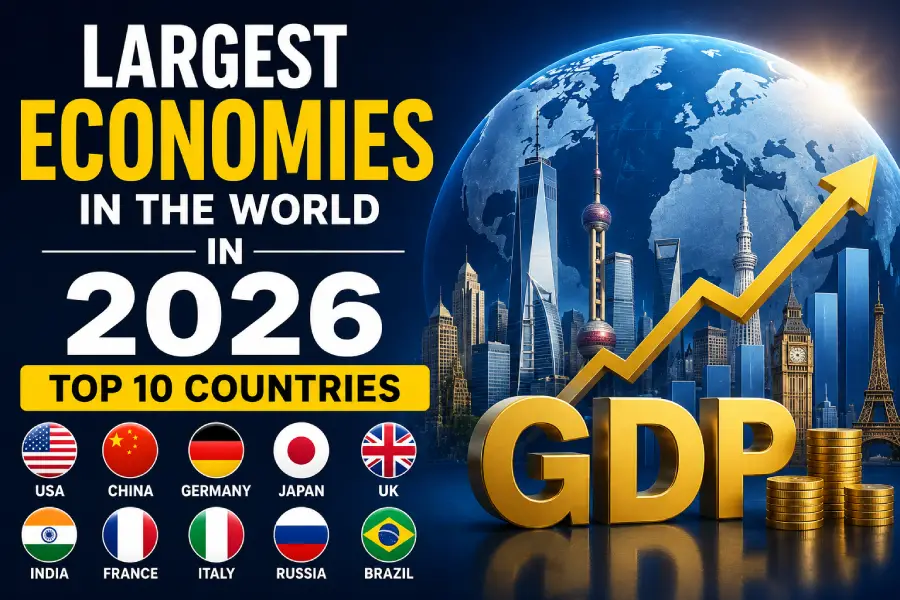
The global economy in 2026 continues to evolve amid technological advancements, geopolitical shifts, inflation control measures, and changing trade dynamics. According to the latest projections from the International Monetary Fund’s World Economic Outlook (April 2026), the United States remains the largest economy in the world, followed by China and Germany.
Nominal Gross Domestic Product (GDP) remains one of the most widely used indicators of a country’s economic strength. It reflects the total market value of all goods and services produced within a country over a specific period.
This article walks through the top 10 largest economies in the world in 2026 based on IMF projections, including GDP figures, growth rates, and GDP per capita data.
Top 10 Largest Economies in the World in 2026
| Rank | Country | Nominal GDP | GDP Growth | GDP per Capita |
|---|---|---|---|---|
| 1 | United States | $32.38 Trillion | 2.32% | $94,430 |
| 2 | China | $20.85 Trillion | 4.41% | $14,874 |
| 3 | Germany | $5.45 Trillion | 0.79% | $65,303 |
| 4 | Japan | $4.38 Trillion | 0.72% | $35,703 |
| 5 | United Kingdom | $4.26 Trillion | 0.80% | $61,056 |
| 6 | India | $4.15 Trillion | 6.48% | $2,813 |
| 7 | France | $3.60 Trillion | 0.86% | $52,083 |
| 8 | Italy | $2.74 Trillion | 0.52% | $46,505 |
| 9 | Russia | $2.66 Trillion | 1.09% | $18,525 |
| 10 | Brazil | $2.64 Trillion | 1.91% | $12,313 |
What Is Nominal GDP?
Nominal GDP measures a country’s economic output using current market prices, without adjusting for inflation. It’s the most widely used metric for comparing the economic size of nations globally.
A higher GDP generally points to:
- Strong industrial and service sectors
- Higher production capacity
- Greater consumer spending
- Better investment opportunities
- Stronger global economic influence
1. United States – The World’s Largest Economy
The United States continues to dominate the global economy in 2026, with a projected GDP of $32.38 trillion. The country’s economy is diversified across technology, finance, healthcare, defense, and consumer spending, which helps it weather sector-specific downturns better than more concentrated economies.
Major American companies such as Apple, Microsoft, and Amazon continue driving innovation and economic growth globally. The US also maintains one of the world’s highest GDP per capita figures at $94,430, reflecting strong productivity and high income levels.
Key economic drivers:
- Technology and AI innovation
- Financial services
- Consumer spending
- Energy production
- Global trade influence
2. China – The Manufacturing and Export Giant
China remains the second-largest economy globally, with a projected GDP of $20.85 trillion. Its growth is fueled by manufacturing, exports, infrastructure investment, and rapid technological development. Despite headwinds like property market concerns and slowing global demand, China is still managing solid growth at 4.41% — among the strongest of any major economy on this list.
Major growth sectors:
- Manufacturing
- Electric vehicles
- Artificial intelligence
- E-commerce
- Renewable energy
3. Germany – Europe’s Economic Powerhouse
Germany is the third-largest economy in the world in 2026, with a GDP of $5.45 trillion. Known for engineering excellence and a strong automotive and industrial export base, Germany’s economy leans on companies like BMW, Mercedes-Benz Group, and Siemens. Growth remains modest at 0.79%, but Germany continues to function as Europe’s industrial backbone.
4. Japan – Technology and Innovation Leader
Japan holds the fourth position, with a projected GDP of $4.38 trillion. Its economy thrives on advanced manufacturing, robotics, electronics, and automobile production, and remains home to global giants like Toyota, Sony, and Honda. An aging population and softer domestic consumption continue to weigh on Japan’s longer-term growth prospects, and the yen’s depreciation in recent years has also made its dollar-denominated GDP more sensitive to currency swings than most peers.
5. United Kingdom – Strong Financial and Service Economy
The United Kingdom is the fifth-largest economy in 2026, with a GDP of $4.26 trillion. The UK economy is heavily service-oriented, particularly in banking, finance, insurance, education, and healthcare, and London remains one of the world’s leading financial hubs.
Key strengths:
- Global financial services
- Higher education
- Creative industries
- Technology startups
6. India – The Fastest-Growing Major Economy
India ranks sixth among the world’s largest economies in 2026, with a GDP of $4.15 trillion. It also records the highest GDP growth rate among the top 10 at 6.48%, driven by strong domestic demand, infrastructure development, digital transformation, and manufacturing expansion. Government initiatives such as “Make in India,” alongside a fast-growing startup ecosystem, continue to reinforce that momentum.
Key economic drivers:
- IT and software services
- Manufacturing
- Infrastructure development
- Digital economy
- Young workforce
Despite that strong growth, India’s GDP per capita remains relatively low, largely a reflection of its very large population spreading that output more thinly per person.
7. France – Luxury, Tourism, and Industrial Strength
France has a projected GDP of $3.60 trillion in 2026. Its economy benefits from tourism, luxury goods, aerospace, and agriculture, with companies like LVMH and Airbus helping anchor its global economic standing. France also remains one of the most visited tourist destinations in the world, which continues to be a meaningful contributor to its services sector.
8. Italy – Strong Manufacturing and Export Economy
Italy ranks eighth globally, with a GDP of $2.74 trillion. It’s known for luxury fashion, machinery, automotive manufacturing, and food exports, with brands like Ferrari and Gucci contributing significantly to Italy’s international trade presence.
9. Russia – Resource-Rich Economic Giant
Russia remains among the top 10 largest economies, with a GDP of $2.66 trillion. Its economy is heavily dependent on natural resources, including oil, natural gas, and minerals, with energy exports continuing to play a central role in its overall economic structure. Geopolitical tensions and sanctions remain major factors shaping Russia’s economic outlook going forward.
10. Brazil – Latin America’s Largest Economy
Brazil closes out the top 10 with a GDP of $2.64 trillion. Its economy is supported by agriculture, mining, energy, and exports, and the country remains one of the world’s largest exporters of soybeans, coffee, iron ore, and beef. Brazil’s economic growth is projected at 1.91% in 2026.
Which Economy Is Growing the Fastest in 2026?
Among the top 10 economies, India is projected to grow the fastest, with a GDP growth rate of 6.48%. Strong domestic consumption, digital expansion, and ongoing infrastructure investment continue to attract global investors and multinational companies to the country.
Largest Economies by GDP Per Capita
Nominal GDP measures total economic size, but GDP per capita is a better reflection of average income levels and living standards. Among the top 10 economies:
- The United States has the highest GDP per capita, at $94,430.
- Germany and the United Kingdom also maintain high income levels.
- India has the lowest GDP per capita among the top 10, largely due to its very large population.
Key Trends Shaping the Global Economy in 2026
A handful of major trends are shaping the global economic landscape this year.
Artificial intelligence boom. AI technologies continue transforming industries including healthcare, finance, manufacturing, and logistics. It’s a trend that’s reshaping more than just economic output figures, too — PostDune’s coverage of how AI is changing user search behavior looks at the same shift from a very different angle: how people find information online.
Green energy transition. Countries are investing heavily in renewable energy and sustainable infrastructure as part of broader climate and energy security strategies.
Digital transformation. E-commerce, fintech, cloud computing, and automation continue to drive productivity gains across sectors.
Geopolitical realignments. Trade policies, sanctions, and international conflicts are reshaping global supply chains in ways that show up directly in growth forecasts, as seen with the drag on Russia’s economy above.
Inflation and interest rates. Central banks worldwide continue balancing inflation control against the need to support economic growth.
Conclusion
The global economic rankings in 2026 highlight the continued dominance of the United States and China, while countries like India are emerging rapidly on the back of strong growth momentum. Nominal GDP remains the standard metric for comparing economic size, but growth rate, innovation, technological advancement, and living standards all play a role in determining a nation’s long-term economic strength.
As the world economy continues evolving, emerging technologies, sustainability initiatives, and geopolitical developments will keep shaping which countries lead the next generation of global economic growth.
FAQs
Which is the largest economy in the world in 2026? The United States is the world’s largest economy in 2026, with a projected GDP of $32.38 trillion.
Which country has the fastest GDP growth among the top 10 economies? India has the fastest projected GDP growth rate, at 6.48%.
What is nominal GDP? Nominal GDP measures the total value of goods and services produced in a country using current market prices, without adjusting for inflation.
Which is the second-largest economy in the world? China is the second-largest economy globally in 2026.
Why is GDP per capita important? GDP per capita reflects average economic output and income per person, which makes it a more useful measure of living standards and prosperity than total GDP alone.