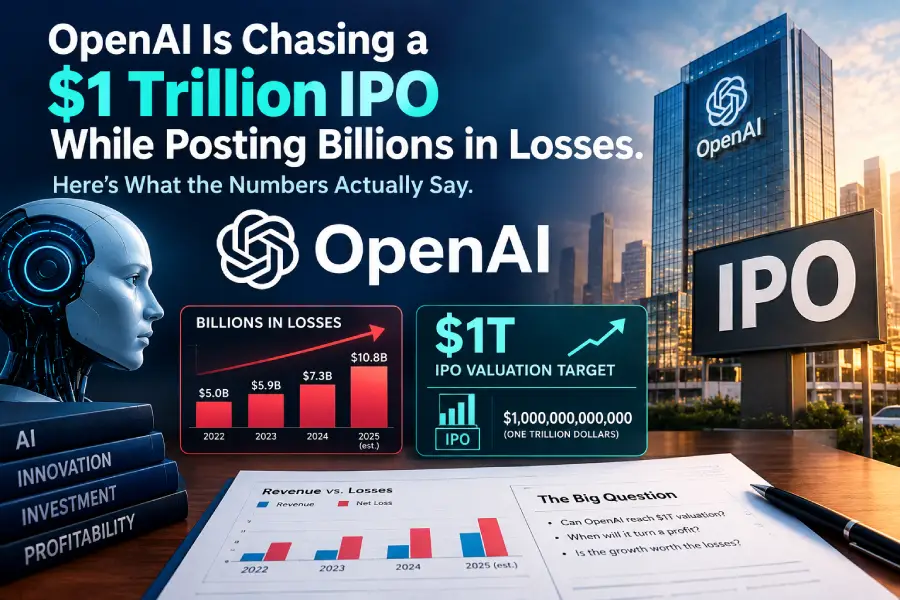
OpenAI is reportedly preparing to enter the public markets at a valuation of more than $1 trillion. At the same time, the company is spending and losing money on a scale that would raise serious questions around almost any other technology business.
Those two realities can exist together.
The more useful question is not whether OpenAI is either an extraordinary growth story or an enormous financial risk. It is how both sides of that story fit together and what the numbers actually tell us about the company behind the headlines.
At an all-hands meeting on August 19, 2026, OpenAI CFO Sarah Friar told employees that the company “will be a public company in 2027,” while leaving open the possibility of an earlier listing if growth continues to accelerate. That was a more concrete timeline than employees had previously received from management.
OpenAI had already taken an important step toward an IPO by confidentially filing paperwork with the U.S. Securities and Exchange Commission on June 8, 2026. A confidential filing allows the company to begin the regulatory process without immediately making all of its financial information public.
The Valuation Math
OpenAI’s latest private valuation stands at approximately $852 billion. That figure was established in March 2026, when the company completed a reported $122 billion funding round, described at the time as the largest private funding round in history.
For its eventual public listing, the company and its advisers are reportedly targeting a valuation above $1 trillion. Some reporting has even suggested that Sam Altman has viewed anything below that level as unacceptable for the IPO.
But valuation only tells part of the story.
OpenAI’s annualized revenue run rate reached approximately $40 billion in August 2026. If investors valued the company at $1 trillion, that would put its valuation at roughly 25 times its annualized revenue.
That is an extremely high sales multiple by conventional standards.
Of course, frontier AI companies do not necessarily fit neatly into conventional valuation models. Investors are paying attention not only to what OpenAI earns today, but also to how quickly its revenue could grow, how large the AI market could become, and whether the company can eventually turn its enormous spending requirements into sustainable profits.
That makes the future growth curve just as important as the current financial statements.
The Growth Story Is Hard to Ignore
Before focusing on OpenAI’s losses, it is worth acknowledging just how unusual its growth has been.
The company generated roughly $3.7 billion in revenue in 2024. By August 2026, its annualized revenue run rate had climbed to around $40 billion.
That is an extraordinary increase in less than two years.
The pace of expansion is particularly notable when compared with the growth trajectories of major technology companies such as Google, Meta, and Amazon during their strongest periods of expansion.
However, the $40 billion figure needs some context.
According to reporting citing people familiar with the company’s finances, OpenAI’s revenue run rate remained around $25 billion for several months during 2026 before accelerating sharply. By August, it had reached approximately $40 billion.
Enterprise business appears to have played a major role in that jump. Business revenue reportedly overtook consumer revenue for the first time in July, while the company’s number of business customers increased by approximately 32% in a single month.
That shift matters because it suggests that OpenAI’s growth is not coming exclusively from individual consumers paying for ChatGPT subscriptions. Businesses are increasingly becoming a significant part of the company’s commercial model.
$40 Billion Does Not Mean $40 Billion in Annual Revenue
There is an important distinction that can easily get lost in headlines.
The reported $40 billion figure is an annualized revenue run rate, not an audited $40 billion annual revenue figure.
An annualized run rate generally takes a recent period of revenue and projects it over twelve months. It is useful for measuring momentum and giving investors an idea of the current pace of business, but it is not equivalent to reporting $40 billion in revenue over a completed fiscal year.
Monthly revenue can also fluctuate considerably.
That distinction becomes particularly important when comparing OpenAI’s current growth claims with its audited financial statements.
The Losses Are Significant and the Accounting Details Matter
This is where the OpenAI story becomes considerably more complicated.
OpenAI’s most recently audited financial statements, covering fiscal year 2025, reportedly showed approximately $13.07 billion in booked revenue and an operating loss of $20.92 billion.
Those are audited figures, rather than estimates based on future performance.
There is also another number that has received substantial attention: a reported $38.5 billion net loss for 2025.
At first glance, that number sounds dramatically worse. But the composition of the loss matters.
According to reporting, roughly $30 billion of the net loss came from a one-time, non-cash accounting adjustment connected to OpenAI’s corporate restructuring.
That does not make the underlying losses small. It does, however, mean that saying OpenAI simply “lost $38.5 billion operating its business” would leave out an important part of the accounting picture.
Depending on which expenses analysts include or exclude, estimates of the underlying operating loss have reportedly ranged from approximately $8 billion to $21 billion.
Either way, OpenAI is spending enormous amounts of money.
But the exact nature of those losses is important when trying to understand the company’s financial position.
Compute Is at the Center of the Problem
One of the biggest reasons OpenAI’s expenses are so high is the cost of computing power.
In 2025, OpenAI reportedly paid Microsoft approximately $17.2 billion for Azure compute access. That amount alone was larger than OpenAI’s entire audited revenue for that year.
This highlights one of the fundamental differences between an AI company and many traditional software businesses.
Running large AI models requires enormous amounts of computing infrastructure. Training models is expensive, but serving those models to millions of users at scale also creates a substantial ongoing cost.
For OpenAI, compute not simply salaries, offices, or marketing is a central driver of its losses.
And those costs may continue rising.
OpenAI’s reported projections for 2026 have placed its computing expenditure as high as $50 billion.
That creates a difficult financial equation: the company needs extraordinary revenue growth to justify its valuation, but generating that revenue also requires significant investment in infrastructure.
What OpenAI Expects From the Next Few Years
OpenAI’s reported internal projections point toward another major jump in revenue.
The company is reportedly targeting approximately $100 billion in annual revenue by 2029, with profitability potentially arriving around the same period.
The exact timing is less certain.
Different analyses have placed the potential breakeven point somewhere between 2029 and the early 2030s. Estimates of cumulative losses before profitability have also varied considerably, ranging from roughly $44 billion to more than $100 billion.
That enormous range is a reminder that these numbers should not be treated as established financial outcomes.
They are projections, estimates, or figures derived from reported internal documents and analyst models. Until such numbers appear in audited public filings, they remain subject to considerable uncertainty.
The Uber Comparison
One comparison that frequently appears in discussions about OpenAI is Uber.
Uber accumulated roughly $31 billion to $33 billion in losses before reaching profitability, depending on the period and accounting measure being considered.
OpenAI’s reported internal projections imply that its cumulative losses before reaching profitability could be several times larger.
There is also an important difference between the two businesses.
Ride-hailing has a relatively straightforward transaction model: customers pay for rides, drivers provide them, and the company takes a portion of the transaction.
AI has a more complicated cost structure. Every interaction with an AI model can require computing resources, meaning that rapid user growth does not automatically translate into equally rapid improvements in margins.
That does not mean OpenAI cannot eventually become highly profitable.
It means the $1 trillion valuation represents a substantial bet on the company’s ability to scale revenue, reduce unit costs, and build sustainable economics around AI.
OpenAI’s Competitive Position Is More Complicated Than It Looks
Another part of the story that deserves attention is competition.
OpenAI remains one of the most recognizable names in generative AI, but its competitors are growing rapidly as well.
Anthropic, one of OpenAI’s closest competitors, reportedly reached an annualized revenue run rate of approximately $65 billion in July 2026.
That would put Anthropic ahead of OpenAI’s reported $40 billion run rate from August, at least when comparing those particular snapshots.
If accurate, that is an important data point because it challenges the assumption that OpenAI automatically leads the market on every commercial metric.
Anthropic has reportedly also confidentially filed for an IPO, with a reported valuation of approximately $965 billion.
That puts the two companies in a remarkably similar valuation range, despite the reported difference in revenue run rates.
OpenAI CFO Sarah Friar has reportedly acknowledged that Anthropic could potentially reach the public markets before OpenAI. Her reported message to employees was essentially that OpenAI would focus on its own timeline rather than treating the order of the IPOs as a competition.
Google Adds Another Dimension
Then there is Google.
Google’s Gemini is another major player in the AI market, although comparing its revenue directly with OpenAI or Anthropic is more difficult.
Alphabet reports its financial performance across a much larger business, and Gemini’s commercial revenue is not presented as a standalone financial figure in the same way that OpenAI’s reported revenue is discussed.
Still, Google’s presence makes one thing clear: the generative AI market is not simply a two-company contest.
OpenAI and Anthropic are competing with each other, while Google has enormous distribution, infrastructure, research capabilities, and an established consumer ecosystem of its own.
The broader market also includes other technology companies developing increasingly capable AI models and products.
As a result, market leadership cannot be determined from brand recognition alone.
What the Numbers Actually Tell Us
Looking at the available figures together produces a much more complicated picture than either “AI is a bubble” or “AI growth makes the valuation inevitable.”
Several things can be true at the same time.
The Growth Has Been Exceptional
Moving from approximately $3.7 billion in revenue in 2024 to a $40 billion annualized run rate in August 2026 represents an extraordinary expansion.
Regardless of what eventually happens to profitability, that rate of growth is difficult to dismiss.
The Losses Are Real, But the Accounting Matters
OpenAI’s reported $20.92 billion operating loss and its separately reported $38.5 billion net loss should not be treated as identical measurements.
The larger net-loss figure reportedly includes a significant one-time, non-cash accounting adjustment.
Understanding that distinction provides a more accurate picture of the company’s underlying financial performance.
A $1 Trillion Valuation Requires Continued Growth
At a $1 trillion valuation and a $40 billion annualized revenue run rate, investors would effectively be valuing OpenAI at roughly 25 times annualized revenue.
That valuation assumes the company can continue growing at an exceptional pace and eventually convert that growth into meaningful profitability.
The question is not simply whether OpenAI can generate more revenue.
It is whether revenue can grow faster than the enormous costs required to generate and serve AI products.
Competition Could Change the Story
OpenAI’s position in the market is not guaranteed.
The reported revenue figures from Anthropic show how quickly competitors can scale. Google and other major technology companies are also investing heavily in AI.
That means OpenAI’s future valuation will depend not only on its own growth, but also on how the competitive landscape develops.
The Bigger Picture
OpenAI’s potential IPO is unusual because the company sits at the intersection of two very different narratives.
On one side is extraordinary growth.
A company that moved from a few billion dollars in annual revenue to a reported $40 billion annualized run rate in less than two years is clearly operating on a massive scale.
On the other side is an equally extraordinary spending requirement.
The company needs enormous amounts of computing power to train and operate its models, and those costs can rise alongside demand.
That is the central financial question behind the IPO.
Can OpenAI turn its enormous popularity and rapidly growing enterprise business into a business model capable of supporting its infrastructure costs while eventually producing substantial profits?
A $1 trillion valuation assumes that the answer can ultimately be yes.
But an IPO will give investors something that private-market headlines and internal projections cannot fully provide: regular public financial reporting.
Once OpenAI is a public company, investors will be able to examine revenue, expenses, cash flow, margins, capital spending, and other financial metrics quarter after quarter.
That will make it much easier to separate the growth story from the financial reality.
For now, both are extraordinary.
OpenAI is growing at a pace that few technology companies have ever matched, while simultaneously spending and losing money on a scale that creates a very different kind of challenge.
The real test will come when those two sides of the business have to coexist under the scrutiny of public markets.
Frequently Asked Questions
What valuation is OpenAI targeting for its IPO?
OpenAI is reportedly targeting a public-market valuation above $1 trillion. That would represent an increase from its reported private valuation of approximately $852 billion established in March 2026.
When will OpenAI go public?
OpenAI CFO Sarah Friar reportedly told employees in August 2026 that the company will be a public company in 2027, while leaving open the possibility of an earlier listing if growth accelerates. The company reportedly confidentially filed IPO paperwork with the SEC in June 2026, but no specific public listing date has been announced.
How much revenue does OpenAI generate?
OpenAI’s annualized revenue run rate reportedly reached approximately $40 billion in August 2026. Its latest audited annual financial figures, covering fiscal year 2025, showed approximately $13.07 billion in booked revenue.
How much money is OpenAI losing?
OpenAI’s audited 2025 financials reportedly showed an operating loss of $20.92 billion. A separate reported figure of $38.5 billion in net losses includes a significant one-time, non-cash accounting adjustment related to corporate restructuring.
Is OpenAI still the clear revenue leader in AI?
The available reported figures do not make that conclusion straightforward. Anthropic reportedly reached a $65 billion annualized revenue run rate in July 2026, compared with OpenAI’s reported $40 billion figure in August. These are different monthly snapshots and should not be treated as directly comparable audited annual results, but they do illustrate how quickly the competitive landscape is changing.
When does OpenAI expect to become profitable?
Reported internal projections have pointed toward approximately $100 billion in annual revenue and profitability around 2029. Other analyses have placed the potential breakeven point somewhere between 2029 and the early 2030s. These remain projections rather than confirmed financial outcomes.