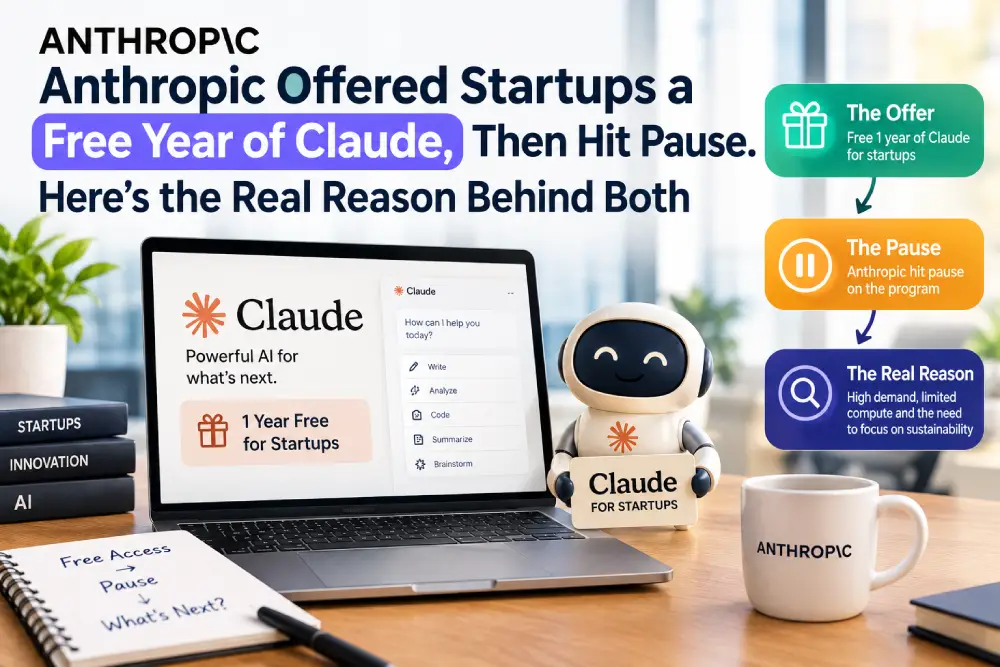
On October 6, 2026, Anthropic made startup founders an offer that seemed almost too good to be true: a free year of Claude Team, $1,000 in API credits, and a bundle of other perks for any company founded in the last five years or funded in the last two.
Three days later, it hit pause.
According to Anthropic’s head of startup marketing, applications in the first 48 hours ran at 21 times the volume the program had seen in its previous five months. The company admitted it had set its acceptance criteria too loosely and “let way too many people in.” The free Team seats and API credits were suspended, and many approved applicants are now being asked to re-verify.
It would be easy to treat this as a simple marketing stumble. But both halves of the story, the generous offer and the rushed retreat, reveal something important about how AI companies are competing right now. The giveaway wasn’t charity. It was a customer-acquisition play borrowed straight from the cloud-computing playbook. And the stampede of applicants showed just how much demand there is for AI tools when the price drops to zero.
This article explains what Anthropic offered, what happened next, why AI labs are courting startups so aggressively, and what founders should actually do now.
Disclosure: this article was drafted with help from Claude, an AI assistant made by Anthropic, the company it discusses. Read it with that in mind.
What Anthropic Offered, and What Happened Next
Anthropic first launched its Claude Startups program in May 2026. The October expansion, announced during San Francisco Tech Week, was meant to open it up to far more companies. In Anthropic’s words, reported by TechRadar: “Many fast-growing AI-native companies have joined the program, and in this next phase we’re opening it up to more.”
The offer
Who could apply: Companies founded within the past five years, or companies that had raised funding within the past two years.
What approved startups would get:
| Benefit | Details |
|---|---|
| Claude Team | One free year, up to five Premium seats (for companies new to Claude Team) |
| API credits | A one-time $1,000, expiring six months after approval |
| Startup Stack | Partner discounts and credits worth up to $45,000 |
| VC-linked credits | Up to $100,000 more in API credits for founders backed by partner VCs |
| Office hours | Sessions with Anthropic’s Applied AI team |
| Marketplace | Access to sell connectors and plug-ins to Claude users |
| Events | Hackathons and founder meet-ups |
For a five-person team, a year of premium Claude seats plus credits is real money. It’s the kind of offer that makes a founder stop and read the terms twice.
Three days later: the pause
That’s exactly what happened, at enormous scale. According to Forbes Australia, the program received 21 times as many applications in its first 48 hours as it had in the previous five months. Anthropic’s account on X reportedly described “hundreds of thousands of applicants,” according to AI Weekly.
The problem was the eligibility rule. “Founded in the last five years or funded in the last two” covers a huge number of businesses that most people wouldn’t call startups, including small agencies, consultancies, and side businesses. Sarah Wolf, Anthropic’s head of startup marketing, acknowledged on X that the acceptance criteria hadn’t been set properly and that the company had “let way too many people in this time.”
Here’s where things stand, based on reporting and Anthropic’s program page as of October 14:
- The free Claude Team year and $1,000 credits are paused.
- New applications are closed. The page says the current cohort is full and points founders to a newsletter for future openings. No reopening date is given.
- Pending applications weren’t advanced, and applicants were emailed.
- Approved applicants who hadn’t claimed their benefits are being asked to re-verify and may be turned down.
- Benefits already claimed reportedly stay in place.
- The Startup Stack partner offers, Applied AI sessions, and events continue for accepted members.
Online reaction was mixed. Some founders on X and Reddit criticized Anthropic for making promises it couldn’t keep and for not verifying applicants from the start. Others saw it as an honest correction of an obvious mistake.
The Real Reason: Distribution, Not Generosity
Why would an AI company give away a year of its product in the first place? Anthropic has been fairly open about the logic. The company has said it believes AI’s value mostly reaches people through the businesses built on top of the models, not through the models on their own.
Read plainly, that’s a statement of strategy. If the biggest payoff comes from companies building products on Claude, then the most valuable moment to win a customer is when a startup is choosing which AI provider to build around. That decision tends to stick.
Why early choices are hard to undo
Once a startup builds on a particular model, the choice spreads through its whole operation:
- Prompts and workflows are tuned to that model’s behavior.
- Code uses that provider’s API, tools, and features.
- Testing and quality checks are calibrated to that model’s strengths and quirks.
- Team habits form around a particular assistant for writing, coding, and research.
- Product features may depend on capabilities only that provider offers.
Switching later is possible, and many companies do use more than one model. But every month of building on one provider adds a little more friction to leaving. A free year isn’t just a year of free usage. It’s a year of habits, code, and processes forming around Claude.
Startups are tomorrow’s big customers
There’s also a long-term bet. Most startups are small spenders today. But the few that succeed can grow into very large customers within a few years. An AI company that supports a startup from its first prototype has a strong chance of keeping it as it scales. Giving away a few thousand dollars of product now can pay back many times over if even a small share of those companies take off.
Benchmarks get headlines; distribution wins markets
AI coverage tends to focus on benchmark scores: which model is best at coding, math, or reasoning. Those differences matter, but they shift every few months as labs leapfrog each other. Distribution is more durable. The lab that’s embedded in a startup’s onboarding flow, internal tools, and product has a head start that a slightly better test score elsewhere won’t easily erase.
The overwhelming response to Anthropic’s offer also says something. Demand for AI tools among small businesses is enormous, and price is clearly a major barrier. Hundreds of thousands of applicants in a couple of days is a strong signal of how many companies want to use AI more but are watching costs closely.
Where You’ve Seen This Before: The Cloud Credit Playbook
If this strategy feels familiar, it should. Cloud providers have been running it for well over a decade.
Amazon Web Services built much of its early dominance by courting startups with free credits through programs that later became AWS Activate. The logic was identical: get developers building on AWS early, before their code and habits settle around a competitor, and many will stay for years as they grow. Google Cloud and Microsoft Azure followed with programs of their own.
Those programs are still large today. According to a comparison by Fin, last verified in August 2026:
| Program | Top credit amount | Typical route to the top tier |
|---|---|---|
| AWS Activate | $200,000+ (invite-only AI tier) | Via approved VCs, accelerators, or AWS invitation |
| Google for Startups Cloud | Up to $350,000 for AI-first startups | Institutional funding and building on Vertex AI or Gemini |
| Microsoft for Startups | Up to $150,000 in Azure credits | Unlocked through usage milestones |
| OpenAI for Startups | Not published | API credits only through partner VCs |
Notice a pattern in that table. The biggest credits almost always come with a gate: proof of venture funding, an accelerator referral, or gradual unlocking as a company proves it’s real. Cloud providers learned long ago that open-ended giveaways attract people who want free resources, not just genuine startups.
That’s precisely the lesson Anthropic ran into. Its broad “founded in five years or funded in two” rule skipped the gating that mature credit programs rely on. The pause and re-verification are, in effect, Anthropic adding that gate after the fact.
The difference: AI lab speed
The cloud credit wars played out over years. The AI version is moving much faster. Model capabilities, prices, and features change every few months, and startups can switch providers more easily than they can move an entire cloud infrastructure. That means AI labs have a shorter window to lock in loyalty, which helps explain why offers like this one can be so aggressive, and why a misjudged one can spiral within days.
The Competition for Builders
Anthropic isn’t the only AI company chasing startups. The fight for early-stage builders now runs across several fronts.
OpenAI runs a startup program with resources, events, and build sessions open to all founders, but API credits are offered only through its network of partner VCs, according to the Fin comparison. It has also run a selective cohort program called Grove.
Google combines its cloud credits with AI. Its largest startup package, up to $350,000, is tied to building on its Vertex AI platform or Gemini models, which neatly links cloud spending and model choice.
Microsoft offers Azure credits that unlock as startups grow, and Azure gives access to multiple AI models, including OpenAI’s.
AWS offers access to many AI models through Amazon Bedrock, including Anthropic’s Claude, alongside its long-running Activate credits.
That last point highlights a complication. Big cloud providers often sell access to several AI labs’ models, so startups can choose models while staying with one cloud. Anthropic’s direct startup program, by contrast, focuses on its own Claude API and apps. Its program page notes that its API credits apply only to the first-party Claude API, not to Claude accessed through AWS, Google Cloud, or Azure.
For founders, this competition is good news. Credits, discounts, and support are widely available, and most providers want your business. The trick is to use these offers without letting them make your technical decisions for you.
What Founders Should Do Now
If you’re a founder or early-stage builder, here’s the practical picture.
If you already applied
Watch your email. Anthropic is contacting approved applicants who haven’t claimed benefits to re-verify. Respond quickly and clearly, with accurate information about your company, funding, and what you’re building. If you already claimed your benefits, reports indicate they remain on your account, but check your account settings to confirm.
If you haven’t applied
New applications are closed for now. If you’re interested, sign up for the Claude Startups newsletter on Anthropic’s program page to hear when a new cohort opens. Expect stricter eligibility next time, possibly tied to venture funding or partner referrals, as with most cloud credit programs.
Check other routes to credits
- Ask your investors. Many VCs and accelerators have partnerships that unlock larger credits from Anthropic, OpenAI, AWS, Google, and Microsoft than public programs offer.
- Look at cloud programs. If you plan to access AI models through a cloud platform, credits from AWS, Google Cloud, or Azure may cover model usage there.
- Compare total value, not headline numbers. Look at expiry dates, which services the credits cover, and what happens when they run out.
Avoid being locked in by a giveaway
Free credits are great. Making your whole architecture depend on them is not. A few habits help:
- Choose models based on fit, not credits. Test the top options on your actual tasks before committing.
- Build a thin abstraction layer around AI calls so you can switch providers or use several without rewriting your product.
- Keep your prompts, evaluations, and data portable. Store them in your own systems, not only inside one vendor’s tools.
- Plan for full price. Model your costs as if credits didn’t exist. If your business only works while things are free, that’s a warning sign.
- Read the terms. Check credit expiry, usage limits, and any data-use policies before you build on them.
A note on the bigger lesson
For anyone running a promotion of their own, Anthropic’s experience is a useful cautionary tale. Broad eligibility rules, generous rewards, and no verification can attract far more people than you planned for, and pulling back an offer damages goodwill. Clear criteria up front are kinder to everyone than corrections afterward.
Final Thoughts
Anthropic’s free year of Claude looked like a gift to founders, but the strategy behind it was straightforward: get Claude into startups’ products and habits at the moment they choose an AI provider, just as AWS did with cloud credits years ago. The stampede that followed showed how hungry small businesses are for AI tools, and how quickly a loosely defined offer can get out of hand.
The bigger story isn’t one pause. It’s that the AI race is increasingly being decided by distribution: which models end up embedded in the products, tools, and workflows of the next generation of companies. Benchmarks will keep making headlines, but the quieter battle over who builds on whom may matter more.
For founders, the takeaway is simple. Take advantage of credits and support when you can get them, but choose your tools on merit, keep your options open, and make sure your business makes sense at full price.
Frequently Asked Questions
What did Anthropic’s Claude Startups expansion offer?
Announced October 6, 2026, it offered eligible startups a free year of Claude Team with up to five Premium seats, $1,000 in API credits, partner discounts worth up to $45,000, possible VC-linked API credits up to $100,000, Applied AI office hours, Marketplace access, and events.
Who was eligible?
Companies founded within the past five years, or that had raised funding within the past two years. That broad rule is one reason demand far exceeded expectations.
Is the offer still available?
No, not right now. The free Team seats and $1,000 credits were paused about three days after launch, and the program page says new applications are closed. Approved applicants who hadn’t claimed benefits are being asked to re-verify.
Why did Anthropic pause it?
Applications in the first 48 hours ran at 21 times the program’s previous five-month volume, and Anthropic said its acceptance criteria let in too many companies that weren’t really startups.
Why do AI companies give free credits to startups?
To win customers early. Once a startup builds its product and workflows around one provider, switching becomes harder, and startups that grow can become large long-term customers. Cloud providers like AWS have used the same strategy for years.