Here’s a headline that seems to break the basic rules of business: a company that reported a net loss of nearly $42 billion last year could go public within weeks at a valuation of up to $2 trillion. That company is Anthropic, the maker of the Claude AI models, and if the reported plans hold, its listing could rank among the largest IPOs ever.
It’s easy to read those two numbers side by side and conclude that the AI market has lost its mind. Some critics will say exactly that. But the real story is more interesting, and more useful to anyone building, investing in, or simply watching the AI industry. Most of that $42 billion wasn’t cash going out the door. And the revenue picture in 2026 looks very different from the one in 2025.
This article walks through what has actually been reported, what the numbers mean once you unpack them, the strongest arguments for and against a valuation this large, and what it all signals for founders and smaller AI companies trying to raise money in the same market.
One caution up front: nearly all the figures here come from news reports citing people familiar with the matter or documents reviewed by journalists. They aren’t audited, and Anthropic hasn’t publicly confirmed the IPO terms. Treat them as reported, not settled, and note that this article is not investment advice.
What Has Been Reported About the IPO
On October 1, 2026, Bloomberg reported that Anthropic was aiming to go public as soon as mid-November, citing people familiar with the matter. According to coverage of that report, the key details are:
- Timing: Formal IPO marketing could begin the week of November 9, with trading starting before Thanksgiving on November 26. The company is still expected to list by the end of 2026, but the schedule could change.
- Valuation: Some prospective investors see $1.8 trillion to $2 trillion as a fair value.
- Size: Anthropic reportedly expects its offering to match or exceed SpaceX’s IPO in size.
- Investor meetings: The company plans to meet prospective investors at its San Francisco headquarters on October 14.
The timeline has already shifted once. Anthropic had earlier been expected to file publicly after the summer, and some investors had anticipated an October listing.
How fast the valuation has climbed
The trillion-dollar talk is striking partly because of how quickly Anthropic’s private valuation rose. In February 2026, it raised $30 billion at a $380 billion valuation. By late May, it had reportedly raised $65 billion at a $965 billion valuation, above OpenAI’s last reported valuation of $852 billion. A $2 trillion IPO would roughly double that again in under six months.
The market backdrop
The timing is bold. IPO markets in 2026 have been choppy. Bloomberg data cited in the same coverage showed that, excluding SpaceX and SK Hynix, more than 100 newly listed stocks had a weighted-average loss of 4% this year, while the S&P 500 gained 12%. Wearable maker Oura even pulled its debut hours before pricing after buyers balked at its valuation.
Meanwhile, OpenAI, Anthropic’s closest rival, has postponed its own IPO plans, with CEO Sam Altman reportedly arguing that now isn’t the right time to list. If Anthropic proceeds, it would be the first of the frontier AI labs to face public-market investors and quarterly disclosure.
The Numbers: Revenue Versus Losses
The headline contrast comes from documents previously reviewed by Bloomberg. Anthropic’s 2025 revenue reached roughly $4.6 billion, up from about $386 million in 2024, a roughly 12-fold jump. Over the same period, its net loss grew from about $8.3 billion to nearly $42 billion.
Read quickly, that looks like a company whose losses are growing as fast as its sales. But the details change the picture considerably.
Most of the $42 billion wasn’t cash
According to the same documents, more than $34 billion of the 2025 net loss came from a change in the fair value of Anthropic’s liabilities. Yahoo Finance’s summary describes this as an accounting adjustment rather than cash leaving the business through operations.
Charges like this typically arise when a private company has financial instruments whose value is tied to its own share price. As the company’s valuation rises, those instruments are remeasured at a higher value, and the increase is booked as a loss. In other words, part of the “loss” is a side effect of Anthropic becoming much more valuable. It’s a real line on the income statement, but it says little about whether the business itself is burning money.
The operating loss, which better reflects the cost of running the business, was a little over $8 billion in 2025. That’s still a very large number, but it’s a fifth of the headline figure.
2026 looks very different
The 2025 accounts are also already out of date. Here is how Anthropic’s reported annualized revenue run rate has moved since the end of last year:
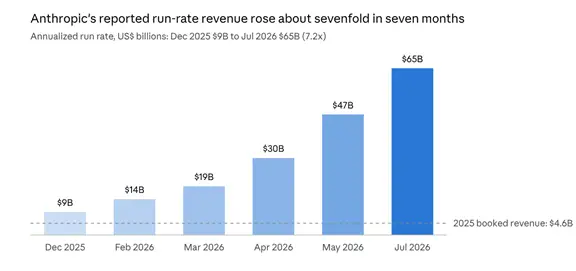
A run rate takes a recent month’s revenue and multiplies it out to a year, so it isn’t the same as booked revenue. Still, the booked numbers point the same way. According to PitchBook’s analysis of the leaked financials, first-quarter 2026 revenue of $4.73 billion exceeded all of 2025, and second-quarter revenue topped $11.5 billion on a preliminary basis. Yahoo Finance also reports that the company posted positive adjusted operating income in the second quarter of 2026.
Much of that growth has been attributed to enterprise customers and Claude Code, the company’s coding agent, which passed $2.5 billion in run-rate revenue by February 2026.
Where the money goes
The biggest cost in frontier AI is compute: the chips, data centers, and power needed to train and run models. Anthropic’s commitments here are enormous. Benzinga reports plans for roughly $518 billion in future cloud, computing, and infrastructure spending. Separately, Broadcom is reportedly set to extend up to $42 billion in convertible financing, which could cover about a third of a $125.2 billion, five-year chip lease commitment.
That’s the real tension in Anthropic’s numbers. Revenue is climbing at a historic pace, but so are the long-term obligations needed to keep that growth going. The IPO filing, when it becomes public, should give the first audited view of how those two lines compare.
The Bull Case: Pricing an AI Lab Like Infrastructure
Why would anyone pay $2 trillion for a company that booked $4.6 billion in revenue last year? Supporters of the valuation tend to make four arguments.
1. The right comparison is the current run rate, not last year
Against 2025 revenue, a $2 trillion valuation is about 435 times sales, which sounds absurd. But PitchBook points out that against the July 2026 run rate, the multiple falls to just under 31 times. That’s still rich, but it’s in the range investors have paid for fast-growing software leaders at other points in market history. Bulls argue that a company growing this quickly should be judged on where it is now, not where it was nine months ago.
2. Frontier AI looks more like infrastructure than software
The deeper argument is about what kind of business a frontier AI lab is. Classic software companies have low marginal costs and high margins from early on. Frontier labs look more like railroads, telecom networks, or cloud providers: they spend heavily upfront on physical capacity, then sell access to it for years.
Amazon is the comparison bulls reach for most often. For much of its early life, Amazon reported thin or negative profits because it kept reinvesting in warehouses and later data centers. Investors who focused on reported losses missed one of the great compounding stories in market history. The bet on Anthropic is that today’s compute spending builds a similar position, one that’s very hard for late entrants to match.
3. Enterprise demand looks durable
Much of Anthropic’s growth has come from businesses rather than consumers, especially software developers using AI coding agents. Enterprise revenue tends to be stickier than consumer subscriptions. Once a company builds workflows, tools, and internal processes around a model, switching costs rise. Bulls see that as evidence the revenue isn’t a temporary spike.
4. Public investors rarely get access to this kind of growth
Finally, there’s simple scarcity. Most of the value created by AI labs so far has gone to private investors. A public listing gives pension funds, mutual funds, and retail investors their first direct way to own a frontier lab. When demand is high and supply is limited, prices tend to stretch. That doesn’t make the price right, but it helps explain why prospective investors may be willing to pay it.
The Bear Case: Is This the Top of the AI Valuation Cycle?
The skeptics have serious arguments too. PitchBook’s own analysis carried a pointed headline: Anthropic’s financials reflect fast growth, but not a $2 trillion valuation. Here are the main concerns.
1. Run rates can fall as fast as they rise
A run rate annualizes one recent month. If customers cut budgets, prices fall, or a big contract ends, the number can drop quickly. PitchBook notes that the July figure should be tested against later quarterly results. Valuing a company at 31 times a number that may not hold for a full year is a bet that growth continues, not a measure of what has been earned.
2. Revenue quality questions remain
Analysts at Futurum have flagged that Anthropic reports some revenue on a gross rather than net basis, which can make headline figures look larger than those of peers who report net. For example, when sales flow through a cloud partner’s marketplace, the accounting choice affects how much revenue appears on the books. The IPO filing will need to settle this, and any restatement could change how the growth story reads.
3. Valuation depends on cash, and compute is expensive
Ultimately, a company is worth the cash it can generate over time. PitchBook stresses that the valuation turns on how much revenue becomes free cash flow. With hundreds of billions of dollars in reported compute commitments, the gap between revenue and free cash could stay wide for years. If model prices fall faster than computing costs, margins could get squeezed rather than expand.
4. Competition is intense
Anthropic competes with OpenAI, Google, Meta, xAI, and a growing field of strong open-weight models, many available at much lower prices. AI models have also shown a tendency to leapfrog each other every few months. Leadership in one product category, such as coding agents, isn’t guaranteed to last.
5. Unusual risks for an unusual company
According to NewsBytes, the IPO filing itself flags the risk that AI models could develop unexpected capabilities during training. That’s not a standard risk factor for a public company. AI labs also face rising regulatory scrutiny, ongoing copyright litigation across the industry, and safety incidents that can hit public trust quickly.
6. The cycle question
Then there’s history. Market peaks are often marked by very large IPOs priced on future potential rather than current profits. Critics point to the dot-com era, when infrastructure companies traded at extreme multiples, and many investors who bought at the top waited years to break even, even in companies that survived and thrived.
The weak IPO market in 2026 adds to the caution. If most new listings are trading below their offer prices, a record-setting deal could either restore confidence or become a symbol of excess. Some will see Anthropic’s listing as a sign the AI boom is maturing into a durable industry. Others will see a classic late-cycle signal. Neither side can know which reading is right until well after the shares start trading.
What It Means for Founders and Smaller AI Companies
Most people reading about a $2 trillion IPO aren’t running a frontier lab. But the way this deal is received will shape the funding climate for everyone building with AI. A few lessons stand out.
Don’t copy the loss-tolerance of a frontier lab
If a company can post a $42 billion headline loss and still attract trillion-dollar interest, it’s tempting to conclude that profitability doesn’t matter right now. That would be the wrong lesson. Anthropic’s position rests on a rare combination: extreme revenue growth, a product category with very few credible competitors, and access to strategic partners willing to finance its compute. Most startups have none of these. For them, investors still ask hard questions about margins, retention, and payback periods.
Learn to explain your own numbers
The $42 billion figure shows how easily accounting items can dominate a story. Founders should understand which parts of their losses are cash and which aren’t, and be ready to explain both clearly. A non-cash charge from remeasuring convertible notes or warrants can look alarming in a headline, even when the underlying business is healthy.
Growth is being rewarded, but only real growth
The market is clearly willing to pay for revenue that compounds quickly. But investors are increasingly separating durable revenue, such as enterprise contracts and repeat usage, from one-off spikes or pilots that never convert. Founders should report metrics that show staying power, like net revenue retention and usage growth among paying customers, not just headline run rates.
Build on the platforms, but watch your dependence
Many startups build products on top of models from Anthropic, OpenAI, or Google. A public Anthropic will face pressure to grow revenue every quarter, which could mean new products that compete with companies building on its platform, or pricing changes. Smart founders will design their products to work across more than one model provider and build value that a model upgrade can’t easily replace, such as proprietary data, deep workflow integration, or domain expertise.
Watch the IPO’s aftermarket closely
If the listing goes well and the shares hold their value, expect a wave of AI companies to accelerate their own IPO plans and private valuations to rise. If the shares stumble, funding could tighten across the sector, especially for companies with heavy compute costs and thin margins. Either way, the deal will reset expectations.
Final Thoughts
The simplest version of this story, “company loses $42 billion, asks for $2 trillion,” makes for a great headline but a misleading summary. Most of the 2025 loss was a non-cash accounting charge, the operating loss was closer to $8 billion, and revenue in 2026 has grown at a pace few companies have ever matched.
That doesn’t mean the valuation is justified. The bull case rests on growth continuing, margins improving as the company scales, and compute investments turning into a lasting advantage. The bear case points to volatile run rates, open accounting questions, huge spending commitments, fierce competition, and a shaky IPO market. Both sides have real evidence.
The most useful thing anyone can do right now is wait for the audited numbers. When the IPO filing becomes public, it will answer questions that leaked documents and run-rate headlines can’t: how much revenue is booked net, how much cash the business really burns, and how its obligations stack up against its growth. Until then, treat every figure, including the ones in this article, as reported rather than confirmed.
Frequently Asked Questions
When is Anthropic’s IPO expected?
According to Bloomberg’s October 1 report, Anthropic could begin formal IPO marketing the week of November 9, 2026, with trading targeted before Thanksgiving. The company is expected to list by the end of 2026, but the timing could change.
Did Anthropic really lose $42 billion?
Its reported 2025 net loss was nearly $42 billion. However, more than $34 billion of that came from a change in the fair value of its liabilities, an accounting adjustment rather than operating cash outflow. Its 2025 operating loss was a little over $8 billion.
What is a revenue run rate?
A run rate takes revenue from a recent period, usually one month, and annualizes it. It’s useful for showing current scale in a fast-growing company, but it isn’t the same as revenue actually booked over a full year.
Why would investors value Anthropic at $2 trillion?
Supporters point to its rapid revenue growth, durable enterprise demand, and the view that frontier AI labs resemble infrastructure businesses that invest heavily early to build a lasting advantage. Critics argue the valuation assumes growth and margins that haven’t been proven yet.
What does this mean for the wider AI market?
As the first frontier AI lab to go public, Anthropic’s IPO will be a test of public investors’ appetite for AI. A strong debut could lift valuations and IPO plans across the sector, while a weak one could tighten funding for AI companies with heavy costs.