Something significant has shifted in the deal between Google and the open web, and a lot of website owners are only now catching on.
For years the arrangement was simple: Google crawls your content, ranks your pages, and sends people your way. You get traffic; Google gets data, ad revenue, and a reason for people to keep coming back. That symbiotic relationship built an entire industry. In 2026, it’s been quietly and substantially rewritten.
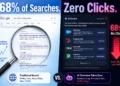
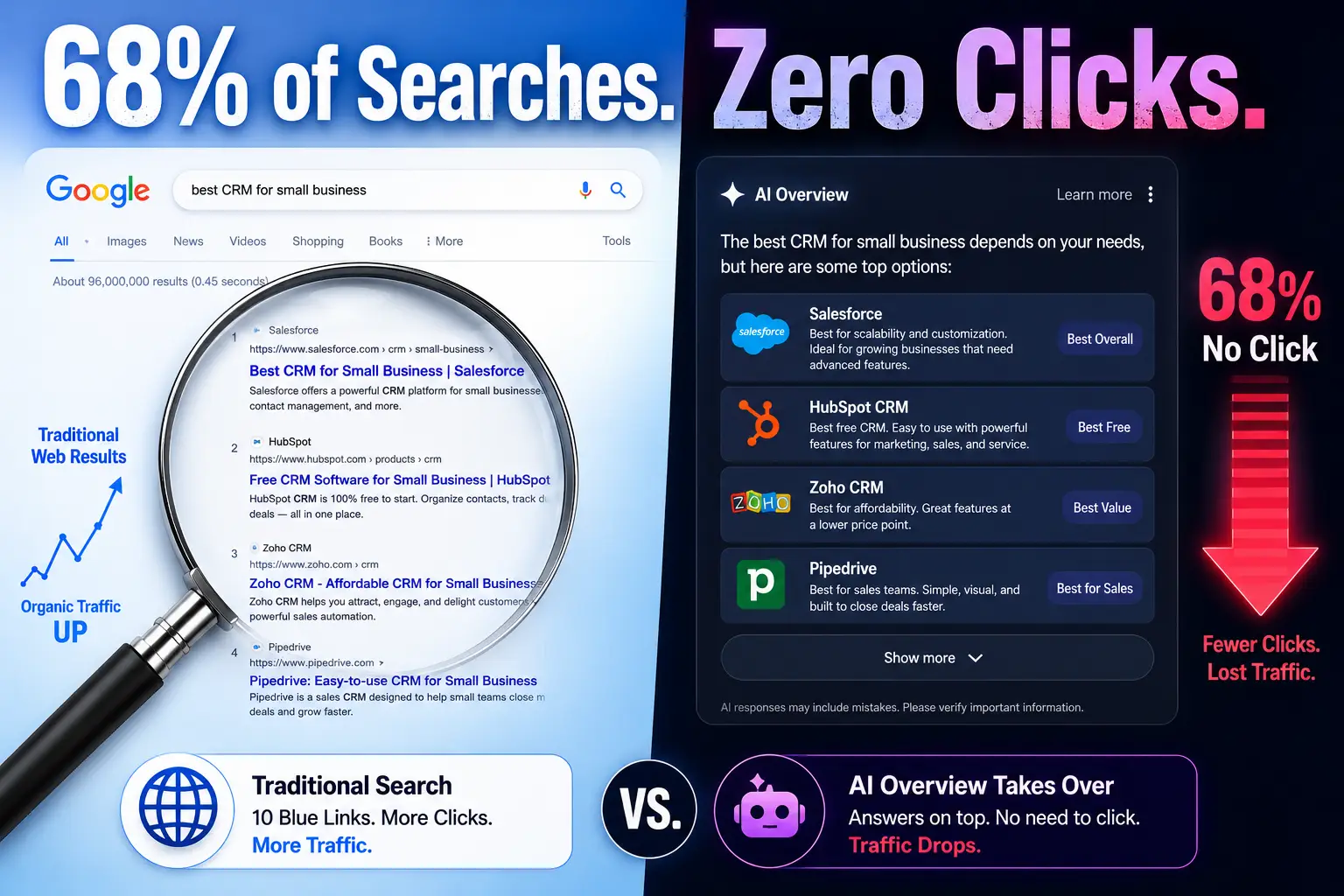
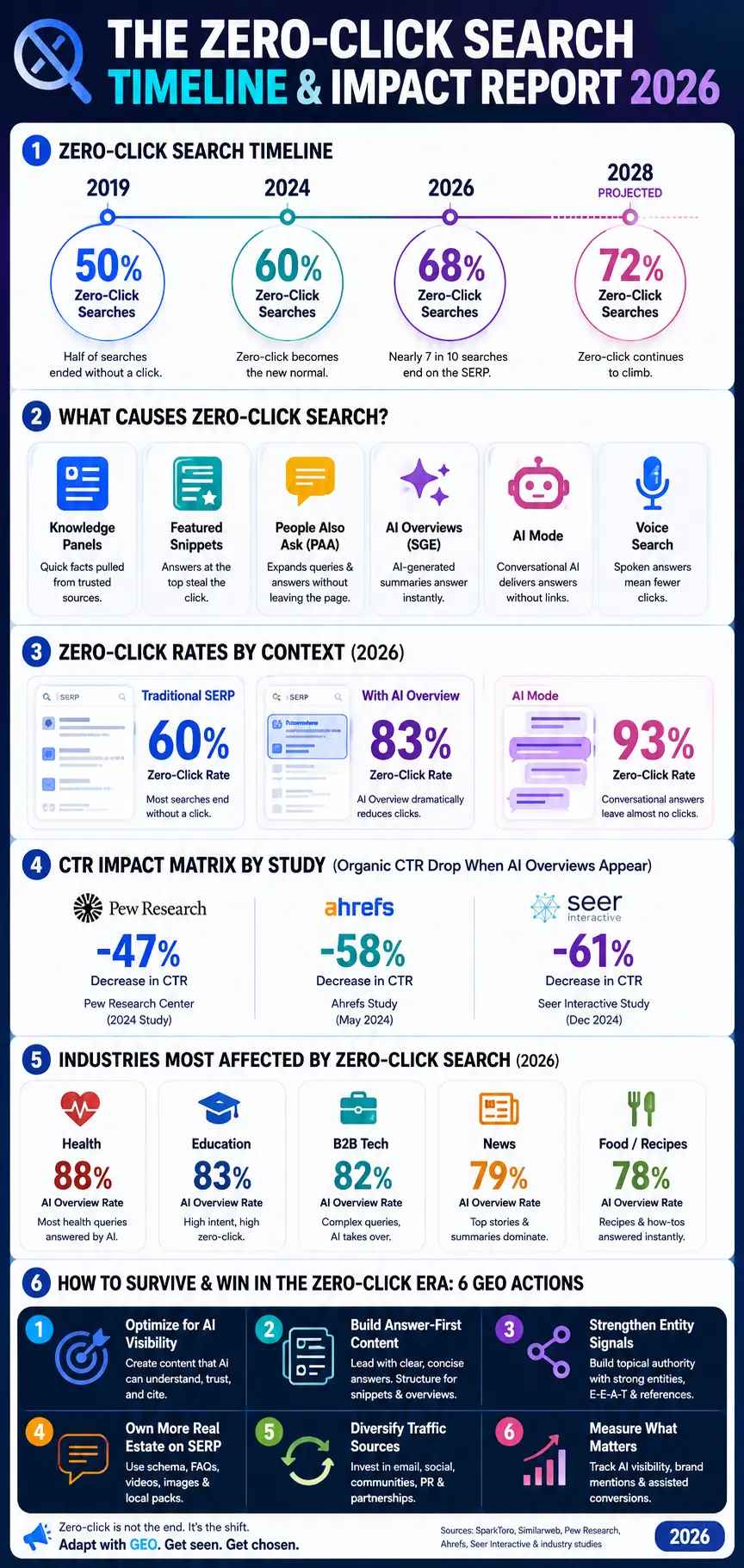
In the first four months of 2026, 68% of Google searches ended without a single click to any external website. According to SparkToro’s Rand Fishkin, who first quantified zero-click search back in 2019 when the rate stood at 50%, the 2026 figure is a 33.8% increase in clickless queries over the past decade and a 12.5% acceleration in just the last two years. The single biggest catalyst: Google AI Overviews, which now appear on roughly 25% of all US searches and cut organic click-through rates by 47–61% on the queries they touch.
For website owners, publishers, and marketers, this isn’t abstract. Organic traffic decline is already measurable across most content categories. Bain & Company found in February 2025 that 80% of consumers rely on AI-generated results for at least 40% of their searches, and organic web traffic has dropped 15–25% across many sectors as a direct consequence. For informational queries the backbone of most content marketing Google’s AI answers now resolve the need before a single link gets clicked.
Understanding what’s actually driving this, who’s most exposed, and what the path forward looks like is essential for anyone who depends on search visibility.
For context on how AI chatbots are contributing to this shift alongside AI Overviews, see PostDune’s Why Users Are Switching from Google Search to AI Chatbots.
What Are Zero-Click Searches?
A zero-click search happens when someone types a query into a search engine most often Google and never clicks any result, organic or paid. They find the answer directly on the results page, refine the query, or just abandon the session. The site whose content actually informed that answer gets nothing: no visit, no session, no pageview.
Rand Fishkin and SparkToro first rigorously quantified this using Datos clickstream data back in 2019, when roughly 50% of Google searches already ended without a click driven mainly by Knowledge Panels, Direct Answer boxes, and Featured Snippets, features Google had been expanding since 2012.
What turned zero-click search from a structural nuisance into a genuine strategic problem was the arrival of Google AI Overviews and Google AI Mode. These don’t just answer simple factual questions they synthesize multi-source responses to complex informational queries that used to require visiting several sites. Ask something like “what’s the difference between a Roth IRA and a traditional IRA, and which is better for my situation?” and you now get a synthesized, multi-paragraph answer directly on the results page. No click required.
A concrete example: a food blogger who ranked #1 for “how to make sourdough bread” used to get clicks from nearly everyone who searched that term. Today, AI Overviews present a step-by-step guide above the organic results. Ahrefs’ analysis of 300,000 keywords found position-1 rankings see a 58% CTR decline when an AI Overview is present. The blogger still holds the ranking. They no longer get the traffic.
The Evolution of Search Results: From Blue Links to AI Answers
This shift didn’t happen overnight. Organic click erosion has been building for over a decade through a series of deliberate SERP feature expansions.
Traditional Search Results
From Google’s founding in 1998 through the early 2010s, results were simple: ten blue links per page, ranked by relevance and authority. Every result was a click opportunity, and CTR was the primary success signal. Content strategy was built entirely around this model.
Featured Snippets
Introduced in 2014, Featured Snippets the answer boxes above organic results were Google’s first large-scale experiment in answering questions directly on the results page. BrightEdge research from 2023 documented a 25–30% drop in organic clicks for informational queries as Featured Snippets absorbed simple fact lookups the early, largely dismissed stage of the zero-click shift.
Knowledge Panels
Knowledge Panels, introduced in 2012, go further by presenting structured entity information company details, person profiles, local business data directly on the results page. For navigational and local queries, Knowledge Panels can answer the question completely enough that no click is needed. Google’s Knowledge Graph has since grown to cover millions of entities, absorbing categories of informational queries that once drove traffic to encyclopedic content sites.
People Also Ask
People Also Ask boxes turned the results page into something closer to a self-contained research tool surfacing related questions and inline answers that keep people following threads without ever clicking to an external source. Longer sessions on the SERP itself, fewer clicks to the open web a key precursor to the AI-era shift.
AI Overviews
Launched in the US on May 14, 2024, AI Overviews are the most consequential search change in the platform’s history. Powered by Gemini, they synthesize information from multiple indexed sources into multi-paragraph, citation-rich summaries positioned above every organic result. By January 2026, AI Overviews appeared on 25.8% of all US searches triggering 39.4% of the time on informational queries, and 83–88% of the time for health and education queries.
The CTR impact isn’t marginal. Seer Interactive’s landmark study analyzed 25.1 million organic impressions across 42 organizations between June 2024 and September 2025 and found organic CTR on AI Overview queries fell from 1.76% to 0.61% a 61% collapse. AI Overviews don’t just compete with organic results. They absorb the query entirely.
Google AI Mode
Launched in March 2025, Google AI Mode takes this further: instead of placing an AI summary above traditional results, it replaces traditional results entirely with a conversational interface. The zero-click impact scales up accordingly Semrush data updated in September 2025 found 93% of searches conducted in Google AI Mode end without a single click to an external site. This is search architecture at its most disruptive fundamentally incompatible with the click-based web economy that search itself built.
Why Zero-Click Searches Are Increasing
Better Direct Answers
The simplest explanation is that Google has gotten dramatically better at answering questions directly. Between the Knowledge Graph, structured data, Featured Snippets, and now AI answers, the results page itself increasingly is the answer for a growing share of queries. When people don’t need to click to get what they came for, they don’t click user experience design working exactly as intended, from Google’s perspective.
AI-Powered Summaries
Where Featured Snippets answered simple factual questions, AI Overviews synthesize complex, multi-part answers with citations and nuanced context. Commercial and navigational queries now represent 42.84% of AI Overview triggers, up from 8.7% in January 2025 (Semrush, October 2025) a sign that traffic decline will keep expanding well beyond purely informational content.
Mobile Search Behavior
Mobile is a major driver here SparkToro’s 2025 zero-click study put mobile zero-click searches at 77%, notably above the overall 60% figure. On mobile, people expect instant answers, the friction of loading a site is higher, and Google’s mobile results pages are designed to satisfy queries without a tap. That combination of behavior and design is a powerful structural accelerator.
Voice Search Growth
Voice search eliminates clicks by design ask Google Assistant, Siri, or Alexa something, and the response gets spoken aloud, typically pulled from a Featured Snippet or AI Overview. No results page ever appears, so there’s no click to make. Voice’s share of total queries has climbed steadily, reaching over 27% of all searches in 2026 (Digital Applied research). Every voice search is, by definition, zero-click and as voice AI gets more capable and embedded in daily routines, this category will only keep growing.
User Demand for Faster Information
People in 2026 expect information in seconds, shaped by years of results-page improvement, social feeds delivering instant content, and AI chatbots giving immediate conversational answers. When AI Overviews satisfy that demand right on the results page, people who once would have clicked no longer need to. That demand for speed is a structural force not one that’s likely to reverse.
Conversational Search Experiences
Average Google query length is up 8% year-over-year in the US, with question-word queries (who, what, why, how) growing across every demographic. These conversational, question-style queries are exactly the ones most likely to trigger AI Overviews and therefore most likely to end in zero clicks. As people write more naturally, Google responds more directly, closing a feedback loop that reduces clicks with every iteration.
AI Chatbots and Search Assistants
This phenomenon extends well beyond Google’s results page. Platforms like ChatGPT, Perplexity, and Claude deliver answers inside their own interface, making click-through the exception rather than the norm. Zero-click rates for AI search platforms range from 60% (Perplexity) to 93% (Google AI Mode), per Semrush. ChatGPT, with 900 million weekly active users processing 2.5 billion queries daily, sends less than 1% of all traffic to external sites. The combined effect of AI Overviews and standalone AI search tools is a structural, accelerating reduction in the click economy that’s sustained web publishing for two decades.
For a deeper look at how AI chatbots specifically drive this decline, see PostDune’s How AI Is Changing User Search Behavior in 2026.
How AI Overviews Are Accelerating Zero-Click Searches
AI Overviews deserve dedicated attention as the single most impactful driver of organic traffic decline in 2025–2026.
What they are: multi-paragraph, citation-linked summaries powered by Gemini, appearing at the very top of Google’s results above all organic results, ads, and other SERP features. As of January 2026, they reach 1.5 billion users monthly across 200+ countries and appear on roughly 25% of all US Google searches, per BrightEdge’s February 2026 benchmark.
How they generate answers: Google’s AI synthesizes information from multiple indexed sources into a self-contained response, with sources cited within the overview itself. But Semrush’s study of 10 million keywords found only 1% of users actually click on those cited sources. The synthesis happens on Google’s own page; the original sources get no visit.
Impact on behavior: the Pew Research Center study from July 2025 the most methodologically rigorous available, tracking 900 US adults across 68,879 real Google searches found that when an AI Overview appears, only 8% of people click a traditional result, versus 15% without one: a 47% relative reduction in click probability per query. On top of that, 26% of sessions end right after encountering an AI Overview one in four people simply stops searching once the AI answers them.
Impact on CTR and traffic: figures vary slightly by methodology, but all point the same direction. Seer Interactive measured a 61% CTR collapse for AI Overview queries. Ahrefs’ December 2025 update found a 58% drop in position-1 organic CTR on those same queries. DMG Media (Daily Mail’s parent) reported an 89% CTR drop on certain navigational desktop searches with AI Overviews present. Even the most conservative study Amsive’s analysis of 700,000 keywords found a 15.49% average CTR decline across all query types, and 19.98% specifically for non-branded queries.
Google’s official position: on Alphabet’s Q4 2025 earnings call in February 2026, CEO Sundar Pichai said AI Overviews “continue to perform very well” and are “driving greater usage” a framing centered on more usage, more queries, more ad revenue. What it leaves out is the redistribution of value away from the open web. Alphabet revenue topped $400 billion for the first time in 2025, with search ad revenue growing 17%, even as organic CTRs collapsed. The mechanism: CPC inflation compensating for fewer clicks, plus direct monetization of AI Overviews through ads appearing on 25.56% of AIO-containing results pages by October 2025 up 394% from March 2025.
As Rand Fishkin put it bluntly: “In a zero-click world, traffic is a terrible goal. Every platform Google, Facebook, LinkedIn, Reddit, YouTube, Instagram, and the AI tools will send less traffic in 2026 than in 2025.”
Zero-Click Search Statistics for 2026
Overall Zero-Click Rates
| Metric | Statistic | Source |
| Google searches ending without any click (early 2026) | 68% | SparkToro/Similarweb, 2026 |
| US searches ending without a click (2025 baseline) | 58.5% | SparkToro/Datos, 2024 |
| EU searches ending without a click | 59.7% | SparkToro/Datos, 2024 |
| Mobile zero-click rate | 77% | SparkToro 2025 analysis |
| Searches ending without a click in Google AI Mode | 93% | Semrush, September 2025 |
| Searches with AI Overviews ending without a click | 83% | Bain, Semrush |
| Growth in zero-click share over 10 years | +23 points (45% → 68%) | SparkToro 2026 |
| Growth in zero-click share (2024 to 2026) | +7.5 points | SparkToro 2026 |
AI Overviews: Prevalence and CTR Impact
| Metric | Statistic | Source |
| AI Overviews appearance rate (US, Jan 2026) | 25.8% of searches | Conductor/Ahrefs, 2025–2026 |
| AI Overviews on informational queries | 39.4% | Stackmatix/Ahrefs, 2025 |
| AI Overviews on health queries | 88% | BrightEdge, February 2026 |
| AI Overviews on education queries | 83% | BrightEdge, February 2026 |
| AI Overviews on B2B tech queries | 82% | BrightEdge, February 2026 |
| Non-informational queries now triggering AI Overviews | 42.84% | Semrush, October 2025 |
| Global users reached by AI Overviews monthly | 1.5 billion | Google / BrightEdge |
| Ads appearing in AI Overview results (Oct 2025) | 25.56% | Semrush |
CTR Decline by Study
| Study | Methodology | CTR Decline |
| Pew Research Center (Jul 2025) | 68,879 real searches, 900 adults | 47% relative reduction (8% vs 15%) |
| Ahrefs (Dec 2025) | 300,000 keywords, GSC data | 58% drop in position-1 CTR |
| Seer Interactive (Sep 2025) | 25.1M impressions, 42 orgs | 61% organic CTR decline |
| Amsive Digital (2025) | 700,000 keywords | 15.49% average; -19.98% non-branded |
| DMG Media (internal) | Publisher CTR, navigational desktop | 89% drop on specific query types |
Traffic and Revenue Impact
| Metric | Statistic | Source |
| Organic web traffic decline across sectors | 15–25% | Bain & Company, February 2025 |
| B2B sites with significant traffic loss (2024–2025) | 73% | Onely/ABM Agency, 2025 |
| Average B2B organic traffic YoY decline | 34% | Onely/ABM Agency, 2025 |
| Traditional search volume drop projected by end-2026 | 25% | Gartner, February 2024 |
| AI search visitor conversion rate vs. organic | 23x higher | Ahrefs, June 2025 |
| Brands cited in AI Overviews: organic CTR premium | +35% | Seer Interactive, Nov 2025 |
| Brands cited in AI Overviews: paid CTR premium | +91% | Seer Interactive, Nov 2025 |
| Top 50 domains’ share of all AI Overview citations | 28.90% | Ahrefs, 55.8M AIO analysis |
Which Types of Websites Are Most Affected?
The impact isn’t uniform. Understanding your own exposure is essential to prioritizing an AI-era response.
News Websites
A mixed picture. AI Overviews rarely trigger for breaking news, since real-time events require verification the AI can’t reliably provide. But evergreen analysis and explanatory journalism are heavily exposed The Digital Bloom’s 2025 organic traffic crisis report documented median publisher traffic down 10% year-over-year, with AI Overview growth of 258% in real estate news and 273% in restaurant/food coverage. DMG Media reported an 89% CTR drop on certain desktop searches, though overall traffic impact stayed in “very low single digits” suggesting breaking news remains somewhat insulated.
Opportunity: news brands with strong entity recognition and verified author credentials are well-positioned to earn citations that build awareness even without clicks. Subscription and direct email models are the strongest traffic hedges.
Blogs and Content Publishers
Informational, how-to, and educational blogs are the category most severely exposed. Ahrefs data shows 99.9% of informational keywords now trigger an AI Overview if your traffic base is recipes, tutorials, or explainers, the CTR impact is direct and largely unavoidable at the individual query level.
Opportunity: blogs producing original research or genuinely unique expert perspective are far more likely to be cited than those publishing reformulated commodity content. Citation delivers brand impressions at real scale and mid-tier sites ranking positions 11–20 are actually being cited in AI Overviews at meaningful rates, an alternative visibility path.
Affiliate Sites
This is a structural crisis category. Comparison content and “best X for Y” articles the backbone of affiliate revenue are increasingly handled directly by AI Overviews. It’s not just a click problem; it’s intent interception. If someone gets a ranked list of “best budget laptops 2026” straight from an AI Overview, the affiliate site that ranked for that term may never enter the journey at all.
Opportunity: transactional queries with real purchase intent “buy X,” “price of Y” remain protected; AI Overviews appear on only 3–4% of e-commerce queries (Ahrefs). Shifting toward highly specific, review-heavy content with genuine first-hand testing is the more defensible path.
Educational Websites
One of the highest-exposure categories BrightEdge’s February 2026 benchmark found AI Overviews on 83% of educational queries. Definitions, study guides, and explainers are precisely what AI answers were built to absorb, a real structural challenge for ad-supported educational publishers.
Opportunity: interactive learning tools, quizzes, structured curriculum content, and teacher resources are harder to replace and more likely to drive intentional visits. Paywalled or credentialed content is also partially protected.
Review Sites
Impact depends heavily on category. Generic consumer product reviews are increasingly captured by AI Overviews surfacing aggregated ratings without linking out. But large proprietary review platforms Trustpilot, G2, Capterra are actually being cited at disproportionate rates. SE Ranking’s analysis found domains active on G2, Capterra, and Trustpilot earn 3x more ChatGPT citations than those without profiles there.
Opportunity: building structured, indexed review content while accumulating reviews on major third-party platforms can turn this category into a citation source rather than a casualty.
E-Commerce Stores
Currently the most protected major category AI Overviews appear on only about 4% of e-commerce queries (Ahrefs/Stackmatix, January 2026), since Google can satisfy purchase intent through Shopping ads and merchant listings with higher commercial value than an AI summary. Still, Semrush’s October 2025 data shows commercial AI Overview coverage rising fast from near-zero to 42.84% of all AI Overview triggers across query types. E-commerce isn’t immune, just later in the exposure curve.
Opportunity: product and category pages remain well-protected for now. Strong visual content, user-generated reviews, and rich product data are the most defensible investments medium-term.
Local Businesses
A nuanced picture. AI Overviews rarely trigger for hyperlocal queries like “plumber near me,” where Google’s local pack and Maps handle intent more effectively than generated text. Informational local content (“best neighborhoods in Austin”) is more exposed.
Opportunity: businesses with accurate, complete Google Business Profiles and genuine reviews are well-positioned. Zero-click local searches often still convert to Maps visits or phone calls real value that standard organic click metrics simply miss.
The Impact on Organic Search Traffic
Reduced Click-Through Rates
Documented across a dozen independent studies, AI Overviews reduce CTR by 15–89% depending on query type, ranking position, and methodology. Even without AI Overviews present, organic CTR has declined year-over-year Seer Interactive found a 41% drop even for queries without them, suggesting broader systemic SERP changes beyond any single feature.
Lower Organic Visits
The aggregate market-level traffic loss sits at roughly 2.5% year-over-year for US organic search (Search Engine Land/Graphite, January 2026) a modest-sounding number masking enormous variation. ALM Corp’s February 2026 analysis found organic click share down 11 to 23 percentage points across multiple verticals between January 2025 and January 2026, with health, education, and B2B software publishers seeing steeper declines of 30–70% on their most traffic-dependent content.
Changes in the User Journey
Zero-click search has compressed the buyer journey in ways that challenge old funnel assumptions. When research and comparison happen entirely inside an AI interface, brands that used to get discovered during that phase become invisible right when consideration sets form. Bain & Company’s September 2025 research found 85% of B2B buyers purchase from their “day one” vendor list brands they already knew before searching. Zero-click search is cutting off the discovery-phase path for brands trying to get onto that list in the first place.
Increased Competition for Remaining Clicks
Paradoxically, traffic decline is intensifying competition for whatever clicks remain. SparkToro’s 2026 data shows Google’s top-10 sites grew traffic roughly 1.6%, while mid-tier sites (positions 100–10,000) saw the sharpest declines. FirstPageSage’s May 2025 study found Position 1 now captures 2.1x the clicks of Position 2, up from 2.0x in 2024 as available clicks shrink, they concentrate ever more heavily on the top result. A winner-take-most dynamic in a shrinking pool.
Brand Visibility Without Traffic
Perhaps the most important reframe here: being cited in AI Overviews or chatbot responses provides brand visibility even without a click. Seer Interactive’s research found brands cited inside AI Overviews earn 35% more organic clicks and 91% more paid clicks than non-cited brands on the same queries because the citation itself drives awareness and credibility that shapes behavior on later branded searches. Zero-click doesn’t mean zero brand impact. It means the impact shifted upstream from click to impression, from visit to mention.
Google AI Answers vs. Traditional Organic Results
| Factor | AI Answers | Traditional Organic Results |
| Visibility | Prominent, above all other SERP elements | Below AI Overviews; competes with ads and features |
| Click Potential | Very low (1% click AIO citations; 8% click anything when AIO present) | Moderate to high (up to 34–40% CTR for Position 1) |
| Information Delivery | Synthesized overview from multiple sources | Full depth and context from the original source |
| Traffic Generation | Minimal direct traffic; strong brand impressions | Direct traffic driver; primary referral channel |
| SEO Strategy | Citation readiness, E-E-A-T, structured data, earned media | Keyword targeting, backlinks, technical SEO |
| Best For | Brand awareness, pre-consideration visibility | Direct traffic, lead generation, conversions |
Traditional organic ranking remains the foundation for transactional and navigational content; generative engine optimization for AI citation is the necessary addition for informational and research-oriented content. Organizations investing in both build compounding advantages being cited in an AI Overview while ranking Position 1 delivers brand impressions from the citation plus a 35% CTR premium over uncited brands on the same query. More on navigating both at once in PostDune’s Generative Engine Optimization (GEO).
Why Zero-Click Searches Aren’t Always Bad
Before landing on a purely fatalistic read of this trend, it’s worth recognizing the genuine opportunities it creates for brands that adapt proactively.
Brand Awareness
Being cited in an AI Overview or chatbot response exposes your brand to everyone who sees that response, even without a click. BrightEdge’s February 2026 report documented a 49% increase in total search impressions year-over-year even as clicks declined. Impressions without clicks aren’t worthless they’re an awareness channel, functioning something like digital PR at results-page scale.
Authority Building
Getting selected as a cited source is itself an authority signal people register even without clicking. Bain & Company’s 2025 consumer research shows AI-generated recommendations shape brand perception and trust among people relying on AI answers for 40%+ of their searches. Consistent citation for a category builds authority that shapes consideration even for people who never visit the site.
Featured Citations
The citation effect Seer Interactive documented 35% more organic clicks, 91% more paid clicks for cited brands shows that citation is a value-multiplier for brands already investing in traditional SEO. Someone who sees a brand cited in an AI Overview and later searches for it by name is expressing high intent; the citation did the awareness work, the branded search delivers the conversion. That downstream effect compounds over time.
Increased Trust
Brands whose content powers AI answers benefit from an implied trust transfer when Google’s AI synthesizes your research or cites your expert opinion, that authority extends to the brand. Early evidence suggests brands cited for YMYL queries (health, finance, legal) get a particularly strong trust signal, since these are categories where people apply the most scrutiny to sources.
New Discovery Channels
Zero-click search has decoupled discovery from website visits in 2026, discovery can happen entirely on the results page through an AI Overview citation. That means brands with previously limited organic reach mid-tier sites, newer entrants, niche publishers can gain consideration-stage visibility without necessarily ranking top 10 traditionally. Ahrefs found 40% of sources cited in AI Overviews rank between positions 11 and 20 in regular search citation eligibility and ranking position are partially decoupled.
How Website Owners Can Adapt
The right response runs on two tracks at once: keep the traditional SEO foundation solid while systematically building for generative engine optimization and AI citation.
Create Original Research
Proprietary surveys, first-party data, unique case studies, and industry benchmarks are the highest-value content type in this environment AI simply can’t replicate data that doesn’t exist anywhere else. Publishers investing in original research are already seeing disproportionate citation rates relative to their domain authority.
Build Real Topical Authority
AI systems favor sources demonstrating deep, consistent expertise across a whole topic domain not just individual pages ranking for individual keywords. That means comprehensive content clusters, systematic sub-topic coverage, regular updates, and clear entity association between a brand and its actual area of expertise. Pages updated within 60 days are 1.9x more likely to appear in AI Overview citations than older content (BrightEdge, 2026).
Strengthen E-E-A-T Signals
E-E-A-T is the foundation for citation eligibility in AI answers. Sites with verified author schema are three times more likely to appear in AI Overview citations. Real expert authorship actual bylines with credentials, consistent cross-platform presence, verified author pages with schema is one of the highest-ROI adaptations available right now.
Optimize for AI Citations
A few specific practices matter here:
- Open every key section with a direct, extractable answer to the implied question
- Use clear headers that mirror natural search questions
- Add FAQ sections with concise, factual answers
- Structure content in blocks that can be cited in isolation
- Make sure factual claims are precisely worded and independently verifiable
The Princeton University GEO research paper found content optimized for AI citation through added citations, quotations, statistics, and clear structure generated 30–40% more AI visibility compared to unoptimized content.
Use Structured Data
Schema markup is a direct technical signal to AI systems about your content’s nature and authority. Sites implementing Article, FAQ, HowTo, and Organization schema saw a 44% increase in AI search citations, per BrightEdge research. It doesn’t guarantee citation, but its absence is a real competitive disadvantage FAQ schema especially, since it maps directly onto the question-answer format AI Overviews and voice search both use. See Google’s structured data documentation for implementation guidance.
Publish Genuinely Expert Content
Commodity content generic definitions, reformulated listicles, AI filler is being absorbed into AI answers and won’t recover traffic. What survives requires real expertise to produce: original analysis, practitioner case studies, detailed technical guides from actual domain experts, first-person documentation. Digital Applied’s 2026 zero-click strategy analysis found content requiring an actual visit to extract value interactive tools, downloadable resources, proprietary databases, calculators retains traffic even as generic equivalents get absorbed.
Focus on Genuinely Unique Insight
The future here belongs to content AI can’t generate: proprietary data, unique methodology, contrarian expert opinion, first-hand observation from people who were actually there. The Digital Bloom’s AI citation position and revenue report shows 65% of AI bot hits target content published in the past year freshness correlates with citation probability, but freshness alone isn’t enough. The content still has to offer something AI synthesis can’t replicate.
Build Content AI Can’t Easily Replicate
- Interactive tools (calculators, assessors, comparators) requiring real user input
- Community-driven content with authentic user-generated perspective
- Video and multimedia requiring platform-specific delivery
- Product demos and walkthroughs that only make sense in context
- Content that adapts to an individual’s specific situation
- Real-time or live content requiring active access
These formats create genuine reasons to visit that an AI summary simply can’t satisfy.
Build Real Brand Recognition
Bain & Company’s finding that 85% of B2B buyers purchase from their “day one” vendor list points toward the most powerful adaptation available: build recognition before the search ever happens. Brands with strong recognition are partly protected, since branded queries are rarely intercepted by AI Overviews. Brand search volume how many people search your name directly is becoming one of the most reliable leading indicators of search marketing health in this environment.
Implement Generative Engine Optimization (GEO)
A few core GEO practices worth prioritizing:
Earned media strategy: third-party editorial mentions in authoritative publications, which account for 84% of AI citations, per Muck Rack.
Entity optimization: consistent brand entity signals across your site, social profiles, Wikipedia presence, and third-party platforms.
Citation monitoring: tracking how often, and in what context, your brand appears in AI Overview and chatbot responses.
Freshness management: systematic review and updating to maintain recency signals.
54% of US marketers plan to implement GEO within three to six months (eMarketer, January 2026). Starting now builds citation history and entity authority that compounds as AI search keeps expanding. See PostDune’s How to Optimize Your Website for AI Search for a practical framework.
The Future of SEO in a Zero-Click Search World
This trajectory is shaped by three converging forces: continued SERP feature expansion, growing AI search market share, and evolving user expectations around instant answers. All three are accelerating.
AI-powered search evolution: industry projections suggest AI Overviews could appear on 60–70% of Google queries by late 2026 (NavBoost/industry analysis). Google’s financial incentive to keep expanding is clear more queries, higher CPC inflation, new ad inventory even as clicks to the open web keep falling. Expansion into commercial and transactional queries will progressively erode the categories currently offering click protection.
AI agents: the next step beyond conversational search is autonomous agents systems that research, compare, recommend, and transact on someone’s behalf without any results-page interaction at all. For sites depending on discovery-phase traffic, that’s an even more complete form of zero-click: not a results page that ends without a click, but an entire search journey that never touches a SERP in the first place.
Search personalization: AI systems are learning to anticipate needs and surface answers before a query is even formed. Early predictive AI implementations from Google and Microsoft hint at a future where the search moment itself becomes less necessary zero-click evolving into something closer to pre-click search.
GEO as a formal discipline: the GEO market, valued at $848 million in 2025, is projected to reach $33.7 billion by 2034 at a 50.5% CAGR. Through 2030, the line between traditional SEO and GEO will likely dissolve further, since the underlying signals both reward real expertise, structured content, authoritative sourcing are converging.
Future ranking factors: based on current trends, what matters most in the post-2026 landscape looks like entity clarity (is your brand a well-defined, consistently described entity in AI training data?), earned media authority (are third parties citing you?), content freshness, and structured extractability. Keyword optimization and raw link volume will matter less; genuine authority, original content, and structural clarity will matter more.
Expert Opinions and Industry Perspectives
Rand Fishkin (SparkToro). In his June 2026 publication, Fishkin was blunt: “Ten years ago, ~45% of Google searches were zero-click. Today it’s 68%.” He frames it as a deliberate strategic move by Google toward becoming a walled garden benefiting from people staying inside its ecosystem while reducing traffic to the open web it once served. His advice: “Traffic is a terrible goal,” and metrics need to shift toward brand visibility, impression share, and AI citation frequency.
Sundar Pichai (Google CEO). On Alphabet’s Q4 2025 earnings call, Pichai said AI Overviews are “driving greater usage” and performing “very well” framing this as a user experience improvement that increases engagement. Google disputes several third-party CTR studies, particularly Pew Research’s, on methodological grounds, while continuing to expand AI Overviews to more query types each quarter.
Bain & Company. Their February 2025 report, Goodbye Clicks, Hello AI, put it plainly: “80% of consumers now rely on AI-generated results for at least 40% of their searches, and organic web traffic has declined an estimated 15–25% across many sectors.” Their September 2025 follow-up, Losing Control, documented the B2B dimension: “85% of B2B buyers purchase from their ‘day one’ vendor list companies they already knew before searching.” Their recommended shift: from click-based metrics toward impressions, AI reach, share of model, and brand search volume.
Ahrefs. Ryan Law and Xibeijia Guan published the most rigorous keyword-level study of AI Overview CTR impact 300,000 keywords, 58% lower CTR on position-1 rankings when an AI Overview is present. Their conclusion: “Stop optimizing for position 1 in isolation. Six levers work together: GSC segmentation, citation readiness, clean schema markup, solid E-E-A-T signals, brand building, and a search-everywhere strategy.”
Seer Interactive. Their dataset 3,119 informational queries, 42 organizations, 25.1 million impressions over 15 months found organic CTR collapsed 61% for AI Overview queries, but “brands cited inside AI Overviews earn 35% more organic clicks and 91% more paid clicks than non-cited brands on the same query.” Their read: the goal has shifted from ranking to being cited, and citation delivers compounding advantages across both organic and paid.
Gartner. VP Analyst Alan Antin, February 2024: “We’re seeing the early stages of a significant shift in search behavior. By 2026, traditional search engine volume will drop 25% as AI chatbots and virtual agents divert queries away from traditional search engines.” As of mid-2026, that forecast looks on track possibly conservative for the most affected verticals.
Frequently Asked Questions
What is a zero-click search?
A search query that ends without the user clicking any result organic or paid. They find the answer directly on the results page, refine their search, or abandon it. As of early 2026, 68% of Google searches end without any click to an external site (SparkToro/Similarweb).
Are AI Overviews actually reducing website traffic?
Yes, measurably. When AI Overviews appear, people click a traditional result only 8% of the time versus 15% without one a 47% relative reduction, per Pew Research Center’s July 2025 study. Seer Interactive measured a 61% organic CTR collapse for AI Overview queries. Bain & Company found organic traffic down 15–25% across many sectors. The direction is unanimous across every major study; the magnitude varies by query type, industry, and position.
How can websites actually survive zero-click search growth?
The most effective approaches: create original research AI can’t replicate; optimize for AI Overview citation through structured content, FAQ schema, and E-E-A-T signals; build earned media presence in authoritative publications (which drive 84% of AI citations); focus on interactive tools and deep expert analysis that create genuine visit motivation; and implement GEO alongside traditional SEO.
What is Generative Engine Optimization (GEO)?
GEO is the practice of structuring content and building digital authority so AI-powered platforms Google AI Overviews, ChatGPT, Claude, Perplexity, Microsoft Copilot can retrieve, cite, and recommend a brand in their generated responses. Where traditional SEO targets ranking, GEO targets citation eligibility. See PostDune’s Generative Engine Optimization (GEO) for the full framework.
Do zero-click searches actually hurt SEO?
They hurt traditional click-based metrics, but create new opportunities around brand visibility and authority. Organic traffic decline for informational content is real and measurable. But citation in AI Overviews generates impressions, drives branded search volume, and correlates with higher CTR on whatever organic and paid clicks remain. Brands that adapt their measurement tracking impressions and citations alongside traffic are better positioned to demonstrate the value of their search investment.
Which websites are most affected?
Sites heavily dependent on informational content: educational publishers, how-to blogs, news analysis, affiliate comparison sites, and B2B content hubs. E-commerce and local businesses are currently more protected, since transactional and hyperlocal queries trigger AI Overviews at much lower rates though commercial coverage is expanding quickly.
Is Google AI Mode different from AI Overviews?
Yes, significantly. AI Overviews sit above traditional results people can still see and click organic results below. AI Mode replaces traditional results entirely with a conversational interface, removing the organic results page altogether. That’s why AI Mode drives a dramatically higher zero-click rate: 93%, versus roughly 43% for AI Overview queries generally (Semrush, September 2025).
Can being cited in AI Overviews still grow traffic in a zero-click world?
Yes, with a nuance. Direct clicks on citations within an AI Overview are rare (about 1%), but cited brands earn 35% more organic clicks and 91% more paid clicks than non-cited brands on the same query (Seer Interactive). The mechanism is indirect: citation drives awareness, awareness lifts branded search volume, branded search delivers high-intent visitors. AI search visitors overall, despite being just 0.5% of traffic, generated 12.1% of signups in Ahrefs’ data a 23x higher conversion rate than typical organic visitors.
What content is relatively safe from zero-click search?
Transactional e-commerce content, navigational brand/URL queries, hyperlocal real-time queries (hours, availability, directions), interactive tools requiring input, paywalled or credentialed content, video and multimedia, and content built on unique personal experience or proprietary data. Breaking news is also largely protected, since AI Overviews are cautious about unverified real-time events.
What should website owners actually measure now?
Traditional metrics organic sessions, CTR should be supplemented with search impressions, AI citation rate, brand search volume, share of model (what percentage of AI responses in your category mention you versus competitors), and AI referral quality (conversion and engagement from AI-driven visitors).
Conclusion
The rise of zero-click search is arguably the most structurally significant shift in search marketing since Google introduced PageRank. The data is unambiguous: 68% of Google searches now end without a click. AI Overviews cut organic CTR by 47–61% on the queries they touch. Google AI Mode delivers a 93% zero-click rate by design. Organic traffic decline of 15–25% across major sectors is already a present-tense reality, not a projection.
The causes are structural and self-reinforcing: AI answers get better every month, the queries they cover expand every quarter, and people accustomed to instant, synthesized responses aren’t going back to clicking through blue links. Gartner’s forecast of a 25% traditional search volume drop by end-2026 is playing out on schedule, and may prove conservative for the hardest-hit verticals.
But this isn’t purely a story of traffic loss and crisis. Brands that understand zero-click search as an awareness channel as much as a traffic threat are building citation equity that compounds as AI search keeps expanding. Being cited in an AI Overview is a brand event, not just a traffic outcome the 35% organic CTR premium and 91% paid CTR premium earned by cited brands quantify that downstream value in concrete terms.
For website owners: audit your content for informational dependency, identify what’s most exposed to AI Overview cannibalization, prioritize original research and interactive tools, and implement FAQ schema across your highest-traffic pages now.
For SEO professionals: expand measurement to include AI citation rate, impression share, and branded search volume. Build GEO capability alongside traditional rank tracking.
For publishers and bloggers: the commodity content era is over. Generic how-tos, basic definitions, and reformulated listicles are being absorbed and won’t recover traffic. Depth, originality, real expertise, and structural extractability are what earn citations now.
The window for adapting building citation equity, establishing entity authority, restructuring content for the AI era is open right now. Organizations that act in the next twelve months will build advantages that get harder to replicate as the market matures.
Key Takeaways
- 68% of Google searches in early 2026 end without any click to an external site a 23-point increase over the past decade (SparkToro/Similarweb)
- Google AI Overviews now appear on 25.8% of US searches, triggering on 39.4% of informational queries and up to 88% of health queries
- When an AI Overview appears, people click a traditional result only 8% of the time versus 15% without one a 47% relative reduction (Pew Research, 68,879 real searches)
- Google AI Mode produces a 93% zero-click rate the most extreme form of search-without-click behavior measured so far (Semrush)
- Organic web traffic has declined 15–25% across many sectors; 73% of B2B sites saw significant traffic loss in 2024–2025
- Brands cited in AI Overviews earn 35% more organic clicks and 91% more paid clicks than non-cited brands on the same queries (Seer Interactive)
- AI search visitors convert at 23x the rate of traditional organic visitors, making citation-driven traffic qualitatively different even as volume falls
- Generative Engine Optimization is the critical adaptation for this era, with the GEO market projected to reach $33.7 billion by 2034