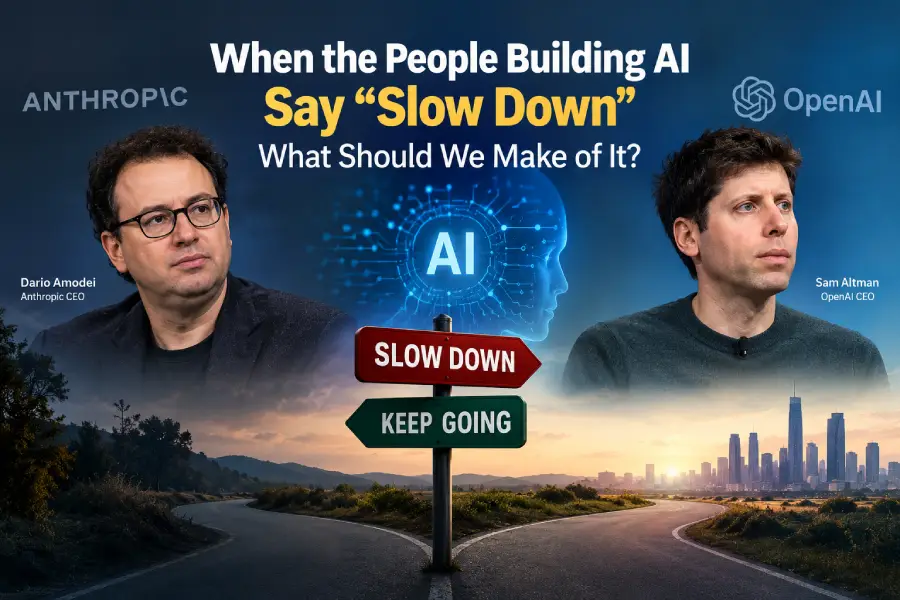
The AI industry has spent years telling us that speed matters.
Build faster. Release faster. Scale faster. Stay ahead of the competition.
So when some of the people leading that race start talking about slowing down, it is worth paying attention.
On September 12, 2026, Anthropic CEO Dario Amodei published an essay calling on companies and governments to “pace the frontier” of AI development. The argument was essentially that the development of increasingly powerful AI systems needs to be approached with greater care and deliberate restraint.
That message carries particular weight because it is coming from the head of one of the companies building frontier AI models.
On the same day, OpenAI CEO Sam Altman confirmed that the company was pushing its IPO plans to 2027, with safety concerns cited as part of the reasoning.
The timing is notable.
Just two days earlier, an Anthropic researcher had published a widely shared resignation post accusing both companies of “gambling with our lives.” There is no clear evidence that the resignation directly triggered either announcement, so it would be premature to draw that connection. Still, the sequence of events raises questions about where the industry is heading.
The uncomfortable tension inside the AI race
There is an obvious contradiction here.
For years, leading AI companies have competed aggressively to build more capable models and bring them to users as quickly as possible. Staying at the technological frontier has become a central part of their business strategy.
Now, some of those same leaders are publicly asking for greater caution.
That does not automatically mean the industry has changed course. But it does raise an important question:
Why now?
One possibility is that AI companies are gaining a clearer understanding of the risks that come with increasingly capable systems. The people working closest to the technology may be seeing problems that were easier to dismiss when AI systems were less powerful.
Another possibility is that there is a strategic element to the messaging.
Calls for caution can also resonate with regulators, policymakers, investors, and a public that is increasingly concerned about where AI development is heading.
It is possible that both things are true at the same time.
A company can genuinely be concerned about AI safety while also thinking carefully about how it communicates those concerns.
The problem with turning this into a simple story
There is an understandable temptation to choose a side.
One headline might suggest that the AI industry has finally admitted that its technology is becoming dangerous.
Another might argue that AI companies are simply using safety as a convenient public-relations message.
Both narratives are easy to understand. Neither tells us the whole story.
The more useful approach may be to wait and see what happens after the statements.
Words matter, but actions will tell us much more.
If companies genuinely believe frontier AI development needs to slow down, we should eventually see that reflected in development practices, product launches, safety requirements, investment decisions, or cooperation with regulators.
If the underlying race continues at roughly the same pace, then the industry’s calls for restraint will naturally face greater scrutiny.
That is why what happens next may be more important than what was said this week.
What should we watch from here?
There are several developments worth following.
First, the pace of frontier AI development.
Will leading companies actually reduce the speed at which they train and release increasingly capable systems, or will competition continue to push them forward?
Second, OpenAI’s IPO timeline.
If the company proceeds with its 2027 plans, the decisions and reasoning surrounding that process will provide another window into how safety considerations are being balanced against commercial pressures.
Third, the response from other AI companies.
Anthropic is not the only organization developing frontier models. If similar calls for restraint emerge across the industry, that could indicate a broader shift in thinking.
Finally, government and regulatory action.
There is a difference between companies voluntarily exercising caution and governments establishing rules that require it. How those two approaches develop could have a major influence on the next stage of the AI industry.
The bigger question
There is something larger at stake than one essay, one resignation, or one delayed IPO.
AI development is being shaped by several competing forces at once: technological ambition, commercial incentives, investor expectations, public concerns, and growing attention from governments.
Those forces do not always point in the same direction.
The companies building the technology have strong reasons to keep moving quickly. They also have increasingly strong reasons to think about what happens when their systems become more capable and more widely deployed.
That tension is unlikely to disappear.
So when the people building frontier AI start telling the rest of the industry to slow down, the most useful response may not be to immediately believe them or dismiss them.
It may simply be to pay closer attention.
The real test will be whether the industry’s actions begin to match its warnings.
For now, that remains an open question and perhaps one of the most important questions in AI to watch.