When people use enterprise software, they usually notice the screens first. But behind those screens is the back end that keeps everything running.
If a payment API slows down at the end of the month, a database becomes overloaded, or an integration quietly fails to send an order, the problem is usually somewhere behind the interface. For large organizations, choosing the right back-end development partner is therefore a major technology decision.
The pressure on enterprise back ends is increasing in 2026. Companies are connecting AI agents to business systems, moving workloads between multiple cloud platforms, and dealing with increasingly demanding requirements around data protection and operational resilience. As a result, APIs, databases, integrations, and infrastructure all have to handle more complexity than they did a few years ago.
This guide looks at what strong enterprise back-end development involves today. It also covers six companies with experience in server-side development, cloud engineering, integrations, and data platforms, along with a practical checklist you can use when evaluating a development partner.
The list includes both large global IT service providers and smaller engineering specialists. There isn’t one right choice for every organization. Your budget, technology stack, project size, industry, and long-term requirements all matter.
Editorial note: This is an independent editorial list, not a paid ranking. The order does not represent a score or ranking. Company information is based on publicly available sources and company announcements, so verify current services, certifications, team size, and capabilities directly before making a decision.
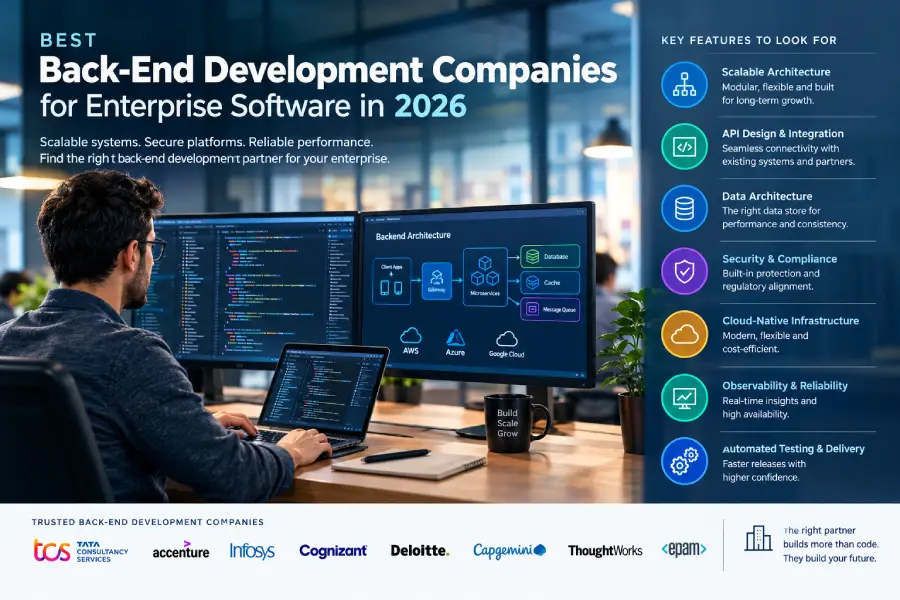
Key Features of Enterprise Back-End Development
Enterprise back-end development is very different from building the server side of a small application.
Large organizations often have older systems, multiple databases, dozens of integrations, different development teams, and strict security requirements. A failure can also affect thousands or millions of users.
A capable back-end development partner should understand the following areas.
1. Architecture That Fits the Business
Microservices have become popular for large applications, but they aren’t automatically the right answer.
A microservices architecture can make independent deployments and scaling easier, but it also introduces more services to operate, more network communication, and additional monitoring and debugging requirements.
For some organizations, a well-designed modular monolith makes more sense. Other parts of the business may benefit from independent services where teams, scaling requirements, or release schedules are different.
The important thing is that your development partner should be able to explain why a particular architecture makes sense for your project rather than simply choosing the latest trend.
Event-driven architecture is also increasingly important. Technologies such as Apache Kafka allow applications to respond to events—such as an order being placed or a payment being completed—without requiring every system to communicate directly with every other system.
2. API Design and Integration
For many enterprises, one of the back end’s most important jobs is connecting different systems.
That could mean linking ERP and CRM platforms, payment gateways, mobile applications, partner systems, internal tools, and increasingly, AI assistants and agents.
This makes API development a critical skill.
Look for experience with consistent REST or GraphQL design, API versioning, documentation, authentication, rate limiting, monitoring, and API gateways.
AI introduces another consideration. As AI assistants and agents gain permission to interact with internal business systems, organizations need tighter access controls, detailed audit trails, and APIs that behave predictably when they receive automated requests at scale.
3. Data Architecture and Performance
Enterprise applications rarely rely on a single type of database.
A typical environment might use PostgreSQL or Oracle for transactional workloads, a NoSQL database for flexible or high-volume data, Redis for caching, and a data warehouse or lakehouse for analytics.
A good back-end team needs to understand when each technology makes sense and how the different systems should work together.
Performance tuning is equally important. Before simply adding more servers, experienced engineers should look at queries, indexes, caching, connection management, and application architecture to find the actual bottleneck.
4. Security and Compliance by Design
Security shouldn’t be something added just before launch.
Strong back-end teams build security into the development process from the beginning. That includes encryption in transit and at rest, identity and access management, secrets management, input validation, dependency scanning, secure coding practices, and regular security testing.
Compliance requirements also vary by industry and location.
For example, the Digital Operational Resilience Act (DORA) has applied to the financial sector since January 17, 2025, creating requirements around ICT risk management and third-party technology providers. Healthcare, payments, and public-sector organizations have their own requirements, including frameworks and regulations such as HIPAA and PCI DSS.
Your development partner should understand the rules that apply to your business—not just general software security practices.
5. Cloud-Native Infrastructure
Most modern enterprise back ends run on major cloud platforms such as AWS, Microsoft Azure, or Google Cloud. Many organizations also operate across more than one provider.
That requires practical experience with containers, Kubernetes, infrastructure as code, managed databases, serverless services, networking, and cloud security.
Tools such as Terraform can help teams manage infrastructure consistently, while managed cloud services can reduce operational overhead.
Cost management matters, too.
A back end that can scale technically but causes your cloud bill to double isn’t necessarily a successful solution. Good engineering teams consider performance, reliability, and cost together.
6. Observability and Reliability
You can’t troubleshoot a system if you can’t see what’s happening inside it.
Mature engineering teams use structured logging, metrics, and distributed tracing to follow requests across multiple services. OpenTelemetry is commonly used as part of modern observability setups.
Reliability also requires more than monitoring. Teams should establish service-level objectives, build redundancy where necessary, plan for failures, and design systems that can degrade gracefully when a component becomes unavailable.
After serious incidents, proper teams also conduct reviews and use what they learn to prevent similar problems from happening again.
7. Automated Testing and Delivery
Enterprise back ends are constantly changing. New features, integrations, security patches, and infrastructure changes all need to be delivered without creating unnecessary risk.
That makes automated testing and CI/CD pipelines essential.
Depending on the system, testing may include unit tests, integration tests, contract tests, security tests, and performance or load testing.
Contract testing is particularly useful when several teams depend on the same APIs. It can catch breaking changes before they reach another application or service.
8. Long-Term Maintainability
Enterprise software can remain in production for 10 years or longer.
That means the quality of the code and documentation matters long after the original development team has moved on.
Clean code, sensible dependencies, clear documentation, automated tests, and a proper knowledge-transfer process can make a major difference over time.
Cheap development work can become surprisingly expensive when the organization later has to rebuild poorly documented systems or replace an architecture that wasn’t designed to evolve.
Best Back-End Development Companies
The companies below were selected based on their publicly documented experience in server-side engineering, cloud technologies, integrations, data engineering, and enterprise software.
The list includes two large global IT service providers and four mid-sized engineering companies. Each has a somewhat different focus, so the right fit depends on your project requirements.
1. Tata Consultancy Services (TCS)
Best for: Banks, insurers, retailers, and other large organizations running mission-critical transactional systems.
Tata Consultancy Services (TCS) is one of the world’s largest IT services companies. Headquartered in Mumbai, it reported 584,519 employees as of March 2026 and approximately US$28 billion in fiscal 2026 revenue.
Its size is reflected in the type of projects it handles. TCS works across areas such as core banking, payment systems, ERP integrations, enterprise applications, and large cloud modernization programs.
Financial services is one of its major areas of expertise. TCS also develops BaNCS, a software platform used across banking, insurance, and capital markets. That gives the company experience with transaction-heavy environments where security, reliability, and regulatory requirements are critical.
The trade-off is typical of very large service providers. Smaller projects may not receive the same level of senior involvement as major programs, and enterprise governance can be extensive.
TCS is generally suited to organizations that need a large team and a partner capable of supporting a major technology program over several years.
2. Capgemini
Best for: Enterprises looking for back-end engineering alongside cloud operations, SAP integration, and European data-sovereignty requirements.
Headquartered in Paris, Capgemini had approximately 421,000 employees at the end of March 2026, with its workforce size significantly affected by the acquisition of WNS.
The company has broad capabilities across application development, cloud modernization, infrastructure operations, SAP, and FinOps. Its acquisition of Cloud4C has also expanded its hybrid-cloud and managed-services capabilities.
For enterprise back-end projects, that breadth can be useful. A single program may involve modernizing applications, connecting SAP systems, moving workloads to the cloud, and then operating the resulting infrastructure.
Capgemini Engineering also works on embedded and software-defined systems, particularly for industrial organizations.
Its combination of application, cloud, infrastructure, and engineering capabilities makes it relevant to European organizations dealing with cloud modernization alongside data-sovereignty and regulatory requirements.
3. SoftServe
Best for: Cloud-native back ends and application modernization across AWS, Azure, and Google Cloud.
SoftServe is headquartered in Austin, Texas, with significant engineering operations across Europe and Latin America.
Cloud engineering is one of the company’s main strengths. SoftServe is an AWS Premier Tier Services Partner and reports 12 AWS competencies. It also signed a Strategic Collaboration Agreement with AWS in July 2025.
In November 2025, the company announced a dedicated AWS business unit focused on helping customers move beyond basic cloud migration toward broader application modernization.
SoftServe also holds Premier partner status with Google Cloud and has a long-standing relationship with Microsoft.
That multi-cloud experience can be useful for organizations running workloads across multiple providers or trying to avoid becoming overly dependent on one platform.
Its industry experience includes financial services, healthcare, retail, energy, and manufacturing.
4. N-iX
Best for: Long-term enterprise platforms that require a stable engineering team and ongoing modernization.
N-iX was founded in Lviv, Ukraine, in 2002 and now has its legal headquarters in Malta. The company reports more than 2,400 engineers across Europe, the Americas, and APAC.
It works with Fortune 500 companies across industries including financial services, manufacturing, supply chain, and retail. N-iX is also an AWS Premier Tier Partner.
Its back-end capabilities cover widely used enterprise technologies such as Java and .NET, along with cloud engineering, data platforms, application modernization, and system integration.
One point that may interest organizations looking for long-term support is the company’s emphasis on extended client relationships. N-iX states that its average client relationship lasts more than seven years.
For enterprise systems that will need continuous development and maintenance over many years, continuity within the engineering team can be an important consideration.
5. ScienceSoft
Best for: Security-sensitive back ends in healthcare, finance, and other regulated industries.
ScienceSoft is headquartered in McKinney, Texas, and has been providing software development services since 1989.
The company holds ISO 9001, ISO 27001, and ISO/IEC 27701 certifications covering quality management, information security, and privacy management.
For enterprise buyers, these certifications can be useful during vendor assessments and security reviews, although certifications should be considered alongside the company’s actual development and security practices.
ScienceSoft has experience in healthcare, including HIPAA-compliant systems, as well as banking and financial services.
Its services cover custom back-end development, databases, system integration, cloud enablement, and security testing.
That combination can be useful when security requirements and back-end engineering need to be handled within the same engagement.
6. STX Next
Best for: Python back ends, data-heavy applications, and AI or analytics platforms.
STX Next was founded in Poznań, Poland, in 2005 and built its reputation around Python development.
The company has described itself as one of Europe’s largest Python software houses. According to its company information, its Python back-end expertise increasingly expanded into data and AI/ML work beginning in 2020.
Its technology experience includes platforms such as Snowflake and Databricks, along with AWS and Azure.
This makes STX Next particularly relevant when a back-end project is closely connected to data pipelines, analytics, or machine learning services.
The company is considerably smaller than global IT service providers such as TCS and Capgemini, which can make it more suitable for focused engineering engagements than extremely large, multi-country transformation programs.
Quick Comparison
| Company | Headquarters | Founded | Back-End Strengths | Potential Fit |
|---|---|---|---|---|
| TCS | Mumbai, India | 1968 | Core banking, transaction systems, large-scale integration | Mission-critical enterprise programs |
| Capgemini | Paris, France | 1967 | Cloud, SAP, application modernization, operations | European enterprises with sovereignty requirements |
| SoftServe | Austin, Texas, US | 1993 | Cloud-native development, AWS modernization | Multi-cloud back ends |
| N-iX | Valletta, Malta | 2002 | Java, .NET, data platforms, modernization | Long-running enterprise platforms |
| ScienceSoft | McKinney, Texas, US | 1989 | Secure custom back ends, integration, security testing | Regulated industries |
| STX Next | Poznań, Poland | 2005 | Python, data engineering, AI/ML services | Data-heavy and AI back ends |
How to Choose a Back-End Development Partner
Back-end development can be difficult to evaluate because much of the important work is invisible.
A polished front-end demo doesn’t tell you how an application will behave when traffic suddenly increases tenfold, a database becomes unavailable, or the codebase has to support five years of additional changes.
These steps can help you look beyond a vendor’s marketing material.
1. Start With Your Own Requirements
Before speaking with development companies, document what the system actually needs to do.
Include expected users, transaction volumes, peak traffic, response-time requirements, uptime targets, integrations, security requirements, and applicable regulations.
A detailed project brief makes vendor proposals easier to compare and can quickly expose generic responses.
2. Match Their Stack to Yours
Technology compatibility matters.
If your organization already uses Java and Spring, for example, a vendor whose main expertise is .NET may need to train engineers or encourage a technology change.
Ask which programming languages, frameworks, databases, and cloud platforms the proposed team uses regularly.
Also ask to meet the engineers who would actually work on the project. Don’t evaluate the technical team solely through sales presentations or high-level architecture discussions.
3. Test Their Architecture Thinking
Give shortlisted companies a realistic example from your business and ask how they would approach it.
A good technical discussion should cover questions about data volumes, consistency, security, team structures, release cycles, expected traffic, and budget.
Pay attention to whether the company explains trade-offs.
For example, if a vendor immediately recommends microservices without first understanding the problem, ask why. Sometimes microservices are appropriate; sometimes a modular monolith is a simpler solution.
4. Review Relevant Enterprise Work
Ask for case studies and references that resemble your project in both scale and industry.
When speaking with references, ask practical questions:
- How did the system perform during peak traffic?
- How did the vendor handle production incidents?
- Were project estimates reasonably accurate?
- How easy was it to communicate with the engineering team?
- Did the system remain maintainable after launch?
- Would the customer consider using the company again?
Specific questions usually provide more useful information than general testimonials.
5. Assess Security and Compliance
Look for relevant certifications and security practices.
Depending on your industry, this could include ISO 27001, SOC 2, HIPAA-related experience, PCI DSS requirements, GDPR, or financial-sector operational resilience requirements.
Don’t stop at asking whether the company has a certification.
Ask how it handles secrets, dependency vulnerabilities, code reviews, access controls, security testing, incident response, and employee access to production systems.
6. Ask About Testing, DevOps, and Observability
A capable back-end team should be able to explain its testing and delivery processes clearly.
Ask about:
- Unit and integration testing
- API and contract testing
- Load and performance testing
- CI/CD pipelines
- Monitoring and alerting
- Logging and distributed tracing
- Incident response
Also ask what happens after the system goes live.
Who is responsible for production support? Is support available 24/7? What are the response times for critical incidents?
These questions matter because launching the software is only the beginning of an enterprise back-end project.
7. Clarify Ownership and Handover
Make sure the contract clearly defines ownership of the source code, infrastructure configuration, documentation, and other project assets.
Agree on documentation and knowledge-transfer requirements before development starts.
Even if you plan to work with the same vendor for years, having a proper handover process protects your organization if the team or vendor changes later.
8. Compare Total Cost, Not Just Hourly Rates
Hourly rates can vary significantly between regions, but the lowest initial quote isn’t necessarily the lowest long-term cost.
Consider development quality, cloud usage, maintenance requirements, technical debt, security, scalability, and future development costs alongside the initial price.
For a large project, a small paid discovery phase or technical pilot can also be useful. It gives both sides an opportunity to test assumptions before a much larger contract is signed.
Questions to Ask on Your First Call
Before choosing a back-end development company, consider asking:
- Which back-end projects of a similar scale have you completed in our industry?
- Who would actually work on our project, and what experience do they have with our technology stack?
- How do you approach load testing and capacity planning?
- What does your security review process look like for each release?
- How do you monitor production systems?
- How do you handle critical incidents?
- What level of post-launch support do you provide?
- What will we own at the end of the engagement?
- How will knowledge transfer be handled?
- What happens if we decide to bring development in-house later?
Final Thoughts
Choosing a back-end development partner is about more than finding a company with a long list of technologies on its website.
The more important questions are whether the team understands your existing systems, can work at your expected scale, takes security seriously, and can build software that remains maintainable as your business changes.
For large, complex programs involving multiple systems and teams, companies such as TCS and Capgemini offer extensive enterprise services. SoftServe has a strong focus on cloud modernization and multi-cloud environments, while N-iX, ScienceSoft, and STX Next bring more specialized capabilities in areas such as long-term engineering, regulated systems, security, Python, data, and AI.
The right choice will depend on your specific requirements rather than company size alone.
Before signing a long-term contract, start with a clear technical brief, give shortlisted vendors a realistic problem to solve, speak with relevant references, and consider a paid discovery phase. That process can reveal much more about a development partner than a sales presentation ever will.
Frequently Asked Questions
What does a back-end development company do?
A back-end development company builds and maintains the server-side parts of software. This can include business logic, APIs, databases, integrations, authentication, cloud infrastructure, security, performance optimization, and reliability engineering.
In simple terms, the back end handles much of the work that users don’t directly see when they interact with an application.
Which back-end languages are most common in enterprise software?
Java and C# with .NET remain widely used across large enterprise environments, particularly in areas such as financial services and government.
Python is widely used for data processing, automation, and AI services. Go is common in cloud infrastructure and performance-sensitive services, while Node.js is frequently used for APIs and real-time applications.
The right language depends on the existing technology stack, project requirements, available engineering skills, and long-term maintenance needs.
Should an enterprise use microservices?
Not necessarily.
Microservices can make sense when independent teams need to deploy different parts of a system separately or when certain services have very different scaling requirements.
However, microservices also introduce operational and architectural complexity.
For some applications, a well-structured modular monolith can be easier and less expensive to operate.
A good development partner should explain the trade-offs based on your particular application instead of assuming that one architecture works for every enterprise.
How long does an enterprise back-end project take?
There is no standard timeline because enterprise projects vary greatly in scope.
A focused API or new service might take several months, while a major platform modernization, core-system replacement, or large migration can take a year or longer.
Instead of relying on one large delivery date, ask vendors to divide the project into phases with clear milestones, dependencies, and deliverables.
Is offshore or nearshore back-end development safe for enterprises?
Offshore and nearshore development can work for enterprise software when the vendor has appropriate security processes, contractual protections, access controls, data-handling procedures, and experience with the relevant industry regulations.
Before signing an agreement, review how the company handles intellectual property, confidential information, production access, employee permissions, security incidents, and compliance requirements.
The location of the engineering team is only one part of the overall risk assessment.