Search hasn’t changed this much since Google introduced PageRank in 1998. For more than two decades, finding information online meant one thing: type a few keywords, get a ranked list of links, click through to a website. That single model is now splitting into two parallel systems, and understanding the gap between them has quickly become one of the more strategically important skills in digital marketing.
AI search vs. traditional search isn’t a hypothetical comparison anymore it’s a present-tense shift reshaping how people find information, how brands get discovered, and how value gets distributed across the internet. The numbers make the story concrete. ChatGPT reached 900 million weekly active users as of February 2026 up 125% from a year earlier and now processes over 2.5 billion queries a day. First Page Sage’s Q2 2026 analysis estimates ChatGPT now accounts for roughly 17% of all digital queries globally, with Google holding around 80%. More strikingly, Search Engine Land’s January 2026 study found that 37% of consumers now start their searches with an AI tool instead of Google a shift that would have sounded far-fetched just three years ago.
For businesses, SEO professionals, and website owners, the stakes here are real. Understanding how AI-powered search and traditional search actually differ how each works, where each wins, and what it means for visibility is the starting point for navigating an information landscape moving faster than at any point in the internet’s history.
For more on the behavioral side of this shift, see PostDune’s guide on How AI Is Changing User Search Behavior in 2026.
The Evolution of Search Technology
The story of search technology is really a story of increasingly sophisticated attempts to match human intent with relevant information. Tracing that path makes the current shift feel less like a sudden break and more like the next, fairly predictable step.
Early Search Engines
The first web search engines AltaVista, Lycos, Yahoo Directory, Excite emerged in the mid-1990s as the web outgrew what any person could navigate manually. These indexed pages and matched keywords, but retrieval quality was rough. Results were easy to game, relevance was inconsistent, and finding anything reliable took real patience.
Keyword-Based Search
Keyword-based search dominated the late 1990s and 2000s. People learned to translate natural questions into search-engine syntax dropping articles, stripping grammar, picking the sharpest possible descriptor. That cognitive overhead was just accepted as the cost of using the web. It also built an entire industry SEO around matching page content to whatever patterns the algorithms rewarded.
Google’s Search Revolution
Google reshaped traditional search starting in 1998 with PageRank, which judged authority not just by content match but by the quality and volume of inbound links. The shift in framing was significant: instead of asking “does this page contain these words?”, Google asked “does the internet’s collective linking behavior suggest this page is trustworthy?” That single change improved result quality enough to make Google the dominant global search engine within a few years.
Semantic Search
Google’s 2013 Hummingbird update marked the start of semantic search a move from literal keyword matching toward interpreting actual intent. “What’s a good restaurant near me for a first date?” stopped being broken into isolated keywords and started being read as one unified request with several implicit parameters. Semantic search meaningfully improved relevance and laid the groundwork for the natural-language interfaces that came after it.
AI-Powered Ranking
Machine learning entered search ranking gradually Google’s RankBrain (2015), BERT (2019), and MUM (2021) shifting relevance scoring from rigid rules toward learned models that could understand synonyms, context, and nuance in ways earlier algorithms simply couldn’t. This era of AI-powered search was still fundamentally link-based, though: a better indexer and ranker, not yet a generator of answers.
Generative AI Search
The generative AI search era properly began with ChatGPT’s launch in November 2022, and accelerated through 2023–2025 with Google’s AI Overviews, Microsoft Copilot, and Perplexity AI. Generative AI search doesn’t rank and return existing content it synthesizes an entirely new response by drawing on patterns learned from indexed material. The output isn’t a list of links; it’s a generated answer a paragraph, a comparison, a recommendation. This is the step that genuinely disrupts the link-based model that’s sustained web publishing for three decades. For the fuller picture of how this is playing out, see The Rise of Zero-Click Searches: What It Means for Websites.
What Is Traditional Search?
Traditional search engines Google, Bing, Yahoo, Baidu run on a three-phase model that’s remained fundamentally consistent since the 1990s, even as each individual piece has grown enormously more sophisticated.
Crawling. Automated programs called spiders systematically follow hyperlinks across the web, recording the content of every page they visit. Googlebot continuously re-crawls billions of pages to keep its index current.
Indexing. Crawled content gets processed and stored in a searchable index a massive database mapping words, entities, and concepts to the pages that contain them. Google’s index reportedly spans hundreds of billions of pages.
Ranking. When someone submits a query, the ranking algorithm evaluates indexed pages against hundreds of signals keyword relevance, page authority, backlink quality, page speed, mobile-friendliness, engagement signals, and increasingly, semantic relevance from machine learning to return a ranked results page.
That results page is the traditional search engine’s core output: organic results alongside ads, featured snippets, Knowledge Panels, image carousels, local map packs, People Also Ask boxes, and now AI Overviews. People scan the results, click through to external sites, and either get what they needed or come back to refine the search.
This model has real strengths breadth, transparency, real-time indexing, direct access to primary sources but it puts the burden of synthesis squarely on the user. Answering a genuinely complex question usually takes several queries and several site visits. That gap is exactly what AI search has exploited.
What Is AI Search?
AI search is a fundamentally different retrieval model. Instead of matching a query against an index and returning a ranked list of links, AI-powered search uses Large Language Models neural networks trained on vast amounts of human-generated text to generate a direct, synthesized response to the question itself.
Models like GPT-4o (OpenAI), Gemini 1.5 Pro (Google), Claude 3.5 Sonnet (Anthropic), and the models behind Microsoft Copilot are trained on huge volumes of text from the web, books, code, and other sources. Through that training, they build statistical models of language, knowledge, and reasoning that let them generate coherent, contextually appropriate answers including to questions they’ve never specifically encountered before.
Conversational search is the primary interface for AI search. Instead of composing a keyword query, someone asks a full, natural-language question; the AI answers directly; follow-ups don’t require starting over; context carries across the whole exchange. That changes the interaction model itself, from query-and-click to dialogue-and-synthesis.
The major AI search platforms in 2026 include:
ChatGPT (OpenAI). The dominant AI search platform by user volume 900 million weekly active users, 76.85% AI chatbot market share (StatCounter, April 2026), and roughly 17% of all global digital queries (First Page Sage, Q2 2026). Its web search mode retrieves live content and synthesizes responses with source citations.
Gemini (Google). Google’s generative AI assistant, integrated into Search as AI Overviews and AI Mode. Gemini reaches roughly 400 million monthly users and grew 157% between April and September 2025 as Google’s native AI search product, it has the largest potential reach of any platform, sitting on top of Google’s existing 8.5+ billion daily search sessions.
Claude (Anthropic). Favored for enterprise and research use, distinguished by its focus on accuracy, nuanced reasoning, and document analysis. Goodie’s AI Search Traffic Report found Claude’s share of B2B AI referrals grew from 1.4% to 18.5% between mid-2025 and mid-2026 the sharpest share gain of any AI search platform in that window.
Microsoft Copilot. Integrated into Bing and the Microsoft 365 suite, Copilot leads for enterprise and workplace contexts, with strong source-citation behavior and deep integration with professional productivity tools.
Perplexity AI. The purest AI search engine product a real-time, citation-first answer engine that shows sources for every claim. Handling 780 million queries a month as of May 2025 and converting at roughly 6x Google’s rate (QuickSEO analysis), Perplexity serves highly engaged research users who want AI synthesis with visible attribution.
Together, these platforms represent an entirely new information infrastructure that’s emerged in under four years and they’re growing at 40–50% annually while traditional search engines grow at 5–10%.
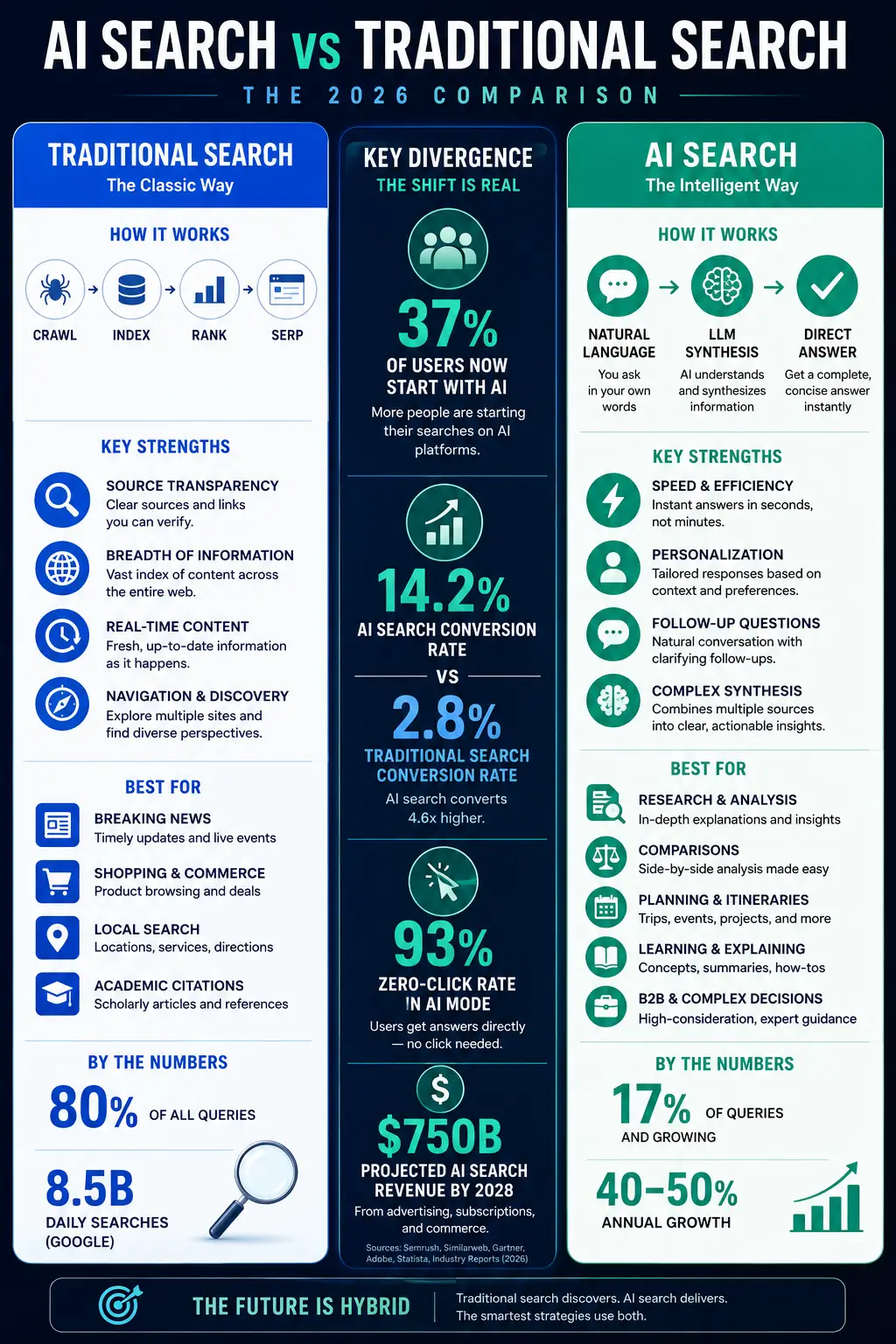
AI Search vs. Traditional Search: The Core Differences
| Feature | Traditional Search | AI Search |
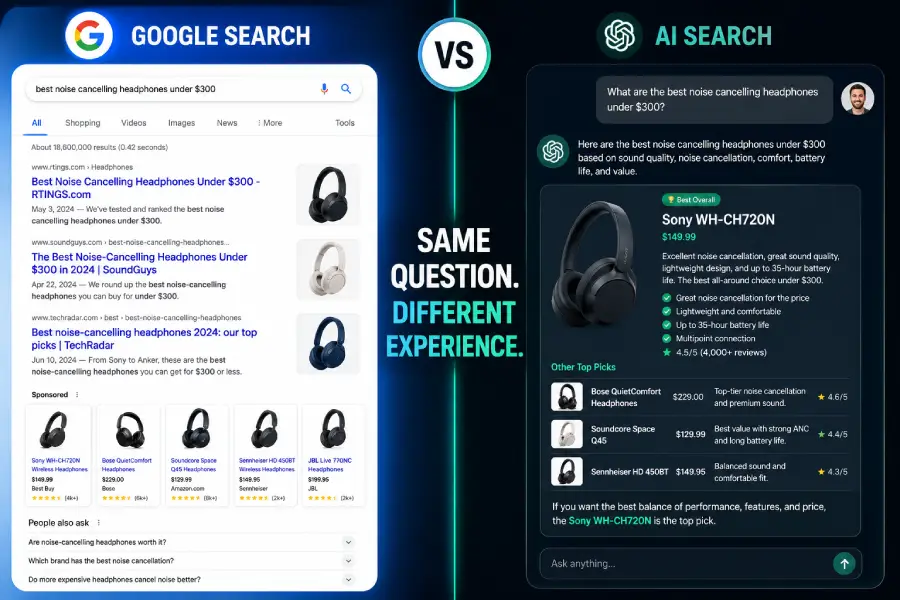
| Search Method | Keyword/semantic query → ranked list of links | Natural language query → synthesized response |
| User Experience | Results page with multiple links to evaluate | Single direct answer; conversational interface |
| Query Style | Keywords and short phrases | Full natural-language questions |
| Context Awareness | Query-by-query; limited memory | Full session memory across follow-ups |
| Follow-Up Questions | Requires a new query; context lost | Native; builds on all prior context |
| Information Delivery | Links to sources; user synthesizes | Pre-synthesized summary |
| Personalization | Location, device, browsing history | Stated preferences, full conversation context |
| Source Visibility | High URL visible before clicking | Variable improving, but inconsistent |
| Best Use Cases | Navigation, transactions, local, breaking news | Research, comparison, planning, decision support |
What this really shows: these are two systems optimized for different goals. Traditional search is optimized for navigation and breadth getting someone to the right source, with full transparency about where the information came from. AI search is optimized for synthesis and depth delivering the answer directly, in natural language, with context carried across a whole research conversation.
Neither wins across every use case. The right approach in 2026 is knowing which system fits which query and which one your audience is actually using to find you. For how this plays out specifically in purchase decisions, see How ChatGPT Is Influencing Consumer Search Decisions.
How People Search Differently With AI
The move from traditional search to AI search isn’t just a technology change it’s a behavioral one. Understanding how search habits differ between the two is essential for anyone adapting a content strategy.
Longer, Fuller Queries
AI platforms consistently get longer, more complete questions than traditional search engines. Google’s own data shows queries that trigger AI Overviews average noticeably more words than typical keyword searches a 10+ word query triggers an AI Overview 53% of the time, versus just 8% for 1–2 word queries. Ridge Marketing’s 2026 search behavior analysis confirms this: people have learned that giving an AI assistant more context produces a more useful, personalized answer, so they write fuller questions instead of clipped keyword phrases.
This habit is bleeding back into traditional search too average Google query length has grown 8% year-over-year in the US, with question-word queries (who, what, why, how, where) rising across every demographic. The line between AI search and traditional search is partly dissolving into one broader shift toward more natural query phrasing.
Genuinely Conversational Interactions
Conversational search the multi-turn dialogue format AI platforms offer is qualitatively different from anything a traditional search engine provides. Someone researching a topic on ChatGPT might ask “explain quantum computing,” then “how does it differ from classical computing for cryptography specifically?”, then “what should I read to go deeper?” Each answer builds on what came before, creating a structured learning arc that a series of separate Google searches can’t really replicate. Orbit Media’s 2026 AI vs. Search Survey found 44% of respondents say AI platforms have changed how they look for information with conversational search cited as the main driver.
Multi-Step Research, Compressed
AI search has turned multi-step research from a multi-session, multi-platform slog into a single extended conversation. What once meant opening Google, clicking through several sites, synthesizing across sources yourself, and repeating that over days now often collapses into one conversation thread. Bain & Company’s Sensor Tower data confirms it: ChatGPT prompt volume grew 70% in the first half of 2025, with planning-related queries the most multi-step category growing even faster than the overall average.
Follow-Up Questions Without Starting Over
Being able to ask a follow-up without restating the whole context is one of the most genuinely useful features AI search offers and one of the clearest illustrations of how different this is from traditional search. A Google follow-up means composing a brand-new query and re-establishing context from scratch. A ChatGPT or Claude follow-up has full memory of everything said earlier in the session. That single capability turns conversational search from a novelty into a real research tool.
Context That Actually Persists
AI assistants increasingly retain context not just within a session but across sessions. Memory features in ChatGPT can remember stated preferences, prior research topics, expertise level, and conversational patterns delivering more personalized responses over time. That’s a form of personalization traditional search can only approximate through blunter signals like location and browsing history.
Real Personalization
AI-powered search personalizes at the level of the individual conversation. A doctor asking about a drug interaction gets a different level of technical detail than a patient asking the same question, based purely on how it’s framed. Traditional search returns identical results regardless of who’s asking. That gap is one of the most functionally significant differences in this whole comparison, and it’s driving strong preference for AI search in high-complexity, high-stakes research.
Benefits of Traditional Search
Despite fast AI search growth, traditional search engines hold onto real, defensible advantages no generative AI platform has fully matched.
Access to Multiple Sources
Traditional search surfaces the breadth of what’s out there on a topic not a synthesis of it. For queries where multiple perspectives genuinely matter (political, contested scientific, legal, investment-related topics), reading several sources directly is a feature, not friction. No AI summary fully replaces reading three different analysts’ takes in their own words.
Easy Source Verification
Traditional search makes verification almost trivial the URL and publication name are visible before you even click. For consequential research, being able to instantly identify and judge the source is a real capability that most AI platforms only partially offer. Anyone who needs to cite sources or assess institutional credibility has good reason to lean on traditional search, at least for the verification step.
Broad, Serendipitous Discovery
Traditional search exposes people to sources they’d never have thought to look for a niche expert, a counterintuitive study, an unexpected angle. That’s a genuine strength of the results-page format. AI platforms synthesize existing, well-established knowledge; they’re less likely to surface something genuinely novel or fringe that hasn’t yet built up enough training signal to get cited.
Fresher, More Current Information
Traditional search continuously crawls and indexes new content, surfacing things published minutes or hours ago. Modern AI assistants with web search ChatGPT, Perplexity can access live content too, but freshness still depends on their specific retrieval setup. For breaking news, real-time prices, or fast-moving situations, traditional search stays more reliably current.
Open-Ended Website Exploration
A lot of what people find through search isn’t an answer to a question it’s a website, a tool, a community worth exploring. Traditional search supports that kind of open-ended discovery in a way AI platforms aren’t yet built for. Someone hunting for a new podcast or a software tool to evaluate benefits from the sheer breadth of a traditional results page.
Real Transparency
Traditional search is far more transparent about where information comes from, roughly how results get ranked, and what commercial relationships (ads) exist between the platform and content providers. That transparency matters a lot in regulatory, educational, and professional contexts where source attribution is required.
Benefits of AI Search
The rapid adoption of AI-powered search comes down to real, measurable advantages in specific use cases advantages that explain why search behavior is shifting so decisively.
Faster Answers
The most basic benefit is time-to-insight. A question that would take three site visits and several thousand words of reading on a traditional search engine gets answered in a synthesized paragraph, in seconds, on ChatGPT or Perplexity. SE Ranking’s 2025 behavioral data found that visitors arriving from AI platforms spend 68% more time on-site when they do click through evidence that AI search users arrive already carrying more background context, having been briefed by the AI before they ever land.
Genuinely Useful Summaries
Generative AI search is especially good at turning large, complex topics into something digestible. Instead of reading five articles to understand a subject, someone can ask an assistant to “explain the key debates around X” and get a structured, coherent overview back. For topics with a well-documented knowledge base, that synthesis is genuinely valuable.
A Genuinely Better Conversational Experience
Conversational search creates a qualitatively different and for a lot of people, more satisfying experience than query-and-click. Asking follow-ups, refining focus, and having the AI remember context turns a search session into something closer to a coherent research conversation, especially for people learning something unfamiliar or working through a complex decision.
Responses That Actually Adapt
AI assistants adjust tone, depth, terminology, and structure based on context. A beginner asking about machine learning gets analogies and conceptual explanations; an ML engineer asking the same question gets technical precision and code examples. Traditional search can’t replicate that it returns the same results no matter who’s asking.
Measurable Productivity Gains
For researchers, consultants, journalists, product managers, and engineers, AI-powered search delivers real productivity gains. McKinsey’s August 2025 survey of US consumers found that, for the first time, AI-powered search ranked as the #1 digital source people use when making buying decisions ahead of traditional search, review sites, and brand websites. Among B2B professionals specifically, 94% of decision-makers used an LLM somewhere in their 2025 purchase process (Forrester).
Handling Genuinely Complex Questions
AI platforms genuinely excel at questions too complex or parameter-rich for traditional search to handle well something like “what’s the best approach for a mid-sized SaaS company to reduce churn while keeping NPS above 60 in a competitive market with limited resources?” ChatGPT can meaningfully engage with that. Google returns a list of generic churn articles and leaves the synthesis to you.
Limitations of Traditional Search
Traditional search carries structural limitations that have pushed people toward AI-powered alternatives limitations that have always been there, just more visible now that an alternative exists.
Information Overload
A Google search for “how to treat lower back pain” returns millions of indexed pages. Judging which sources are credible, which advice applies to your specific situation, and how to reconcile conflicting information across sources is a real cognitive task. Traditional search is excellent at indexing information; it offers limited help actually synthesizing it.
Too Many Clicks
Answering a genuinely complex question through traditional search usually takes three to five separate site visits, each with its own navigation and evaluation overhead. That multi-click pattern is particularly badly suited to mobile, where every tap and page load is real friction compared to a single conversational answer.
SEO Spam and Thin Content
The commercial incentive to rank has produced a huge ecosystem of content optimized for algorithms rather than actual usefulness. Thin content, keyword stuffing, and AI-generated filler have degraded results-page quality in a lot of categories and people who’ve tried AI platforms often cite escaping that low-quality content as a big reason for switching.
Research That Eats Hours
For complex, multi-stage research, traditional search demands hours that AI assistants can compress into minutes. That time cost is especially sharp for B2B buyers: 6sense’s 2026 Buyer Experience Report found buyers complete roughly 70% of their purchase journey before ever contacting a vendor and AI platforms have dramatically sped up that self-directed research phase.
Heavy Ad Saturation
Modern Google results pages are heavily commercialized above-the-fold space on high-value commercial queries can be mostly ads, results features, and AI Overviews, pushing organic results well down the page. That saturation has eroded trust in traditional search for unbiased research, especially among younger users most attuned to advertising. AI platforms currently offer a mostly ad-free experience though Google’s rapid expansion of ads into AI Overviews (appearing in 25.5% of AI Overview results as of 2026, up 394% from early 2025) suggests that window may not stay open long.
Limitations of AI Search
AI-powered search carries its own real limitations, and understanding them matters for deciding when and how to actually rely on these tools.
Hallucinations
AI assistants can generate confident, well-structured responses that are simply wrong. This “hallucination” problem is the single biggest accuracy limitation of generative AI search, and it’s particularly risky because errors show up in exactly the same authoritative tone as accurate answers. AP-NORC’s State of the Facts survey found only 8% of people think AI chatbot answers are always or often factual a striking number that coexists with the 60% who say AI gives better answers than traditional search. People prefer AI answers without fully trusting them.
Inconsistent Source Attribution
Most AI platforms don’t consistently reveal which sources actually informed a given response. Anyone wanting to verify a specific claim or check the credibility of the underlying information often has to run a separate traditional search to do it. Perplexity and Microsoft Copilot are exceptions their citation-first design keeps attribution genuinely transparent but the broader AI search ecosystem still has a real transparency gap compared to traditional search.
Potential Bias
AI assistants are trained on data reflecting the internet’s existing distribution of information including its biases, gaps, and imbalances. They can systematically favor well-documented, majority viewpoints while underrepresenting minority perspectives or emerging evidence, and that’s hard for anyone to detect because the response still sounds authoritative and comprehensive regardless of actual coverage.
Limited Transparency
Traditional search clearly labels ads, documents ranking factors at a high level, and shows the source of every result. AI platforms offer far less visibility into how a response was actually generated, which sources were weighted, what training biases might be present, or whether any commercial relationship shaped the recommendation.
Overconfidence
AI assistants present answers with the same steady, authoritative tone whether the underlying information is well-established, genuinely uncertain, or flat wrong. Traditional search doesn’t share this problem a peer-reviewed journal result and an anonymous blog post are visually distinguishable. A hallucinated ChatGPT response and an accurate one look identical.
AI Search Statistics and Industry Trends for 2026
Market Share and Scale
| Metric | Statistic | Source |
| Google global search market share | ~80% of all digital queries | First Page Sage, Q2 2026 |
| ChatGPT share of all digital queries | ~17% | First Page Sage, Q2 2026 |
| ChatGPT weekly active users (Feb 2026) | 900 million | OpenAI |
| ChatGPT WAU growth (Feb 2025 → 2026) | +125% | OpenAI |
| ChatGPT AI chatbot market share | 76.85% | StatCounter, April 2026 |
| Claude share of B2B AI referrals (H1 2026) | 18.5% (up from 1.4%) | Goodie Wave 2 Report |
| AI platform visits growth (YoY) | +28.6% | Similarweb, March 2026 |
| AI referral visits (June 2025) | 1.13 billion | Similarweb via TechCrunch |
| Combined AI referral traffic growth (2024–2025) | +527% | Previsible / Semrush |
| ChatGPT daily queries (July 2025) | 2.5 billion | OpenAI |
User Adoption and Behavior
| Metric | Statistic | Source |
| US adults who have used AI to search | 60% | AP-NORC survey, July 2025 |
| Under-30 adults who have used AI to search | 74% | AP-NORC, July 2025 |
| US adults using AI LLMs (all purposes) | 52% | Elon University survey, 2025 |
| Consumers starting searches with AI, not Google | 37% | Search Engine Land, January 2026 |
| Daily AI search initiators (with AI summaries) | 29% | Deloitte TMT Predictions 2026 |
| Gen Z adults who have used AI chatbots | 82% | AP-NORC, 2025 |
| Under-30 using AI several times per day | 28% | AP-NORC, 2025 |
| Consumers saying AI delivers better answers | 60% | Ridge Marketing analysis |
| Consumers who trust AI search results | 19% | All About AI research |
| AI ranked as #1 digital source for buying decisions | First place | McKinsey, August 2025 |
Traffic Quality and Conversion
| Metric | Statistic | Source |
| AI search traffic conversion rate | 14.2% vs Google’s 2.8% | Exposure Ninja / QuickSEO analysis |
| AI visitors’ time on-site vs organic | +68% longer | SE Ranking, 2025 |
| AI-referred traffic conversion advantage | 4.4x traditional organic | Seer Interactive |
| ChatGPT referral conversion vs Google organic (retail) | 11.4% vs 5.3% | Retail analysis |
| Brands citing AI Overviews: organic CTR premium | +35% | Seer Interactive, 2025 |
| Brands citing AI Overviews: paid CTR premium | +91% | Seer Interactive, 2025 |
| US revenue flowing through AI search (projected 2028) | $750 billion | McKinsey, 2025 |
| Brands systematically tracking AI search performance | Only 16% | McKinsey CMO Survey, September 2025 |
Future Projections
| Metric | Statistic | Source |
| Traditional search volume decline by end-2026 | -25% | Gartner, February 2024 |
| AI search visitors overtaking traditional | Projected 2028 | Semrush |
| AI search projected to overtake traditional in daily queries | ~2029–2030 | TTMS Forecast Analysis |
| AI Search Engine Market value (2025) | $18.84 billion | Industry analysis |
| AI Search Engine Market projected value (2033) | $50+ billion | Industry analysis |
| GEO market projected value (2034) | $33.7 billion | Dimension Market Research |
What This Means for SEO and Website Owners
This shift has concrete, measurable implications for every business that depends on search visibility. Understanding them matters for making sound strategic calls now, not later.
Organic Traffic Is Shifting, Unevenly
The aggregate impact on organic traffic is real but uneven. US organic search traffic has declined roughly 2.5% year-over-year a moderate headline number that hides a lot of variation by query type. Informational queries the backbone of most content marketing are being absorbed by AI Overviews and AI platforms at rates that produce CTR declines of 47–61% on affected queries (Pew Research, Seer Interactive). Transactional and navigational queries are considerably more insulated.
AI Overviews Are Everywhere
Google’s AI Overviews now appear on roughly 25.8% of all US searches, triggering on 39.4% of informational queries and up to 88% of health-related ones (Ahrefs, BrightEdge, 2026). When an AI Overview shows up, people click a traditional result only 8% of the time, versus 15% without one (Pew Research, July 2025).
Zero-Click Search Keeps Rising
The move toward zero-click behavior queries resolved without visiting any external site is the most structurally significant challenge facing organic traffic. Zero-click rates reach 83% when AI Overviews appear and 93% in Google AI Mode sessions (Semrush). For a full breakdown of how to adapt, see The Rise of Zero-Click Searches: What It Means for Websites.
Content Strategy Has to Shift
Generic informational content basic definitions, simple how-tos, surface-level comparisons is being absorbed into AI synthesis and won’t reliably drive organic traffic going forward. Content that survives requires genuine differentiation: original research, proprietary data, real expert perspective, interactive tools, first-person documentation. This isn’t a threat to good content it’s a culling of commodity content.
E-E-A-T Now Functions as an AI Citation Signal
Google’s E-E-A-T framework started as a guideline for human quality raters; by 2026, it’s functioning as a direct AI citation signal. Sites with verified author schema are three times more likely to show up in AI Overview citations (BrightEdge). Building real author and organizational presence consistent expert bylines, credentials, cross-platform thought leadership is now core to competing in AI search.
Structured Data Matters More Than Ever
Schema markup is the primary technical signal helping AI platforms understand and extract information from your content. Implementing Article, FAQ, HowTo, Product, and Organization schema correlates with a 44% increase in AI search citations (BrightEdge). See Google’s structured data documentation for implementation details.
Generative Engine Optimization (GEO) Is the New Parallel Discipline
Generative Engine Optimization also called GEO, AEO (Answer Engine Optimization), or LLMO is the emerging practice of optimizing content for AI citation rather than ranking position. The GEO market, valued at $848 million in 2025, is projected to reach $33.7 billion by 2034 at a 50.5% CAGR. Currently only 23% of marketers invest in GEO measurement, though 54% plan to start within six months (eMarketer, January 2026). See PostDune’s Generative Engine Optimization (GEO): The Complete Guide for the full framework.
Which Search Method Is Better? It Depends on the Task
The honest answer is: neither, universally. Each system genuinely wins in specific contexts. Here’s the use-case breakdown.
Quick Facts and Simple Lookups
Winner: AI search. For simple factual questions (“What’s the capital of Morocco?”), AI assistants answer faster than clicking through a results page though Google’s Knowledge Panels handle these well too, making it close to a tie for the simplest queries.
Product Research
Winner: AI search for research, traditional for final comparison. ChatGPT and Perplexity are strong at synthesizing comparisons and personalizing recommendations. But for final verification live pricing, recent reviews, actual availability traditional search still provides more reliably current source access.
Academic and Scholarly Research
Winner: Traditional search, with caveats. For accessing specific papers, authors, and citations, traditional search Google Scholar especially offers better source access and citation transparency. AI platforms can help explain concepts and summarize literature, but shouldn’t serve as primary sources for formal academic work.
Shopping
Winner: depends on the phase. AI wins for research-phase shopping in complex categories like electronics or travel. Traditional search wins for navigational and transactional shopping finding a specific product page, checking current price, completing a purchase. Adobe Digital Insights’ 2026 data shows AI-referred retail traffic converting 31% better than non-AI traffic evidence that AI pre-purchase research is producing higher-intent buyers for traditional e-commerce.
News and Current Events
Winner: Traditional search. Traditional search provides real-time access to the freshest news with clear attribution to established outlets. AI platforms can synthesize recent news but are generally slower to reflect breaking events and apply more caution around real-time claims to avoid repeating misinformation.
Technical Learning
Winner: AI search. For learning to code, understanding technical concepts, or debugging, AI assistants like ChatGPT and Claude are dramatically more effective than traditional search the ability to ask follow-ups, get code adapted to your specific problem, and have concepts explained at exactly the right level makes AI the clear pick for technical learning.
Travel Planning
Winner: AI search for research, traditional for booking. AI assistants excel at destination comparison, itinerary building, and synthesizing multi-variable travel research. But for actual booking comparing live prices, checking availability, reading recent traveler reviews traditional search connected to travel platforms provides fresher data.
Business and B2B Research
Winner: AI search, and growing. The B2B data is fairly decisive: 94% of decision-makers used an LLM somewhere in their 2025 purchase process (Forrester), 51% of B2B software buyers start research in an AI chatbot rather than Google (G2), and 69% chose a different vendor than originally planned based on AI guidance. AI has become the dominant starting point for the consideration phase of complex B2B decisions.
The Future of Search
Where search goes next depends on three accelerating forces converging: continued AI platform capability improvement, growing user trust and familiarity, and AI getting woven into every major search surface. The trajectory points toward a world where the line between AI search and traditional search partly dissolves into one unified, AI-mediated experience.
AI Agents
Beyond conversational search, autonomous AI agents represent the next real shift systems that don’t just answer questions but take multi-step action on someone’s behalf. An agent researching a software purchase doesn’t just synthesize reviews; it compares pricing, checks compatibility, reads recent release notes, and books a demo. Search becomes an invisible step inside a larger workflow. This is already showing up in enterprise contexts and is expected to go mainstream through the late 2020s.
Multimodal Search
AI platforms are rapidly expanding past text into image, audio, and video input. People can already search by uploading a photo, describing a visual concept, or speaking naturally. Multimodal AI search will increasingly blur the line between visual search (traditionally Google Images/Lens) and conversational search into one unified interface.
Voice Search
Voice interfaces converging with generative AI search is creating a genuinely frictionless model: assistants that listen, understand context, synthesize a response, and speak it back no screen, no keyboard, no results page needed. This will accelerate as AI assistants get more deeply embedded in everyday devices.
Deeper Personalization
The next stage of search will be personalized not just by location and browsing history but by individual knowledge state, professional context, and long-term usage history. Systems that genuinely know their users will deliver information calibrated to the individual in ways that would have sounded like science fiction a decade ago.
Predictive Search
The most advanced near-future model is predictive rather than reactive AI surfacing relevant information before someone consciously forms an intent, based on context signals, calendar data, recent activity, and inferred need. The search moment itself starts to disappear in favor of proactive delivery.
Where This Lands by 2030
TTMS’s LLM vs. traditional search forecast projects AI-powered search reaching query-volume parity with traditional search around 2029–2030 for genuinely informational queries. By 2028, McKinsey projects $750 billion in US revenue flowing through AI search platforms. Gartner’s projected 25% decline in traditional search volume by end-2026 is tracking on schedule. The inflection point isn’t a question of “if” it’s “when,” and the consensus lands somewhere around the end of this decade.
Expert Insights and Industry Perspectives
Rand Fishkin (SparkToro). Fishkin’s 2026 zero-click research offers maybe the sharpest framing of this whole dynamic: “Google searches per US user fell roughly 20% year-over-year not because users left Google, but because each user now needs fewer searches per task thanks to AI summaries.” His strategic takeaway: “Traffic is a terrible goal. Every platform will send less traffic in 2026 than in 2025. Brand visibility, impressions, and citations are the metrics that matter now.”
Sundar Pichai (Google CEO). On Alphabet’s Q4 2025 earnings call, Pichai said Google Search “had more usage in Q4 than ever before,” framing AI Mode and AI Overviews as expanding Google’s value rather than cannibalizing it AI search and traditional search, in his framing, aren’t competitors but features within one unified experience. The numbers back that up: Google’s Q4 2025 search revenue grew 17% year-over-year to $63 billion.
Gartner. VP Analyst Alan Antin, February 2024: “By 2026, traditional search engine volume will drop 25% as AI chatbots and virtual agents divert queries away from traditional search engines.” As of mid-2026, this forecast is tracking closely against observed market data one of the more accurately predictive analyst calls in recent technology forecasting.
McKinsey. Their August 2025 survey of nearly 2,000 US consumers found AI-powered search ranked, for the first time, as the #1 digital source people use for buying decisions ahead of traditional search, review sites, and brand websites. Their forecast: $750 billion in US revenue flowing through AI search platforms by 2028. Their warning: “Only 16% of brands systematically track how they’re performing in AI search results. The gap between buyer behavior and measurement practice is one of the most significant strategic blind spots in marketing today.”
Andreessen Horowitz. Partner Olivia Moore has described the AI search competitive dynamic as “winner take all, or at least winner take most,” while noting “things are changing very quickly.” The firm has backed multiple AI search visibility startups, with over $200 million in VC flowing into the category in 2025 alone (Sequoia, Kleiner Perkins, NEA) the thesis being that AI search visibility infrastructure is a genuinely large category whose early leaders will build compounding advantages.
Frequently Asked Questions
What is the difference between AI search and traditional search?
It comes down to output model. Traditional search engines like Google crawl and index the web, then return a ranked list of links in response to keyword queries. AI search platforms like ChatGPT, Gemini, and Perplexity use Large Language Models to generate a synthesized, direct answer to a natural-language question no external click required. Traditional search gives you sources; AI search gives you answers. Most sophisticated users in 2026 lean on both, depending on the query.
Is AI search replacing Google?
Not replacing competing for specific query types, while Google adapts around it. Google still commands roughly 80% of all digital queries and has integrated AI-powered search directly through AI Overviews and AI Mode. Gartner projects a 25% decline in traditional search volume by end-2026, but absolute Google query volume hasn’t actually dropped total search (traditional plus AI) has grown roughly 26% globally. The more accurate framing: AI platforms are capturing new search volume and a chunk of informational queries, while Google retains dominance in navigation, transactions, and local search. See Why Users Are Switching from Google Search to AI Chatbots for more detail.
Which is more accurate: AI search or Google Search?
It depends on the query type. For well-established, broadly documented topics, AI assistants like ChatGPT are highly accurate. For edge cases, specialized subjects, fast-changing information, or claims requiring precise sourcing, traditional search provides a more reliable path to accurate primary sources. The core distinction: traditional search can direct you to an accurate source; AI search synthesizes what it already knows, which can contain errors. Only 19% of users fully trust AI search results, compared to 45% for traditional search a reasonable amount of caution given the hallucination risk (All About AI research).
What are the actual benefits of conversational search?
Five stand out: natural language expression without needing search-engine syntax; context retention across a multi-turn research session; follow-up questions without losing prior context; personalization to stated needs and expertise level; and synthesized answers that skip the need to visit multiple sources. These matter most for complex research, technical learning, travel planning, and B2B decision support specifically.
How is AI actually changing SEO?
AI search is creating a parallel discipline Generative Engine Optimization alongside traditional SEO rather than replacing it. Traditional SEO (keyword targeting, backlinks, technical optimization) still matters for the majority of traffic flowing through traditional search. GEO structuring content for AI citation, building E-E-A-T signals, implementing structured data, earning third-party editorial coverage matters for the fast-growing AI search share. Organizations investing in both build compounding advantages. The shift from ranking to “being cited” is arguably the most fundamental strategic change in SEO in two decades. See PostDune’s How to Optimize Your Website for AI Search for a practical framework.
What is semantic search, and how does it relate to AI search?
Semantic search was the earlier phase of AI entering traditional search systems interpreting the meaning behind a query instead of literally matching keywords. Google’s Hummingbird (2013), RankBrain (2015), and BERT (2019) were all semantic-search milestones. Generative AI search is the full evolution of that trajectory: not just understanding what a query means, but generating a synthesized answer that directly addresses it. Semantic search made traditional search smarter; generative AI search made it conversational.
Which AI search platform is actually best?
It depends on the use case. ChatGPT is the most versatile and widely used, with 76.85% AI chatbot market share and the broadest capability range. Perplexity is preferred by research-oriented users who want transparent inline citations. Claude excels at enterprise use, long-document analysis, and nuanced reasoning and showed the sharpest B2B referral traffic growth of any platform in H1 2026. Microsoft Copilot leads for enterprise and Microsoft 365 integration. Gemini has a natural advantage for queries that benefit from Google’s real-time data access.
What percentage of searches are actually AI searches in 2026?
By different measures: ChatGPT accounts for roughly 17% of all digital queries globally (First Page Sage, Q2 2026); AI platforms collectively represent about 20% of search-related traffic worldwide (Graphite, March 2026); and 37% of consumers now start their searches with an AI tool (Search Engine Land, January 2026). Traditional search still handles the large majority of query volume Google alone processes roughly 8.5 billion queries a day, versus ChatGPT’s estimated 250 million search-equivalent queries daily. The AI share is small in absolute terms but growing 40–50% annually.
How should businesses actually adapt to AI search?
A dual-track strategy makes the most sense: keep investing in traditional SEO for transactional and navigational queries, while systematically building GEO capability for informational and research queries. In practice, that means implementing schema markup across key content, building real E-E-A-T signals through expert authorship and earned media, creating original research AI can’t just synthesize from existing content, monitoring brand visibility across ChatGPT, Gemini, Perplexity, and Claude, and tracking AI citation rate as a core KPI alongside traditional rankings.
What’s the actual future of traditional search engines?
They’re not disappearing they’re evolving into AI-integrated platforms. Google’s own response to AI search competition has been to build generative AI capability directly into its own products (AI Overviews, AI Mode, Gemini), keeping its distribution advantage while adding AI synthesis on top. The most credible path through 2030 is gradual convergence: traditional search becomes more AI-integrated, AI platforms become more web-connected, and the line between the two blurs into one unified experience. The real competition is over who builds the most trusted, capable, and embedded version of that convergent experience.
Conclusion
This comparison was never really about one system beating another it’s about search technology evolving into two complementary systems that, together, are reshaping how people find and process information. Traditional search remains dominant by volume, essential for navigation and transactions, and still unmatched for source transparency. AI search is growing 40–50% annually, winning the research and synthesis use cases that drive commercial decisions, and converting visitors at four to five times the rate of traditional organic traffic.
The most important takeaway from 2026’s data is this: the question isn’t whether to invest in AI search visibility it’s whether you can afford to wait. With 37% of consumers already starting searches with AI, 94% of B2B decision-makers using an LLM somewhere in their 2025 purchase process, and $750 billion in projected US revenue flowing through AI search platforms by 2028, the brands investing now in GEO, E-E-A-T signals, and AI citation readiness are building advantages that compound as the market matures.
For website owners and publishers: audit your content for informational-dependency risk. Invest in original research, structured data, and FAQ schema. Track AI citation rates across ChatGPT, Claude, Gemini, and Perplexity as a core KPI alongside traditional rankings.
For SEO professionals: build a parallel GEO practice. The shift from “rank to get clicked” to “get cited to build authority” is arguably the most fundamental strategic change in the discipline’s history.
For digital marketers: expand your measurement framework to include branded search lift, AI citation rate, and AI referral conversion quality alongside traditional session and impression metrics.
For everyone else: the distinction between AI search and traditional search will keep getting less meaningful as both converge but the brands and publishers who understand today’s differences and adapt to them now will be best positioned for whatever that convergent future actually looks like.
Key Takeaways
- AI search platforms now account for roughly 17% of all digital queries globally (First Page Sage, Q2 2026) up from near-zero four years ago while Google holds about 80%
- 37% of consumers now start their searches with AI tools rather than Google, rising to 74% among under-30 users (Search Engine Land, January 2026; AP-NORC, July 2025)
- AI search traffic converts at 14.2% versus Google’s 2.8% a roughly 5x advantage reflecting the higher purchase intent of pre-researched AI users (Exposure Ninja)
- AI search platforms are growing 40–50% annually while traditional search grows 5–10%, with query-volume parity projected around 2029–2030 (TTMS forecast)
- The core difference is output model: traditional search returns ranked links to external sources; AI search synthesizes a direct answer via LLMs, no click required
- Generative Engine Optimization (GEO) optimizing for AI citation rather than ranking is the essential parallel discipline to traditional SEO; only 23% of marketers currently invest in it
- 84% of AI citations come from earned editorial coverage in third-party publications, not brand-owned content making digital PR a core part of AI search visibility strategy (Muck Rack, May 2026)
- Neither system wins universally: AI search wins for research, synthesis, and complex decisions; traditional search wins for navigation, real-time news, academic citation, and source transparency