Introduction
Artificial intelligence has transformed from a simple chatbot technology into a powerful way of finding and interacting with information. Instead of typing a few keywords into a search engine and browsing multiple webpages, users can now ask complete questions in natural language and receive structured, conversational answers within seconds.
One of the biggest developments driving this change is ChatGPT Search.
Built into ChatGPT, ChatGPT Search combines conversational AI with web search capabilities, allowing users to ask questions, receive detailed answers, explore follow-up topics, and access current information when appropriate. Rather than acting as a traditional search engine that simply lists webpages, it focuses on understanding user intent and providing helpful, context-aware responses.
For example, instead of performing several separate searches such as:
- Best mirrorless camera
- Mirrorless camera for beginners
- Best Sony camera under $1,200
- Sony vs Canon mirrorless
A user can simply ask:
I’m a beginner photographer with a budget of $1,200. Should I buy a Sony or Canon mirrorless camera, and which model would you recommend?
Instead of searching through multiple review websites, ChatGPT Search can organize the information into a clear explanation, compare suitable options, and answer follow-up questions naturally.
This conversational experience is one of the main reasons many people are changing how they search online. If you want to understand this broader trend, read our article How AI Is Changing User Search Behavior in 2026.
In this guide, you’ll learn what ChatGPT Search is, how it works, its major features, benefits, limitations, practical use cases, and how it compares with Google AI Mode and traditional search engines.
What Is ChatGPT Search?
ChatGPT Search is an AI-powered conversational search experience that combines natural language understanding with web information retrieval to answer user questions more interactively than traditional search engines.
Unlike conventional search engines that primarily return a ranked list of webpages, ChatGPT Search is designed to:
- Understand conversational language.
- Interpret complex questions.
- Generate structured responses.
- Maintain context across follow-up questions.
- Assist with research, writing, coding, brainstorming, and learning.
- Incorporate current web information when needed.
The result is a search experience that feels more like talking to a knowledgeable assistant than using a traditional search engine.
Why ChatGPT Search Is Different
Traditional search engines require users to browse multiple webpages before finding the information they need.
ChatGPT Search changes this process by acting as both:
- An AI assistant
- A conversational search tool
Instead of searching for:
Best laptop
Users can ask:
I’m a graphic designer who travels frequently. I need a lightweight laptop with excellent battery life and a high-quality display. What would you recommend?
The AI understands the complete request and provides recommendations based on the specified requirements.
Why ChatGPT Search Is Becoming Popular
Several factors have contributed to the rapid adoption of conversational AI search.
1. Natural Conversations
People no longer need to think in terms of keywords.
Instead, they can communicate naturally using complete sentences.
For example:
Instead of:
best SEO tools
Users can ask:
Which SEO tools would you recommend for a small business with a limited budget, and why?
2. Context Awareness
Unlike traditional search engines, ChatGPT Search remembers previous questions during the conversation.
Example:
User
Recommend a beginner drone.
ChatGPT
Suggests several drone models.
User
Which one is easiest to fly?
The AI understands that “Which one” refers to the previously recommended drones without requiring the user to repeat the full question.
3. Productivity Beyond Search
ChatGPT Search can assist with far more than finding information.
Common tasks include:
- Writing articles
- Brainstorming ideas
- Creating outlines
- Explaining technical concepts
- Summarizing documents
- Learning new skills
- Coding assistance
- Comparing products
- Planning trips
- Business research
This versatility makes it valuable for students, professionals, creators, and businesses alike.
How ChatGPT Search Works
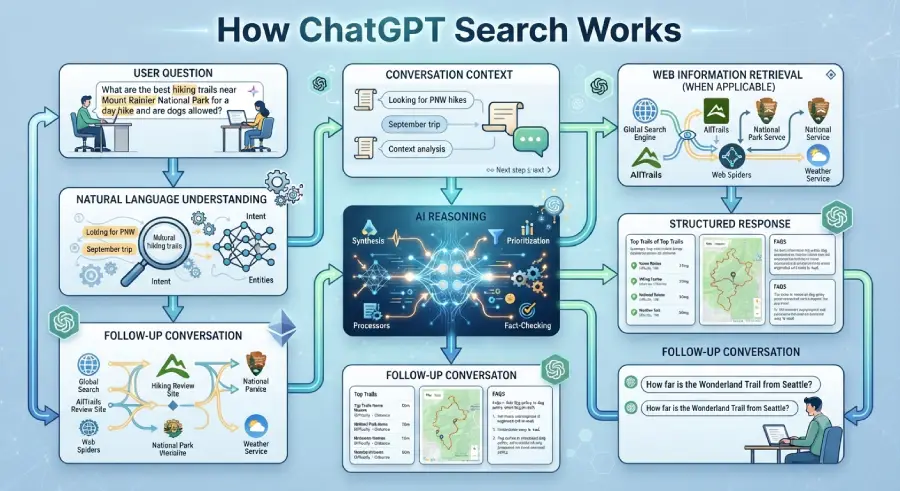
Although the experience feels simple, several advanced AI technologies work together behind the scenes.
A simplified workflow looks like this:
User Question
      │
      ▼
Natural Language Understanding
      │
      ▼
Conversation Context
      │
      ▼
Web Information Retrieval (when applicable)
      │
      ▼
AI Reasoning
      │
      ▼
Response Generation
      │
      ▼
Follow-up Conversation
Let’s explore each stage.
Step 1: Understanding Natural Language
The first step is interpreting what the user actually means.
Instead of focusing only on keywords, ChatGPT Search analyzes:
- Sentence structure
- User intent
- Context
- Relationships between concepts
- Previous conversation
For example:
I’m planning a two-week trip to Japan in October. I enjoy history, photography, and local food. Which cities should I visit?
Rather than matching keywords like “Japan” or “travel,” the AI understands:
- Destination
- Travel duration
- Interests
- Desired recommendations
This allows it to provide a much more personalized answer.
Step 2: Maintaining Conversation Context
One of ChatGPT Search’s biggest strengths is its ability to maintain context across multiple interactions.
Instead of treating every search as independent, it remembers earlier parts of the conversation.
Example:
User
Recommend a gaming laptop.
AI
Provides recommendations.
User
Which one has better battery life?
The AI understands the reference without requiring additional clarification.
This creates a smoother, more efficient search experience.
Step 3: Retrieving Relevant Information
When appropriate, ChatGPT Search can retrieve information from the web to help answer questions that benefit from current or external information.
This enables users to ask about topics such as:
- Technology
- Business
- Sports
- Finance
- Travel
- Product comparisons
- Recent developments
The platform combines retrieved information with AI reasoning to produce a coherent response.
Step 4: AI Reasoning
Instead of copying information directly from webpages, ChatGPT Search analyzes relevant information and organizes it into a structured explanation.
For example:
If someone asks:
Compare electric vehicles for families.
The AI may organize its response into sections such as:
- Safety
- Driving range
- Charging
- Interior space
- Technology
- Pricing
- Best recommendations
This structure helps users understand complex topics more quickly.
Step 5: Generating the Response
Finally, ChatGPT Search produces a conversational answer that may include:
- Summaries
- Recommendations
- Comparisons
- Step-by-step instructions
- Lists
- Tables
- Explanations
- Actionable suggestions
Instead of forcing users to search repeatedly, it encourages a continuous conversation.
Key Features of ChatGPT Search
ChatGPT Search offers a wide range of capabilities that extend beyond traditional web search.
Conversational Search
Ask questions naturally without worrying about exact keywords.
Context Awareness
The AI remembers previous messages and supports meaningful follow-up conversations.
Writing Assistance
Generate outlines, edit drafts, improve grammar, summarize text, and brainstorm ideas.
Coding Assistance
Explain programming concepts, debug code, generate examples, and assist with technical documentation.
Research Support
Summarize complex topics, compare information, and explain technical subjects in an easy-to-understand format.
Productivity Features
Use ChatGPT Search for:
- Meeting preparation
- Business planning
- Learning
- Email drafting
- Project planning
- Idea generation
Multi-Modal Capabilities
Depending on the features available, ChatGPT can also work with images, documents, and other input types to provide more comprehensive assistance.
Why ChatGPT Search Matters
ChatGPT Search represents a shift from finding information to understanding information.
Rather than asking users to compare dozens of webpages themselves, it helps organize knowledge into clear, conversational answers that save time and improve productivity.
As conversational AI continues to evolve, tools like ChatGPT Search are influencing how people learn, research, create content, and make decisions online.
This trend is explored further in our article Why Users Are Switching from Google Search to AI Chatbots, where we examine the factors driving the growing adoption of AI-powered search experiences.
ChatGPT Search vs Google AI Mode
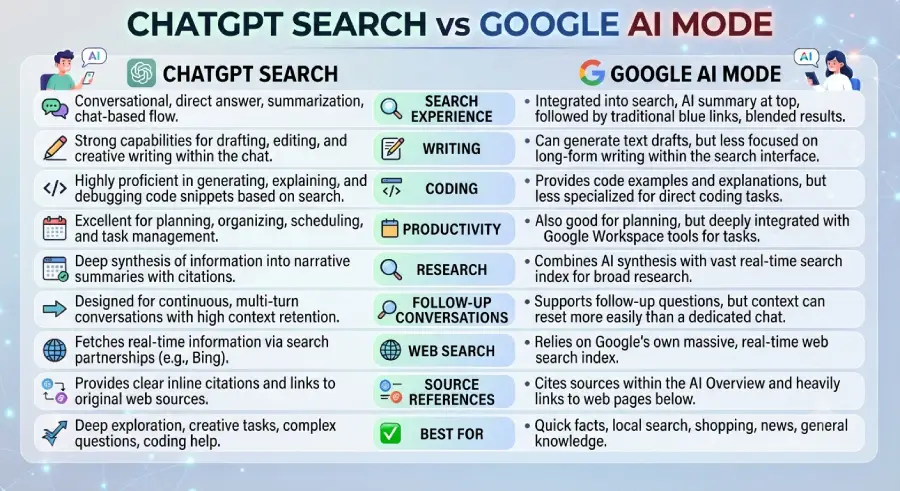
ChatGPT Search and Google AI Mode both represent the next generation of AI-powered search, but they are designed with different priorities in mind.
Google AI Mode extends the traditional Google Search experience with AI-generated responses, while ChatGPT Search combines conversational AI with web search capabilities to create an interactive assistant that helps users research, learn, write, code, and solve problems.
Although both platforms can answer questions and summarize information, their strengths differ depending on the task.
| Feature | ChatGPT Search | Google AI Mode |
|---|---|---|
| Primary Purpose | AI assistant with web search | AI-enhanced Google Search |
| Search Style | Conversational | Conversational + traditional search |
| Follow-up Questions | Excellent | Excellent |
| Context Memory | Maintains conversation context | Supports contextual follow-ups |
| Writing Assistance | Excellent | Good |
| Coding Support | Excellent | Good |
| Brainstorming | Excellent | Good |
| Research Support | Excellent | Excellent |
| Product Comparisons | Excellent | Excellent |
| Integration | AI productivity workflows | Google ecosystem |
| Best For | Writing, coding, learning, productivity | General web search and information discovery |
Which One Should You Choose?
Choose ChatGPT Search if you want to:
- Brainstorm ideas
- Write articles or emails
- Learn new concepts
- Generate code
- Debug programs
- Analyze documents
- Compare products
- Continue long conversations
- Improve productivity
Choose Google AI Mode if you want to:
- Explore current web information.
- Find official websites.
- Search local businesses.
- Compare shopping options.
- Navigate Google’s ecosystem.
- Perform general internet searches.
Many users now combine both tools depending on the task.
For a broader comparison of leading AI search platforms, read Best AI Search Engines in 2026: Features, Pros, Cons, and Use Cases.
ChatGPT Search vs Traditional Search
Traditional search engines require users to browse multiple webpages before finding answers.
ChatGPT Search changes that workflow by providing organized, conversational responses.
| Traditional Search | ChatGPT Search |
|---|---|
| Keyword-based | Natural language |
| List of links | AI-generated answers |
| Manual comparison | Built-in comparisons |
| Independent searches | Follow-up conversations |
| Multiple webpages | Structured summaries |
| User synthesizes information | AI helps organize information |
Example
Traditional Search:
Best AI writing tools

↓

Open 8–10 websites

↓

Compare features manually

↓

Reach a conclusion
ChatGPT Search:
Recommend the best AI writing tools for bloggers under $30/month.

↓

AI analyzes the request.

↓

Provides comparison table.

↓

Explains pros and cons.

↓

Answers follow-up questions.
This conversational workflow can save time while making research more efficient.
Best Use Cases for ChatGPT Search
ChatGPT Search is more than a search engine it is a versatile AI assistant that supports a wide range of tasks.
1. Students
Students can use ChatGPT Search to:
- Understand complex subjects
- Summarize study materials
- Explain mathematical concepts
- Learn programming
- Prepare presentations
- Generate practice questions
- Improve writing skills
Example
Explain quantum computing like I’m a beginner.
Instead of presenting technical jargon, ChatGPT Search can simplify the explanation into clear, understandable language.
2. Content Writers
Content creators can use ChatGPT Search for:
- Topic research
- Content outlines
- Blog writing
- Headline generation
- Meta descriptions
- FAQs
- Editing
- Content improvement
Example:
Generate ten blog ideas about AI search for beginners.
3. SEO Professionals
SEO specialists can use ChatGPT Search to:
- Generate keyword ideas
- Build topic clusters
- Create content briefs
- Improve article structure
- Research search intent
- Brainstorm internal linking strategies
For example, the AI Search content hub you’re building on PostDune is a perfect example of a topic cluster that supports topical authority.
4. Developers
Developers frequently use ChatGPT Search for:
- Explaining code
- Debugging
- Learning new frameworks
- API documentation
- SQL queries
- Regular expressions
- Code optimization
Example:
Explain Python decorators with practical examples.
5. Researchers
Researchers benefit from ChatGPT Search by using it to:
- Summarize complex papers
- Compare viewpoints
- Explain technical terminology
- Generate research questions
- Organize information
It serves as a useful starting point, although important findings should always be verified using original, authoritative sources.
6. Business Owners
Businesses can use ChatGPT Search to:
- Research competitors
- Develop marketing ideas
- Draft business plans
- Prepare presentations
- Create customer FAQs
- Analyze market trends
- Improve productivity
7. Everyday Users
For everyday tasks, ChatGPT Search can help with:
- Travel planning
- Product recommendations
- Meal ideas
- Learning new skills
- Personal finance education
- Home improvement projects
- Technology advice
Benefits of ChatGPT Search
Natural Conversations
Users interact with AI just as they would with another person.
Faster Research
Instead of opening multiple websites, users receive organized summaries that can accelerate the research process.
Better Productivity
ChatGPT Search combines search with writing, coding, brainstorming, planning, and problem-solving, making it useful for both personal and professional work.
Personalized Responses
The AI considers the context of the conversation and tailors responses to the user’s goals and follow-up questions.
Multi-Purpose Assistant
Unlike traditional search engines, ChatGPT Search can support tasks such as:
- Writing
- Learning
- Coding
- Planning
- Decision-making
- Idea generation
all within the same conversation.
Limitations of ChatGPT Search
Although ChatGPT Search is highly capable, it also has limitations.
AI Can Make Mistakes
Generative AI may occasionally produce inaccurate, outdated, or incomplete information.
Critical decisions should always be verified using trusted, authoritative sources.
Not Every Answer Needs AI
For tasks such as:
- Finding an official government website
- Checking a company’s homepage
- Accessing a banking portal
- Looking up a local business
a traditional search engine may be faster and more appropriate.
Context Can Influence Responses
Because ChatGPT Search remembers conversation history within a chat, follow-up responses depend on the existing context. If the conversation shifts significantly, starting a new chat may provide clearer results.
Availability of Features
Capabilities such as web search, document analysis, or multimodal interactions may vary depending on the platform version and available features.
SEO Implications of ChatGPT Search
The rise of conversational AI is changing how publishers think about search visibility.
Rather than focusing only on keyword rankings, content creators should also consider how AI systems discover, understand, and reference their content.
1. Helpful Content Wins
Content that genuinely answers users’ questions is more valuable than content created primarily to target keywords.
2. Topic Clusters Build Authority
Publishing interconnected articles around a single topic demonstrates expertise.
Your AI Search hub is an excellent example, connecting resources such as:
- The Complete Guide to AI Search in 2026
- What Is AI Search?
- How AI Search Works
- Best AI Search Engines in 2026
- Google AI Mode Explained
- ChatGPT Search Explained
- AI Search vs Traditional Search
This structure helps readers and search engines understand your site’s depth of coverage.
3. Direct Answers Improve Visibility
Articles should answer important questions early and clearly.
Example:
What is ChatGPT Search?
ChatGPT Search is an AI-powered conversational search experience that combines natural language understanding with web information retrieval to provide structured, context-aware answers and support follow-up conversations.
Providing concise definitions improves readability and helps users quickly understand the topic.
4. Internal Linking Strengthens Content
Strong internal links help users discover related resources while reinforcing topical relevance.
Within this article, readers are encouraged to explore:
- The Complete Guide to AI Search in 2026
- What Is AI Search?
- How AI Search Works
- Best AI Search Engines in 2026
- Google AI Mode Explained
- AI Search vs Traditional Search: Key Differences Explained
- How AI Is Changing User Search Behavior in 2026
- Why Users Are Switching from Google Search to AI Chatbots
- How ChatGPT Is Influencing Consumer Search Decisions
- The Rise of Zero-Click Searches: What It Means for Websites
This interconnected approach creates a strong content hub that supports both user navigation and long-term SEO.
Best Practices for Using ChatGPT Search
To get the best results:
- Ask clear, specific questions.
- Provide context when necessary.
- Break complex tasks into manageable steps.
- Verify important information with authoritative sources.
- Use follow-up questions to refine responses.
- Combine ChatGPT Search with traditional search when appropriate.
- Stay aware of the limitations of AI-generated content.
Frequently Asked Questions (FAQs)
1. What is ChatGPT Search?
ChatGPT Search is an AI-powered conversational search experience that combines natural language understanding with web information retrieval to provide direct, context-aware answers. Instead of only showing a list of webpages, it helps users understand information through structured responses and supports follow-up questions.
2. How does ChatGPT Search work?
ChatGPT Search works by:
- Understanding natural language queries.
- Interpreting user intent.
- Retrieving relevant web information when appropriate.
- Using AI reasoning to organize information.
- Generating conversational responses.
- Maintaining context for follow-up questions.
This creates a more interactive search experience than traditional keyword-based search.
3. Is ChatGPT Search free?
ChatGPT Search is available through ChatGPT, though features and usage limits can vary depending on your plan and the platform’s current offerings. Check the latest availability within ChatGPT for the most up-to-date information.
4. Can ChatGPT Search replace Google Search?
Not entirely.
ChatGPT Search is excellent for:
- Learning
- Research
- Writing
- Brainstorming
- Coding
- Summarizing information
Traditional search engines remain valuable for:
- Finding official websites
- Local business searches
- Shopping
- Maps
- Breaking news
- Accessing specific webpages
For many users, using both tools together provides the best experience.
5. Is ChatGPT Search accurate?
ChatGPT Search aims to provide helpful and relevant information, but like all AI systems, it can occasionally produce inaccurate or incomplete responses. Always verify important information—especially for medical, legal, financial, or safety-related topics—using authoritative sources.
6. Does ChatGPT Search support follow-up questions?
Yes.
One of its biggest strengths is maintaining conversational context, allowing users to ask follow-up questions without repeating the entire topic.
Example:
User
Recommend the best DSLR cameras.
User
Which one has the best battery life?
The AI understands that “Which one” refers to the cameras mentioned earlier.
7. Is ChatGPT Search good for students?
Yes.
Students commonly use ChatGPT Search for:
- Explaining difficult concepts
- Summarizing study material
- Preparing presentations
- Learning programming
- Practicing interview questions
- Improving writing skills
It can be a valuable learning aid when combined with trusted educational resources.
8. Is ChatGPT Search useful for SEO?
Yes.
SEO professionals use ChatGPT Search for:
- Keyword brainstorming
- Content planning
- Topic clusters
- Search intent analysis
- Content outlines
- Meta descriptions
- FAQ generation
- Internal linking ideas
However, human expertise and editorial review remain essential for creating high-quality, trustworthy content.
9. Can ChatGPT Search help developers?
Absolutely.
Developers frequently use it for:
- Debugging code
- Learning programming languages
- API explanations
- SQL queries
- Regular expressions
- Documentation
- Algorithm explanations
10. How is ChatGPT Search different from Google AI Mode?
ChatGPT Search focuses on being an AI assistant with conversational search capabilities, while Google AI Mode extends the traditional Google Search experience with AI-generated responses.
ChatGPT Search is generally stronger for:
- Writing
- Coding
- Brainstorming
- Long-form conversations
- Productivity
Google AI Mode is well suited for:
- General web search
- Product discovery
- Local information
- Integration with Google’s search ecosystem
11. Can businesses benefit from ChatGPT Search?
Yes.
Businesses can use ChatGPT Search to:
- Generate marketing ideas.
- Research competitors.
- Create customer support content.
- Draft emails and reports.
- Brainstorm product ideas.
- Analyze business trends.
- Improve team productivity.
12. What is the future of ChatGPT Search?
Conversational AI search is evolving rapidly. Future improvements are likely to include better reasoning, richer multimodal capabilities, improved personalization, and deeper integration with productivity tools. As these technologies mature, AI search is expected to become an increasingly important part of how people find and use information.
Key Takeaways
- ChatGPT Search combines conversational AI with web search capabilities.
- It understands natural language and supports follow-up conversations.
- It is well suited for research, writing, coding, learning, and productivity.
- Traditional search engines remain important for navigation, official websites, local search, and breaking news.
- High-quality, trustworthy content remains essential in the era of AI-powered search.
- Publishers should focus on topical authority, helpful content, and strong internal linking.
- Using ChatGPT Search alongside traditional search can provide a more complete search experience.
Conclusion
ChatGPT Search represents a significant shift in how people discover and interact with information online. Instead of relying solely on keyword-based searches and browsing multiple webpages, users can ask detailed questions in natural language and receive structured, conversational answers that save time and simplify complex topics.
Its ability to maintain context, support follow-up questions, and assist with tasks such as writing, coding, research, and brainstorming makes it more than just a search tool—it functions as a versatile AI assistant for both personal and professional use.
At the same time, traditional search engines continue to play a critical role in helping users access official sources, current news, local businesses, and specific websites. Rather than viewing ChatGPT Search as a replacement, it is more accurate to see it as a complementary way of finding and understanding information.
For content creators, marketers, and website owners, the rise of conversational AI highlights the importance of creating original, helpful, and trustworthy content. Building comprehensive topic clusters, answering user questions clearly, and maintaining strong internal linking structures will remain valuable strategies as AI-powered search continues to evolve.
Whether you’re a student, developer, business owner, researcher, or blogger, understanding how ChatGPT Search works can help you use AI more effectively and prepare for the future of online search.
Related Reading on PostDune
Continue exploring our AI Search knowledge hub with these comprehensive guides:
➡ The Complete Guide to AI Search in 2026: How Artificial Intelligence Is Transforming the Future of Search
➡ What Is AI Search? A Beginner’s Guide to AI-Powered Search in 2026
➡ How AI Search Works: A Complete Guide to AI-Powered Search Technology
➡ Best AI Search Engines in 2026: Features, Pros, Cons, and Use Cases
➡ Google AI Mode Explained: Features, How It Works, Benefits, Limitations, and SEO Impact
➡ How AI Is Changing User Search Behavior in 2026
➡ Why Users Are Switching from Google Search to AI Chatbots
➡ How ChatGPT Is Influencing Consumer Search Decisions
➡ The Rise of Zero-Click Searches: What It Means for Websites
➡ AI Search vs Traditional Search: Key Differences Explained
Together, these articles create a comprehensive AI Search content hub that helps readers understand the technology, compare major platforms, and stay informed about the future of search.